
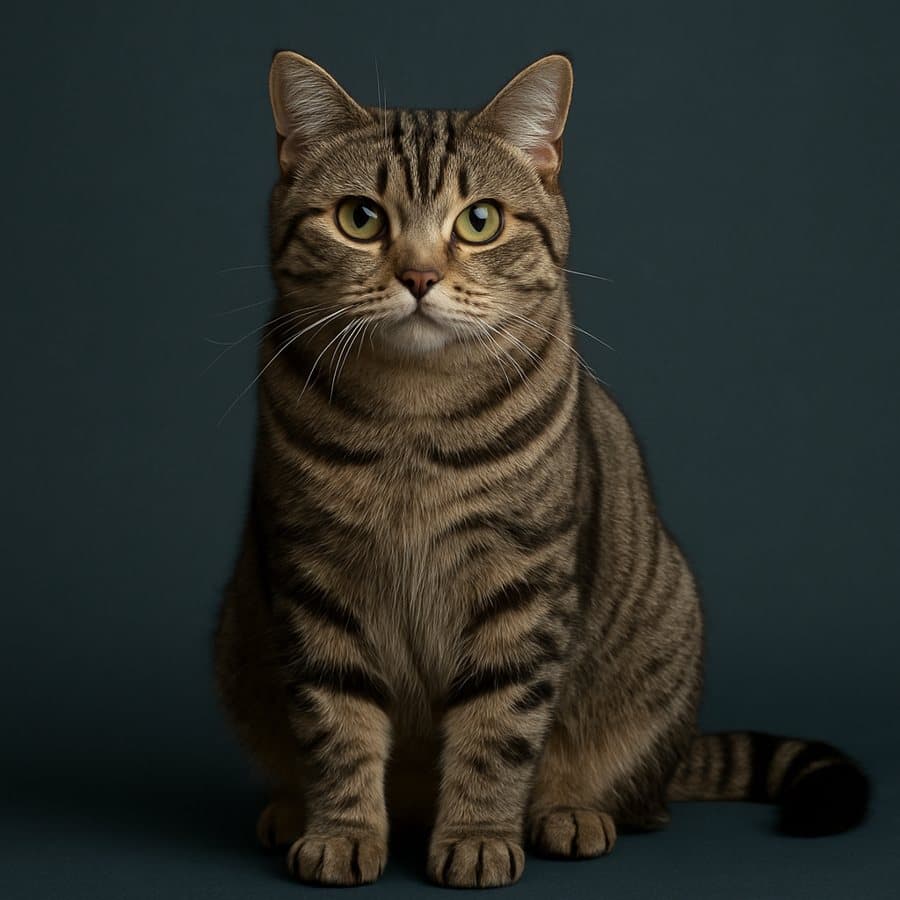
This is general guidance. Always ask your vet.
How big does a American Shorthair get?
An adult American Shorthair weighs 3.5 to 7 kg and stands 20 to 25.5 cm at the withers.
Females are visibly less massive than males while keeping a balanced, heavily boned build.
[S7][S8][S9][S10][S11][S12]How long does a American Shorthair live?
A American Shorthair lives 15 to 20 years.
Veterinary clinical registries place the expected lifespan between 15 and 20 years.
[S3][S15][S16]What health problems are common in the American Shorthair?
The most common in the American Shorthair are: Hypertrophic Cardiomyopathy (HCM), Obesity and Secondary Osteoarthritis, Feline Lower Urinary Tract Disease (FLUTD), Polycystic Kidney Disease (PKD).
Hypertrophic Cardiomyopathy (HCM) [S4][S24][S25]
This condition involves the thickening of the muscular walls of the heart, affecting normal circulation.
Ask your vet about:
- Echocardiogram
- Cardiac ultrasound
Obesity and Secondary Osteoarthritis [S4][S24][S26]
Excess body weight places sustained mechanical pressure on joints, leading to wear and joint inflammation.
Ask your vet about:
- 9-point Body Condition Score evaluation
- Regular body weight checks
- Orthopedic joint palpation
- Radiographs
Feline Lower Urinary Tract Disease (FLUTD) [S27]
This disorder affects the bladder and urethra through inflammation, crystal formation, or urinary stones.
Ask your vet about:
- Urinalysis
- Urine culture
- Abdominal ultrasound
- Abdominal radiography
Polycystic Kidney Disease (PKD) [S28]
This inherited disorder causes liquid cysts inside the kidneys that slowly impair normal organ function.
Ask your vet about:
- Genetic DNA testing for the PKD1 variant
- Abdominal ultrasonography
What is a American Shorthair's temperament like?
The American Shorthair is calm, affectionate, and even-tempered. They enjoy being close to family members while keeping an independent demeanor.
[S15][S17][S18][S19][S20]How much exercise does a American Shorthair need?
A American Shorthair needs 15 to 30 minutes of exercise a day.
They combine short active play sessions with long resting periods throughout the day.
- Energy3 / 5
How does a American Shorthair handle heat and cold?
The thick double coat insulates against cold weather. Summer heat brings overheating risks if cool resting spots and hydration are missing.
- Handles heat3 / 5
- Handles cold4 / 5
How much does a American Shorthair shed, and how do you groom it?
Brush or comb the coat once or twice weekly with a steel comb or slicker brush to remove loose fur.
Short, thick, firm double coat
- Shedding3 / 5
Is a American Shorthair good with children and other pets?
They adapt well to apartments and get along with cat-friendly dogs and children. Their strong hunting instinct makes them a risk to pet birds and pocket rodents.
- With children5 / 5
- With other pets4 / 5
- In an apartment5 / 5
Is a American Shorthair easy to train?
They are intelligent and food-motivated. You can teach them commands, retrieve games, and harness walking using positive reinforcement.
- Ease of training4 / 5
What does a American Shorthair eat at each life stage?
- KittenFeed a complete growth kitten diet high in protein and calories, containing DHA and balanced calcium-to-phosphorus ratios for skeletal growth.
- AdultOffer measured adult maintenance food with moderate fat levels, controlled calories, and moisture from wet food to prevent excess weight.
- SeniorProvide easily digestible proteins, moisture-rich meals, controlled phosphorus levels, and joint-support nutrients like omega-3 fatty acids.
Where does the American Shorthair come from?
European settlers brought working domestic cats on ships, including the Mayflower in 1620, to protect food stores from rodents. These cats developed dense coats and solid bodies on North American farms. The Cat Fanciers' Association recognized the breed as the Domestic Shorthair in 1906 and renamed it the American Shorthair in 1966.
Country of origin: United States.
[S1][S2][S5][S6]Fun facts about the American Shorthair
- Cats ancestral to the American Shorthair traveled on the Mayflower in 1620 to defend onboard food stores from rodents. [S1][S2]
- During the 1849 California Gold Rush, miners bought working shorthair cats at premium rates to manage camp rodent populations. [S17]
- The very first shorthair registered in the CFA stud book in 1900 was an orange tabby male named Ch. Belle of Bradford. [S6]
- The American Shorthair served as a foundation ancestor to create the Exotic Shorthair, Bombay, and Ocicat breeds. [S32][S33]
- Breed standards recognize over 80 distinct coat color and pattern combinations, ranging from solid tones to classic tabbies. [S17][S34]
Tips by life stage and weather
- KittenIntroduce litter boxes and scratching posts early to build clean habits.
- KittenProvide puzzle feeders and small wand toys to channel innate hunting instincts.
- AdultEngage your cat in 15 to 30 minutes of interactive chasing games daily to avoid excess body fat.
- AdultInstall vertical cat trees and high wall perches to provide apartment exercise and quiet retreats.
- SeniorConsult the vet for routine body condition scoring and joint assessments during checkups.
- SeniorServe wet food daily to increase dietary hydration and protect aging kidneys.
- Hot seasonKeep cool interior resting surfaces and fresh water accessible to prevent overheating in warm seasons.
- Hot seasonKeep the coat unclipped, as shaving damages natural heat regulation and fur growth.
- Cold seasonKeep your cat indoors away from freezing winter conditions despite their thick undercoat.
- Cold seasonBrush the dense undercoat twice weekly to remove loose fur during seasonal coat shedding.
- Rainy seasonKeep indoor exercise active with fake mice and puzzle toys when wet weather limits outside light.
- Rainy seasonCheck that indoor rest spots stay dry so the water-resistant double coat remains clean and dry.
In the Kiba Vet app, your pet's breed profile shows a tip of the day based on its age and the weather where you live.
This is general guidance. Always ask your vet.
Checked against sources; veterinary review pending. Updated on September 29, 2026.
Written with the help of AI from the cited sources and checked fact by fact against them by a second model.
Sources
Every health fact and every number on this page comes from these sources. Identifiers from Wikidata (CC0).
- S1 American Shorthair - Wikipedia
- S2 zoomalia.ie
- S3 purina.com
- S4 American Shorthair Cat Breed: Characteristics, Care & Photos | Chewy
- S5 American Shorthair Facts - Wisdom Panel™ Cat Breeds
- S6 The American Shorthair – National American Shorthair Club
- S7 acf.asn.au
- S8 cfa.org
- S9 American Shorthair Personality and Care | Vet American
- S10 American shorthair: health, nutrition | Royal Canin MT
- S11 American Shorthair: health, nutrition | Royal Canin US
- S12 unitedpetclub.com
- S15 American Shorthair Cat Breed Guide | Pets Best
- S16 American Shorthair Cat Breed Information and Pictures - PetGuide | PetGuide
- S17 American Shorthair | VCA Animal Hospitals
- S18 All About the American Shorthair Cat (Cat Breed) – Everything You Need to Know
- S19 Breed Info – Horizon Pet Care
- S20 American Shorthair | Cat Breeds | VIDA Veterinary Care
- S21 American Shorthair Cat Breed: Care, Traits & Health | Zifurs
- S22 Which Cat Breeds Are Best for Apartment and Rental Living?
- S23 Mau Mew: Cat Breeds for Apartments
- S24 How Long Do American Shorthair Cats Live? – La Petite Labs
- S25 American Shorthair - The Cat Fanciers' Association
- S26 American Shorthair Cat Health Problems: 10 Common Issues — Catster
- S27 6 Common American Shorthair Cat Health Problems (Vet-Reviewed) | Hepper Pet Resources
- S28 researchgate.net
- S30 American Shorthair Cat Breed Health and Care | PetMD
- S31 American Shorthair Age Calculator, Lifespan & Weight Chart | PetAge
- S32 All about Exotic Shorthair breed
- S33 Ocicat Breed Profile: Things to Know Before Adopting a Ocicat
- S34 All about American Shorthair breed