
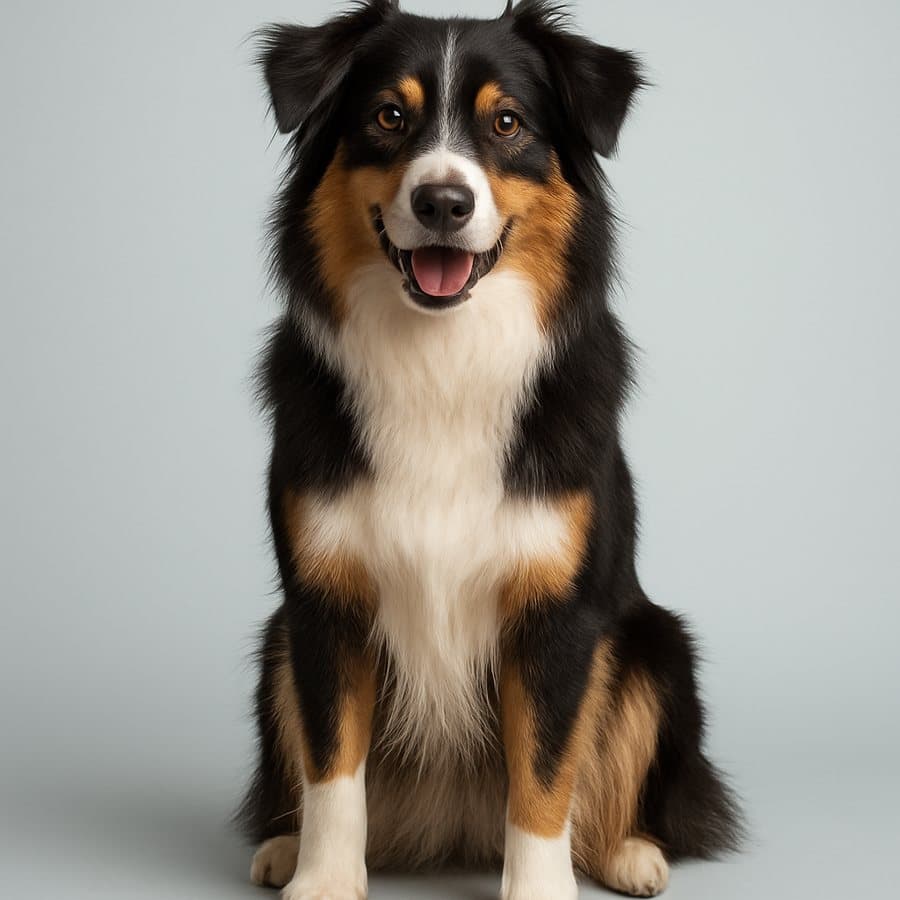
This is general guidance. Always ask your vet.
How big does a Australian Shepherd get?
An adult Australian Shepherd weighs 18.1 to 29.5 kg and stands 46 to 58 cm at the withers.
Breed standards value overall physical balance and moderate bone structure in proportion to height. Quality takes priority over exact size measurements.
[S1][S2][S3][S8][S9][S10]How long does a Australian Shepherd live?
A Australian Shepherd lives 12 to 15 years.
Major registries document a lifespan between 12 and 15 years, while UK population studies record median survival times of 12.9 to 13.7 years.
[S3][S11][S12][S13]What health problems are common in the Australian Shepherd?
The most common in the Australian Shepherd are: Multidrug Resistance 1 (MDR1 / ABCB1 Mutation), Hip Dysplasia, Elbow Dysplasia, Hereditary Cataracts (HSF4 Mutation), Collie Eye Anomaly (CEA), Progressive Retinal Atrophy (prcd-PRA), Idiopathic Epilepsy.
Multidrug Resistance 1 (MDR1 / ABCB1 Mutation) [S21]
A genetic defect in the blood-brain barrier causes severe neurotoxicity when the dog encounters certain common veterinary drugs.
Ask your vet about:
- ABCB1/MDR1 cheek-swab or blood DNA test before prescribing preventatives or treatments
Hip Dysplasia [S23]
An abnormal development of the hip joints leads to stiffness, abnormal gait, and secondary arthritis.
Ask your vet about:
- OFA or PennHIP pelvis radiographs
- Official OFA final radiograph evaluation at 24 months of age or older
Elbow Dysplasia [S24]
A structural malformation of the elbow joint causes forelimb lameness.
Ask your vet about:
- OFA extreme flexion elbow radiographs at 24 months of age or older
Hereditary Cataracts (HSF4 Mutation) [S24][S25]
An inherited genetic mutation creates bilateral clouding of the eye lenses.
Ask your vet about:
- HSF4 genetic DNA panel
- Annual Canine Eye Registration (CAER) examination by an ACVO veterinary ophthalmologist
Collie Eye Anomaly (CEA) [S26]
A congenital disorder impairs the normal growth of the retina and choroid tissue inside the eye.
Ask your vet about:
- Puppy ophthalmic screening at 6 to 8 weeks of age
- NHEJ1 gene DNA screening test
What is a Australian Shepherd's temperament like?
The Australian Shepherd is an animated, intelligent worker that displays strong loyalty toward its family. They tend to be reserved around strangers and retain active guarding drives.
[S1][S14][S15]How much exercise does a Australian Shepherd need?
A Australian Shepherd needs 60 to 120 minutes of exercise a day.
Simple neighborhood strolls do not satisfy this breed. They require vigorous aerobic activities such as running, hiking, and canine sports alongside structured mental tasks.
- Energy5 / 5
How does a Australian Shepherd handle heat and cold?
The double coat provides insulation in cold, wet weather and shields against heat. Heavy exercise in hot, humid weather carries a risk of heat exhaustion.
- Handles heat3 / 5
- Handles cold4 / 5
How much does a Australian Shepherd shed, and how do you groom it?
Brush once or twice a week with an undercoat rake and slicker brush, increasing to daily sessions during seasonal shedding periods. Bathe every 4 to 8 weeks or when soiled, and maintain regular nail, ear, and dental hygiene.
Medium-length, weather-resistant double coat with straight or wavy hair
- Shedding4 / 5
Is a Australian Shepherd good with children and other pets?
Their herding drive can prompt them to nip at the heels of running children and animals without early guidance. Apartments present challenges due to the breed's barking tendencies and extensive exercise requirements.
- With children4 / 5
- With other pets4 / 5
- In an apartment1 / 5
Is a Australian Shepherd easy to train?
This breed grasps complex cues rapidly through reward-based techniques and praise. Harsh handling causes emotional withdrawal, while early socialization prevents natural aloofness from turning into reactivity.
- Ease of training5 / 5
What does a Australian Shepherd eat at each life stage?
- PuppyFeed an AAFCO-formulated puppy diet balanced in proteins, fats, and DHA to fuel joint, bone, and brain development. Split daily rations into 3 or 4 small meals and assess physical body condition with your vet.
- AdultTransition between 12 and 14 months of age to an adult maintenance diet tailored to active dogs. Regulate portions based on your vet's body condition scoring to preserve lean muscle and prevent weight gain.
- SeniorBegin a senior formulation around 7 to 8 years of age featuring reduced calories, extra dietary fiber, and omega-3 fatty acids like EPA and DHA. Have your vet review your dog's joint and cognitive condition to adapt the feeding plan.
Where does the Australian Shepherd come from?
Basque shepherds traveled to the United States from Australia in the 19th century with their working dogs. Ranchers in California and across the American West crossed these animals with European and British lines to create the breed. The Australian Shepherd Club of America formed in 1957, with official American Kennel Club recognition following in 1993 and definitive FCI recognition granted in 2007.
Country of origin: United States.
[S1][S2][S3][S4][S5][S6][S7]Fun facts about the Australian Shepherd
- Despite the name pointing to Australia, the breed was created entirely on ranches across the American West. [S1][S2]
- Australian Shepherds gained wide national fame in the 1950s and 1960s performing trick acts at western rodeos. [S1][S32]
- Around one in five Aussies is born with a natural bobtail due to an inherited mutation in the T-box gene. [S1][S2]
- The breed frequently exhibits heterochromia, displaying marbled irises or two completely different colored eyes. [S1][S17]
- The Miniature American Shepherd was created directly from small Australian Shepherd foundation dogs in 1960s California. [S33][S34]
Tips by life stage and weather
- PuppyExpose your puppy to varied people, animals, and surroundings between 8 and 16 weeks of age to counteract natural aloofness.
- PuppyRedirect instinctive heel nipping toward chew toys and practice impulse control during family playtime.
- AdultIncorporate structured activities such as agility, disc games, or obedience trials to drain physical energy.
- AdultSupply interactive food puzzles and scent challenges daily to keep this working brain occupied.
- SeniorMaintain low-impact daily walks to preserve joint mobility without placing excess strain on the limbs.
- SeniorSchedule regular physical exams with your veterinarian to monitor aging hips, elbows, and vision.
- Hot seasonLimit running and fetch sessions to early mornings or late evenings when ambient temperatures drop.
- Hot seasonKeep the double coat intact without shaving, as the undercoat shields the skin from solar heat.
- Cold seasonAllow the dog's natural double coat to provide warmth during outdoor sessions in chilly weather.
- Cold seasonInspect the coat and paws after outings to ensure cold dampness does not linger near the skin.
- Rainy seasonBrush through the coat with an undercoat rake after outdoor walks to clear wet debris before it mats.
- Rainy seasonDry the water-resistant outer coat and undercoat thoroughly following walks in heavy storms.
In the Kiba Vet app, your pet's breed profile shows a tip of the day based on its age and the weather where you live.
This is general guidance. Always ask your vet.
Checked against sources; veterinary review pending. Updated on September 29, 2026.
Written with the help of AI from the cited sources and checked fact by fact against them by a second model.
Sources
Every health fact and every number on this page comes from these sources. Identifiers from Wikidata (CC0).
- S1 kutya-tar.hu
- S2 Australian Shepherd - Wikipedia
- S3 Australian Shepherd Breed Guide: Temperament, Coat & Care — STOKESHIRE
- S4 Australian Shepherd Dog Breed: Size, Personality and More | Dog Food Advisor
- S5 Australian Shepherd Dog Breed Information and Pictures
- S6 Breed Spotlight: The Australian Shepherd - Gator Kennels
- S7 AUSTRALIAN SHEPHERD
- S8 Breed Standard - United States Australian Shepherd Association
- S9 Breed Standard - ASCA
- S10 Australian Shepherd Dog Breed Information | Halo Collar
- S11 Dog Lifespan Chart by Breed & Size | 50+ Breeds Compared (2026)
- S12 worldhealth.net
- S13 researchgate.net
- S14 dogsvictoria.org.au
- S15 Australian Shepherd - All About Dogs | Orvis
- S16 Australian Shepherd Dog Breed Guide | Lemonade
- S17 Australian Shepherd Dogs Breed - Information, Temperament, Size & Price | Lancaster Puppies
- S18 PPVC Breed Specific: The beautiful and intelligent Australian shepherd
- S19 Australian Shepherd Breed Guide: Facts & Traits | Royal Canin AU
- S20 Is the Australian Shepherd the Right Dog Breed for You?
- S21 Australian Shepherd Studs | Verified Studs | PairMyPet
- S22 The Australian Shepherd Dog Breed
- S23 How Long Do Australian Shepherds Live? Lifespan – La Petite Labs
- S24 Herding Group Health Testing Requirements – American Kennel Club
- S25 USASA HEALTH & GENETICS PROGRAM - United States Australian Shepherd Association
- S26 Genetic Health Tests for Australian Shepherds - Embark – Embark Vet
- S27 Best Australian Shepherd Dog Food: Complete Guide
- S28 Navigating Australian Shepherd Nutrition (Puppies to Seniors for Lifelong Health) – Dog Standards
- S29 Life Stage Nutrition: Dog | PFIAA
- S30 Australian Shepherd Feeding Chart by Age & Weight | PlainBowl
- S31 purina.com
- S32 Australian Shepherd Dog Breed Information
- S33 fci.be
- S34 The History of the Miniature American Shepherd Breed