
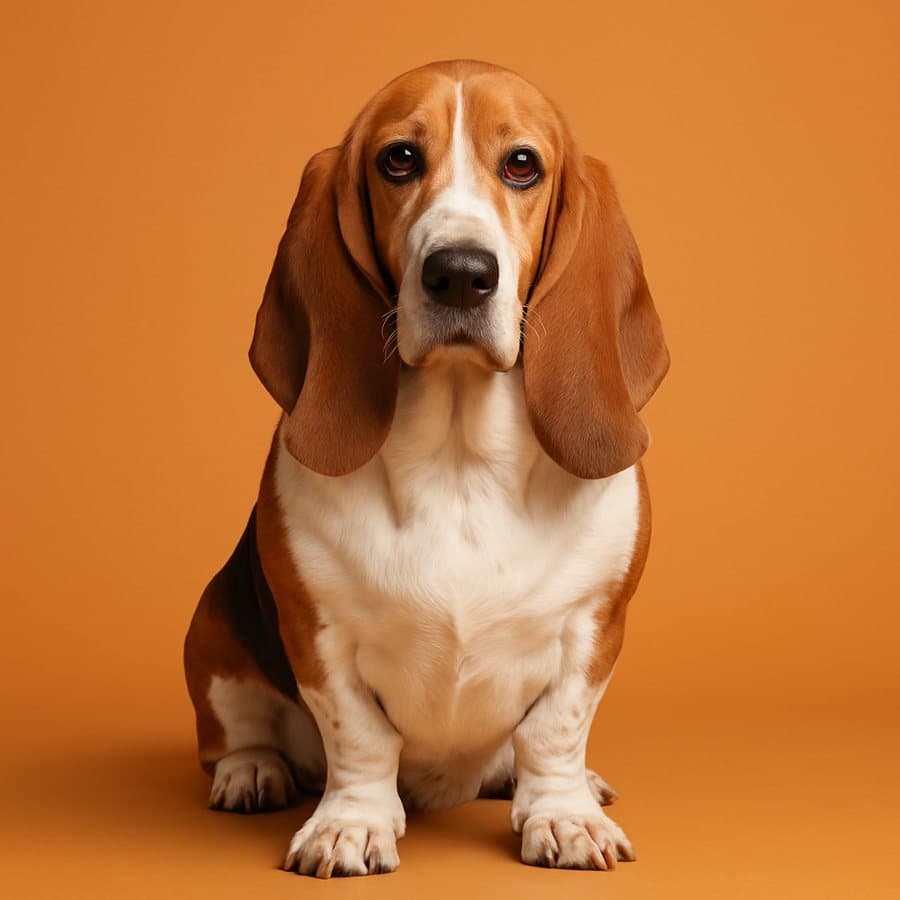
This is general guidance. Always ask your vet.
How big does a Basset Hound get?
An adult Basset Hound weighs 20 to 34 kg and stands 33 to 38 cm at the withers.
FCI standard specifies a height between 33 and 38 cm for both sexes. The Kennel Club in the UK provides separate weight standards for males (25 to 34 kg) and females (20 to 29 kg), while AKC notes a broader weight range of 18.1 to 29.5 kg.
[S2][S5][S8][S9][S11]How long does a Basset Hound live?
A Basset Hound lives 10.4 to 13 years.
A large UK companion dog study identified a median lifespan of 12.5 years, while the AKC reports an expectancy of 12 to 13 years. The UK Kennel Club health survey noted a median lifespan of 10.4 years.
[S9][S12][S13][S16][S17][S18]What health problems are common in the Basset Hound?
The most common in the Basset Hound are: Intervertebral Disc Disease (IVDD), Primary Open-Angle Glaucoma (POAG), Gastric Dilatation-Volvulus (GDV), Elbow and Hip Dysplasia, Thrombopathia, Ectropion and Entropion.
Intervertebral Disc Disease (IVDD) [S24][S26][S30]
Spinal disc degeneration and herniation caused by chondrodystrophic conformation, leading to back pain or mobility problems.
Ask your vet about:
- FGF4 retrogene insertion genetic screening
- Spinal neurological examination
- Spinal MRI or CT scan
Primary Open-Angle Glaucoma (POAG) [S25][S26][S27]
An inherited eye disorder that causes fluid buildup and increased pressure inside the eye, risking vision loss.
Ask your vet about:
- ADAMTS17 DNA mutation test
- Tonometry for intraocular pressure
- Gonioscopy evaluation
Gastric Dilatation-Volvulus (GDV) [S24][S32]
A condition in deep-chested dogs where the stomach fills with gas and twists on its axis, cutting off circulation.
Ask your vet about:
- Abdominal radiography
- Preventive gastropexy evaluation
Elbow and Hip Dysplasia [S24][S25][S27][S31]
Malformation of the hip or elbow joints during growth that leads to secondary osteoarthritis and stiffness.
Ask your vet about:
- OFA radiographic hip and elbow evaluation
- PennHIP imaging
What is a Basset Hound's temperament like?
The Basset Hound is placid, highly devoted, and affectionate toward family members. They possess a determined hunting instinct that commands their attention on scent trails, paired with social pack instincts that make them susceptible to distress when left alone.
[S6][S10][S19]How much exercise does a Basset Hound need?
A Basset Hound needs 30 to 60 minutes of exercise a day.
Basset Hounds show low-to-moderate indoor energy levels but require daily physical activity. Exercise should consist of leashed walks and scent work, avoiding jumps and repetitive stairs to protect joints and the spine.
- Energy2 / 5
How does a Basset Hound handle heat and cold?
Dense bone mass, heavy bodies, and deep chests increase the risk of overheating in hot weather. In cold weather, low ground clearance exposes chests and bellies to cold ground, and thin ear leathers face frostbite risk.
- Handles heat2 / 5
- Handles cold2 / 5
How much does a Basset Hound shed, and how do you groom it?
Weekly brushing with a rubber curry brush or hound mitt handles year-round shedding. Long ears and facial folds need routine cleaning and drying, while nails require regular trimming to maintain paw posture.
Short, smooth, dense, and weather-resistant
- Shedding3 / 5
Is a Basset Hound good with children and other pets?
The breed shows great patience with children and gets along well with other dogs and socialized cats. They settle well in apartments, though owners must manage their deep howling.
- With children5 / 5
- With other pets4 / 5
- In an apartment4 / 5
Is a Basset Hound easy to train?
Their strong scent drive leads them to follow trails above verbal commands, which makes reliable off-leash recall difficult. Training succeeds with early, positive reinforcement using food rewards, and house-training requires extra patience.
- Ease of training2 / 5
What does a Basset Hound eat at each life stage?
- PuppyFeed a puppy diet formulated for medium-to-large breeds to regulate growth and maintain controlled calcium-to-phosphorus ratios. Divide food into three to four small meals every day to prevent stomach distension.
- AdultOffer a calorie-monitored adult maintenance food to prevent weight gain from their low metabolic rate. Split daily food into two measured meals and avoid vigorous exercise directly before and after eating.
- SeniorProvide a senior formula with controlled calories, moderate high-quality protein, and joint supplements such as omega-3 fatty acids, glucosamine, and chondroitin to support aging joints and back.
Where does the Basset Hound come from?
Monks at the Abbey of Saint-Hubert in France originally bred the hound for trailing through dense vegetation. In the late 19th century, breeders in Great Britain developed the modern breed through crosses with the Bloodhound. The American Kennel Club recognized the breed in 1885.
Country of origin: Great Britain.
[S1][S2][S4]Fun facts about the Basset Hound
- The Basset Hound possesses over 220 million olfactory receptor cells, placing its sense of smell second only to the Bloodhound. [S19][S36][S38]
- Their long ears drag along the ground while tracking to stir up scent particles and funnel them into the nose. [S19][S38]
- Loose skin folds around the neck form a dewlap that helps trap scent molecules around the hound's face. [S6][S19]
- The breed has true dwarfism, which creates short legs combined with dense, heavy bone mass. [S39][S40]
- Because of heavy bones and short limbs, Basset Hounds struggle in water and are poor swimmers without canine life jackets. [S6]
Tips by life stage and weather
- PuppyAvoid letting your puppy use stairs or leap off furniture to protect their developing joints and spine.
- PuppyEstablish a consistent house-training schedule early, using patient positive reinforcement and high-value food rewards.
- AdultWeigh your dog frequently and measure meal portions strictly to avoid obesity on their low-slung frame.
- AdultKeep your dog on a leash in open areas because scent trails will override verbal recall commands.
- SeniorInspect and clean ear canals and skin folds every week to prevent moisture-related infections.
- SeniorTrim nails consistently to prevent flat-footed splaying and postural strain on heavy front legs.
- Hot seasonWalk your dog during cooler morning and evening hours to prevent overheating in warm weather.
- Hot seasonFit your dog with a canine life jacket if they are near pools or water, as heavy bones hinder swimming.
- Cold seasonDry your dog's chest and belly after walks because their low ground clearance brings them close to cold mud.
- Cold seasonExamine the thin tips of their long ears after cold outings to protect them from frostbite.
- Rainy seasonWipe down skin folds on the face and neck thoroughly after rainy walks to prevent fungal dermatitis.
- Rainy seasonUse a specialized ear-drying cleaner recommended by your vet after damp outings to stop bacterial ear infections.
In the Kiba Vet app, your pet's breed profile shows a tip of the day based on its age and the weather where you live.
This is general guidance. Always ask your vet.
Checked against sources; veterinary review pending. Updated on September 29, 2026.
Written with the help of AI from the cited sources and checked fact by fact against them by a second model.
Sources
Every health fact and every number on this page comes from these sources. Identifiers from Wikidata (CC0).
- S1 fci.be
- S2 FCI-STANDARD No 163 - bassethoundclubs Webseite!
- S3 rover.com
- S4 Basset Hound Dog Breed Information
- S5 kusa.co.za
- S6 Bassets Unlimited - Basset Hound Breed Standards
- S8 Basset Hound Weight Chart by Age & Growth Guide
- S9 How Long Do Basset Hounds Live? Lifespan & Longevity | VitaDog
- S10 Basset Hound | National Kennel Club
- S11 Basset Hound Dimensions & Drawings | Dimensions.com
- S12 Dog Lifespan Chart by Breed | 155 Breeds Compared
- S13 Dog Breed Lifespan Research: A UK Study from 2024
- S16 Basset Hound Lifespan and Health Issues
- S17 The Lifespan of Basset Hounds - Basset Hound Foundation
- S18 Dog Age Calculator
- S19 Basset Hound — Breed Guide, History & Characteristics | Prestige Breed
- S20 Basset Hound - Care-A-Lot Pet Supply
- S21 Are Basset Hounds Safe in Cold Weather? - iHeartDogs.com
- S22 10 Dog Breeds That Hate Winter | FOTP
- S23 A Fur Coat in This Heat? - Carolina Basset Hound Rescue
- S24 Basset Hound | VCA Canada Animal Hospitals
- S25 11 Common Health Problems in Basset Hounds to Be Aware Of — Dogster
- S26 All Dna Tests - OFA
- S27 Dog Breed Health Testing Requirements: CHIC Guide and Costs | BreedTracker
- S28 10 Common Basset Hound Health Issues to Watch Out For (Vet Answer) | Hepper Pet Resources
- S30 How Long Do Basset Hounds Live? Lifespan & Care – La Petite Labs
- S31 OFA Health Testing - Iska Kennels
- S32 Bloat: Gastric Dilatation and Volvulus in Dogs | VCA Animal Hospitals
- S35 pennylanelabradors.com
- S36 pawlicy.com
- S37 How Long Do Dogs Live? Lifespan Chart by Dog Breed | JustFoodforDogs Blog
- S38 Basset Hound Health Problems | K9 Carts
- S39 HEALTH & TESTING GUIDE - Havanese Club of America
- S40 Dog Breed Disease Predispositions, Inherited Disorders and Congenital Conditions | Dr. Bob's Pet Health Information