
This is general guidance. Always ask your vet.
How big does a Bengal get?
An adult Bengal weighs 2.7 to 10 kg.
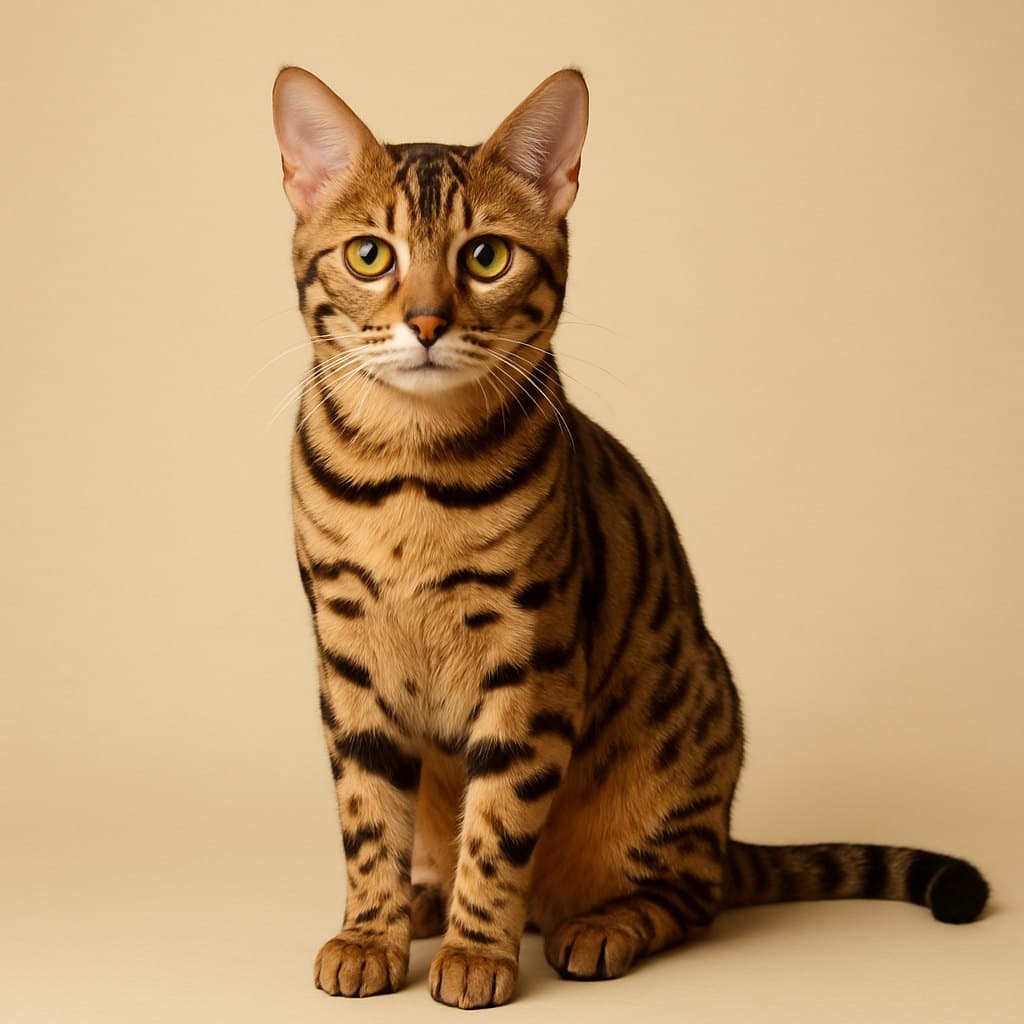
Bengals are long, muscular cats with substantial boning. Males typically weigh between 4.1 kg and 6.8 kg, though some large males reach up to 10 kg.
[S2][S7][S8][S9]How long does a Bengal live?
A Bengal lives 8.5 to 16 years.
General estimates place Bengal life expectancy between 12 and 16 years in indoor environments, while epidemiological population studies record an average of 8.51 years due to early juvenile mortality and trauma.
[S10]What health problems are common in the Bengal?
The most common in the Bengal are: Hypertrophic Cardiomyopathy (HCM), Progressive Retinal Atrophy (PRA-b), Erythrocyte Pyruvate Kinase Deficiency (PK-Def), Patellar Luxation and Hip Dysplasia.
Hypertrophic Cardiomyopathy (HCM) [S21][S22]
A cardiac condition where heart muscle walls thicken and compromise heart function.
Ask your vet about:
- Echocardiogram screening by a veterinary cardiologist
Progressive Retinal Atrophy (PRA-b) [S22][S23][S24]
An inherited genetic disorder causing the photoreceptor cells in the retina to deteriorate, leading to vision loss.
Ask your vet about:
- Genetic cheek-swab DNA test
- Blood DNA screening for PRA-b
What is a Bengal's temperament like?
Bengals are curious, confident, and affectionate cats that stay closely attached to their owners. They produce wide ranges of vocal sounds, possess strong hunting drives, and express playful curiosity around household objects.
[S4][S8][S11][S12][S13][S14][S15]How much exercise does a Bengal need?
Bengals have exceptionally high energy levels. They require daily interactive play sessions, food-foraging games, and vertical structures like tall cat trees and wall walkways.
- Energy5 / 5
How does a Bengal handle heat and cold?
The short, single pelt tolerates warm indoor temperatures well. Because they lack a dense undercoat, Bengals are sensitive to drafts and ambient temperatures under 15 °C.
- Handles heat4 / 5
- Handles cold2 / 5
How much does a Bengal shed, and how do you groom it?
Brush weekly with a soft bristle brush or rubber curry mitt to clear loose hair, alongside routine claw trimming and regular veterinary dental checks.
Short to medium, dense, silky pelt
- Shedding2 / 5
Is a Bengal good with children and other pets?
Bengals live well with respectful children, active cats, and cat-friendly dogs. Their strong predatory drive makes them unsafe around rodents, birds, reptiles, and fish. In apartments, they require vertical climbing setups to prevent boredom-related damage.
- With children4 / 5
- With other pets3 / 5
- In an apartment3 / 5
Is a Bengal easy to train?
Highly intelligent and responsive to positive reinforcement with clickers and treats. You can teach them basic commands, indoor fetch, and outdoor walking on a harness and leash.
- Ease of training5 / 5
Where does the Bengal come from?
Jean Sugden Mill initiated the breed in California in 1963 by crossing a wild Asian leopard cat with a domestic cat. In the 1970s, genetic researcher Dr. Willard Centerwall bred Asian leopard cats with domestic felines at Loyola University to study leukemia virus resistance. Jean Sugden Mill resumed breeding in 1980 using cats from Dr. Centerwall alongside domestic outcrosses like Egyptian Maus and Indian street cats, leading to TICA championship recognition in 1991.
Country of origin: United States.
[S1][S2][S3][S4]Fun facts about the Bengal
- Bengals frequently enjoy water, playing in running sink taps, splashing tubs, and jumping into showers. [S4][S13][S20]
- This is the only recognized domestic cat breed with rosetted markings resembling a wild leopard or jaguar. [S4][S8][S27]
- Many Bengals express a genetic glitter trait that produces an iridescent, crystalline sparkle across the coat under natural sunlight. [S4][S20]
- The breed name comes directly from the scientific classification of the Asian leopard cat, Prionailurus bengalensis. [S1][S2]
- Bengals readily adapt to walking on a harness and leash outdoors, often showing dog-like enthusiasm on walks. [S13][S14]
- Many Bengals dip their front paws into water bowls and lick the water off rather than drinking directly. [S13][S15]
Tips by life stage and weather
- KittenBegin leash and harness training early inside the home so your Bengal kitten becomes comfortable with outdoor gear.
- KittenUse clicker training paired with positive reinforcement to teach early house manners and retrieve games.
- AdultInstall tall cat trees, climbing shelves, and vertical wall walkways to keep your adult cat active indoors.
- AdultSecure small household items such as keys and jewelry in closed drawers to prevent your cat from hiding them.
- SeniorProvide warm fleece beds and draft-free rest areas to protect your aging cat from drops in temperature.
- SeniorMaintain weekly dental cleanings and regular veterinary wellness visits to support your older cat.
- Hot seasonSchedule vigorous play sessions and leash walks for early morning or late evening hours to avoid midday heat exhaustion.
- Hot seasonProvide shallow water tubs or supervised sink access so your cat can play and cool off during hot afternoons.
- Cold seasonPlace heated pads or cozy fleece nests in sleeping spots to protect your Bengal when indoor temperatures drop below 15 °C.
- Cold seasonKeep your Bengal away from cold drafts and uninsulated windows during winter spells.
- Rainy seasonRedirect your Bengal's physical energy indoors during wet weather with food-foraging puzzles, wand toys, and laser games.
- Rainy seasonSecure terrariums, bird cages, and fish aquariums indoors while your cat stays inside during heavy storms.
In the Kiba Vet app, your pet's breed profile shows a tip of the day based on its age and the weather where you live.
This is general guidance. Always ask your vet.
Checked against sources; veterinary review pending. Updated on September 29, 2026.
Written with the help of AI from the cited sources and checked fact by fact against them by a second model.
Sources
Every health fact and every number on this page comes from these sources. Identifiers from Wikidata (CC0).
- S1 Bengal Cat History: From Wild Origins to Beloved Household Pets
- S2 Bengal cat - Wikipedia
- S3 Bengal Cat standards and characters for show | PDF
- S4 rover.com
- S7 TICA Bengal Standard | Sierra NV Bengals
- S8 Bengal Cats: What to Know
- S9 anyflip.com
- S10 How Long Do Bengal Cats Live? Lifespan – La Petite Labs
- S11 acf.asn.au
- S12 Bengal Cat: Ultimate Guide to Care, Temperament, Grooming & Health
- S13 10 Fun Facts about Bengal Cats
- S14 ABOUT BENGALS | Hot Spotz Bengals
- S15 27 Facts About Bengals - Royal Bengal Cattery - Bengal Cats and Kittens
- S16 Caring for your Bengal cat | Peqaboo
- S17 Raising A Bengal In A Very Hot And Humid Place. Help. | TheCatSite
- S18 5 Cat Breeds That Need Extra Care in Winter | Rufus & Coco Australia
- S19 Temperament of bengal cats - frequent questions about the bengal cats: temperament, habbits, care
- S20 petinsurance.com
- S21 quality-bengal-kittens.com
- S22 Bengal Cat Health Tests Explained - Ashmiyah Bengal Cats
- S23 ucdavis.edu
- S24 Genetics of Breeding Bengals - Royal Bengal Cattery - Bengal Cats and Kittens
- S25 Bengal Cat Guide | Complete Breed & Care Information
- S26 VCA Official Health Statement - Vizsla Club of America
- S27 Rosettes on Cats: What They Are and Why They Happen — Catster