
This is general guidance. Always ask your vet.
How big does a Bombay get?
An adult Bombay weighs 2.5 to 6.8 kg and stands 23 to 36 cm at the withers.
Bombays carry surprising weight for their medium size due to their dense, muscular build.
[S1][S7][S8][S9][S10][S11]How long does a Bombay live?
A Bombay lives 12 to 16 years.
Healthy individuals frequently reach 18 to 20 years of age.
[S3][S12][S13][S14]What health problems are common in the Bombay?
The most common in the Bombay are: Burmese Head Defect (Craniofacial Dysplasia), Hypertrophic Cardiomyopathy (HCM), Brachycephalic Airway Syndrome and Tear-Duct Issues, Periodontal Disease and Gingivitis, Obesity and Secondary Diabetes.
Burmese Head Defect (Craniofacial Dysplasia) [S24][S25][S26][S27]
A severe congenital malformation of the skull and face inherited from foundational Burmese ancestry.
Ask your vet about:
- Genetic ALX1 mutation testing
Hypertrophic Cardiomyopathy (HCM) [S24][S28][S29]
A heart condition that causes the muscular walls of the heart to thicken.
Ask your vet about:
- Transthoracic echocardiogram
- NT-proBNP biomarker blood test
Brachycephalic Airway Syndrome and Tear-Duct Issues [S21]
Airflow obstruction and poor tear drainage resulting from a short muzzle and moderate facial stop.
Ask your vet about:
- Upper respiratory tract evaluation
- Nasolacrimal duct patency examination
What is a Bombay's temperament like?
The Bombay is an extroverted, highly affectionate cat that attaches closely to human family members. They greet visitors confidently and use a soft, gentle voice to communicate.
[S3][S11][S14][S17][S18]How much exercise does a Bombay need?
Bombays balance lively bursts of athleticism with relaxed cuddles. They require daily interactive play and vertical climbing spaces.
- Energy4 / 5
How does a Bombay handle heat and cold?
Bombays actively seek warmth due to their single-layer coat without an undercoat. Their short facial structure makes them vulnerable to respiratory distress in extreme heat and humidity.
- Handles heat3 / 5
- Handles cold1 / 5
How much does a Bombay shed, and how do you groom it?
Weekly brushing with a rubber curry comb, soft-bristle brush, or chamois cloth keeps the coat shiny and clears loose hairs.
Short, fine, satin-like single coat
- Shedding1 / 5
Is a Bombay good with children and other pets?
Bombays adapt well to apartments when provided with climbing trees and enrichment. They dislike prolonged isolation and bond well with gentle children, cat-friendly dogs, and other cats.
- With children4 / 5
- With other pets4 / 5
- In an apartment5 / 5
Is a Bombay easy to train?
Bombays learn tricks, basic cues, and scratching-post habits quickly with positive reinforcement and clicker training. Many fetch toys naturally and accept leash training.
- Ease of training4 / 5
What does a Bombay eat at each life stage?
- KittenOffer measured portions rather than free feeding to support steady growth and avoid early weight gain.
- AdultUse strict portion control with scheduled meals to keep your adult cat muscular without accumulating surplus body fat.
- SeniorMonitor body condition closely at each veterinary checkup and maintain measured feedings to avoid obesity-linked metabolic problems.
Where does the Bombay come from?
Breeder Nikki Horner began developing the Bombay in 1958 in Louisville, Kentucky, crossing sable Burmese cats with solid black American Shorthairs. The goal was to produce a domestic cat resembling a miniature wild black leopard. The Cat Fanciers' Association granted the breed championship status in 1976, followed by The International Cat Association in 1979.
Country of origin: United States.
[S1][S2][S3][S4][S5][S6]Fun facts about the Bombay
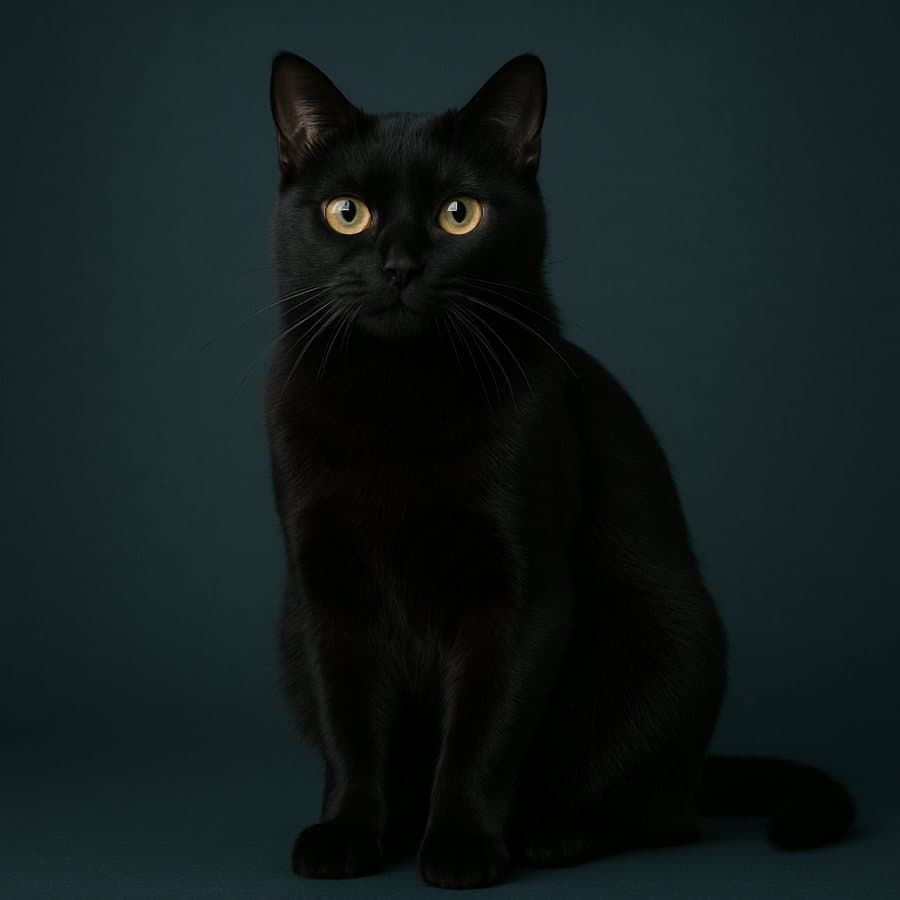
- Breed creator Nikki Horner nicknamed the Bombay the 'parlor panther' to highlight its resemblance to a tiny indoor black leopard. [S4][S5]
- The American breed standard requires vivid copper to deep gold eyes, often described by fanciers as new copper pennies. [S7][S31]
- Unlike many common black cats that display pinkish tones, the Bombay features completely black paw pads and solid black nose leather. [S6][S14][S23]
- Because the sable color gene inherited from Burmese ancestors is recessive, two black Bombay parents can produce a sable-colored kitten. [S1][S14]
- American Bombays come from Burmese and American Shorthair crosses, whereas British Bombays were created from European Burmese, domestic black cats, and Chinchilla Persians. [S4]
Tips by life stage and weather
- KittenProvide puzzle toys and climbing posts to redirect your kitten's energetic curiosity.
- KittenStart gentle dental and coat brushing early so your kitten accepts routine grooming.
- AdultEngage your cat in daily interactive play with wand toys or games of fetch.
- AdultInstall tall cat perches and window seats to support your cat's athletic jumping habits.
- SeniorTrack your senior cat's body condition score with your veterinarian to prevent weight problems.
- SeniorPlace accessible steps near favorite resting spots to ease jumping for aging joints.
- Hot seasonKeep your cat inside air-conditioned rooms during heat waves to avoid brachycephalic respiratory strain.
- Hot seasonEnsure constant access to fresh, cool water across multiple stations in your home.
- Cold seasonProvide warm thermal blankets or enclosed cat beds away from cold floor drafts.
- Cold seasonKeep your cat strictly indoors because their fine single coat lacks an insulating undercoat.
- Rainy seasonUse indoor laser games and puzzle feeders to keep your cat exercised during wet weather.
- Rainy seasonMaintain dry, cozy bedding indoors so your cat stays comfortable during damp, cool spells.
In the Kiba Vet app, your pet's breed profile shows a tip of the day based on its age and the weather where you live.
This is general guidance. Always ask your vet.
Checked against sources; veterinary review pending. Updated on September 29, 2026.
Written with the help of AI from the cited sources and checked fact by fact against them by a second model.
Sources
Every health fact and every number on this page comes from these sources. Identifiers from Wikidata (CC0).
- S1 fanciers.com
- S2 Choosing a Bombay
- S3 Bombay | VCA Animal Hospitals
- S4 Bombay cat - Wikipedia
- S5 Bombay Cat - Breed Characteristics, Temperament & Care
- S6 Bombay Cat Breed Guide – Scrumbles: Natural Pet Food
- S7 cfa.org
- S8 All about Bombay cat breed
- S9 Bombay Cat Dimensions & Drawings | Dimensions.com
- S10 What no one tells you about the Bombay cat [Essential guide]
- S11 The Vet’s Guide to Bombay Cats: Facts, Care, and Training Tips – Vets Love Pets
- S12 Bombay Cat Breed Health and Care | PetMD
- S13 How Long Do Bombay Cats Live? Vet-Verified Facts & Data — Catster
- S14 purina.com
- S17 Bombay Cat Personality and Care | Vet American
- S18 Bombay - Cat Breed Information Guide | Pro Plan
- S19 Bombay Cat: Complete Care Guide for Indian Pet Parents | TailStart
- S20 Bombay Cat: Personality, Care & Shedding Guide
- S21 All About the Bombay Cat (Cat Breed) – Everything You Need to Know
- S22 Care and Grooming
- S23 How does Bombay look like?
- S24 Bombay Cat Health Problems: 5 Common Issues — Catster
- S25 ucdavis.edu
- S26 Checking your browser - reCAPTCHA
- S27 Head Defect – LABOGEN
- S28 Bombay Cat: Complete Breed Guide — Temperament, Health, and Care – CATLINK
- S29 Bombay - Healthy Paws Veterinary Clinic
- S30 What is the Average Bombay Cat Lifespan? - Gomine Official
- S31 Bombay Cat Breed Profile | Litter-Robot