
This is general guidance. Always ask your vet.
How big does a Boxer get?
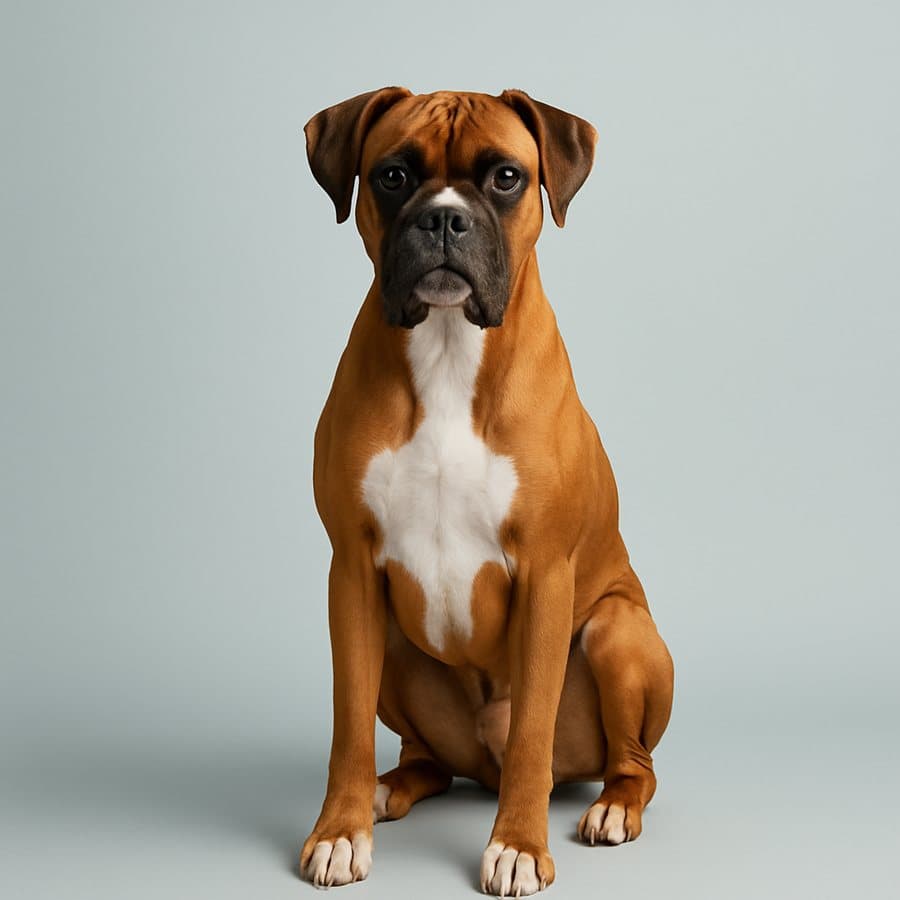
An adult Boxer weighs 25 to 32 kg and stands 53 to 63.5 cm at the withers.
Heights encompass standards from The Kennel Club and the AKC. Weights reflect The Kennel Club standard.
[S8][S9]How long does a Boxer live?
A Boxer lives 10 to 12 years.
Large-scale veterinary studies report a mean lifespan of 10.46 years and a median survival time of 11.3 years.
[S10][S11][S12][S13][S14]What health problems are common in the Boxer?
The most common in the Boxer are: Arrhythmogenic Right Ventricular Cardiomyopathy (ARVC), Subaortic Stenosis (SAS), Hip Dysplasia, Mast Cell Tumors (MCT) and Other Neoplasias, Hypothyroidism.
Arrhythmogenic Right Ventricular Cardiomyopathy (ARVC) [S24][S25][S26]
A genetic heart muscle disease that leads to irregular heartbeats and cardiac dysfunction.
Ask your vet about:
- Annual 24-hour Holter monitor ambulatory ECG screening
- DNA genetic marker testing for the striatin deletion mutation
Subaortic Stenosis (SAS) [S27][S28]
A congenital narrowing of the area beneath the aortic valve that obstructs normal blood flow from the heart.
Ask your vet about:
- Cardiac auscultation by a veterinary cardiologist
- Transthoracic Doppler echocardiography
Hip Dysplasia [S18][S29][S30]
A malformation of the ball-and-socket hip joint causing joint laxity and degenerative changes.
Ask your vet about:
- OFA pelvic radiographs at 24 months
- PennHIP passive laxity testing
Mast Cell Tumors (MCT) and Other Neoplasias [S18][S31]
Skin or subcutaneous tumors arising from cells involved in immune responses.
Ask your vet about:
- Fine-needle aspiration cytology of any new skin lump
- Biopsy and histopathological grading
Hypothyroidism [S18]
An endocrine disorder resulting from an underactive thyroid gland producing insufficient thyroid hormones.
Ask your vet about:
- Routine thyroid hormone blood panels
What is a Boxer's temperament like?
Boxers are confident, alert, and deeply devoted dogs. They act as natural watchdogs without unnecessary barking and keep an exuberant, playful temperament into their mature years.
[S5][S15][S16][S17]How much exercise does a Boxer need?
This high-energy working breed needs daily physical outlets like brisk walks, fenced play, or agility, paired with mental challenges like scent games and puzzle toys.
- Energy5 / 5
How does a Boxer handle heat and cold?
Due to their brachycephalic facial structure, Boxers struggle to cool down in heat and humidity. Their short single coat and low body fat provide limited cold defense.
- Handles heat1 / 5
- Handles cold2 / 5
How much does a Boxer shed, and how do you groom it?
Brush weekly with a rubber curry comb or hound glove, wipe down with a damp cloth instead of frequent baths, and clean facial folds regularly.
Short, smooth, hard, tight-fitting coat in fawn or brindle, often with white markings.
- Shedding3 / 5
Is a Boxer good with children and other pets?
Boxers are patient with children. They can live in apartments if their exercise demands are met, but they may chase smaller animals and can show same-sex dog aggression.
- With children5 / 5
- With other pets3 / 5
- In an apartment3 / 5
Is a Boxer easy to train?
Boxers learn quickly through positive reinforcement, toys, and praise, though an independent streak can show up. Early training is necessary to manage exuberant jumping.
- Ease of training4 / 5
What does a Boxer eat at each life stage?
- PuppyProvide high-quality puppy nutrition and consult your veterinarian to establish balanced growth plans.
- AdultFeed at least two measured meals per day of an adult diet high in digestible protein and moderate fat. Avoid vigorous play or running immediately before and after eating to minimize bloat risk.
- SeniorSelect a senior-specific, calorie-adjusted diet to accommodate a slower metabolic rate and prevent excess weight gain.
Where does the Boxer come from?
Developed in late nineteenth-century Germany, the Boxer descends from the Brabant Bullenbeisser, a hunting dog crossed with Bulldog ancestors. The breed served in both World Wars as courier, pack, and guard dogs before achieving recognition by the AKC in 1904 and the FCI in 1955.
Country of origin: Germany.
[S1][S2][S3][S4][S5][S6][S7]Fun facts about the Boxer
- A Boxer holds a Guinness World Record for the longest tongue on a domestic dog, which measured 43 cm. [S16][S17]
- Between 20% and 25% of Boxer puppies are born white due to carrying two copies of the extreme piebald gene. [S6][S12]
- Around 12% to 14% of white Boxers experience deafness in one or both ears due to missing pigment cells in the inner ear. [S12][S17]
- People call Boxers the 'Peter Pan of dogs' because they keep a youthful, puppy-like demeanor up to three years of age or beyond. [S17]
- The breed's common name stems from their playful habit of rising on their hind legs and sparring with their front paws. [S6]
Tips by life stage and weather
- PuppyStart positive socialization and obedience early to teach good manners before your puppy gains full physical strength.
- PuppyDirect puppy mouthing toward safe chew toys and puzzle games to fulfill their need for mental stimulation.
- AdultDivide daily food rations into at least two separate bowls to avoid feeding one large single meal.
- AdultSchedule quiet rest periods before and after feeding times to help protect against stomach bloat.
- SeniorMonitor your dog closely for new skin nodules or bumps and report any changes promptly to your veterinarian.
- SeniorAdjust food portions to match your senior dog's reduced activity and maintain a healthy body condition.
- Hot seasonExercise your Boxer during early morning or late evening hours to avoid peak heat.
- Hot seasonKeep your dog in air-conditioned spaces with plenty of fresh water to prevent respiratory distress.
- Cold seasonLimit exposure to freezing drafts because their short single coat offers minimal insulation.
- Cold seasonProvide warm indoor bedding elevated away from cold tile or concrete floors.
- Rainy seasonWipe your Boxer thoroughly with a dry towel after wet walks to keep moisture out of their short coat.
- Rainy seasonInspect and clean facial skin folds gently after rainy outings to prevent skin fold irritation.
In the Kiba Vet app, your pet's breed profile shows a tip of the day based on its age and the weather where you live.
This is general guidance. Always ask your vet.
Checked against sources; veterinary review pending. Updated on September 29, 2026.
Written with the help of AI from the cited sources and checked fact by fact against them by a second model.
Sources
Every health fact and every number on this page comes from these sources. Identifiers from Wikidata (CC0).
- S1 7 Game-Changing Boxer Dog Facts That You Should Discover
- S2 7 Fascinating Boxer Dog Facts Every Owner Needs to Know
- S3 fci.be
- S4 FCI STANDARD
- S5 About The Boxer - American Boxer Club
- S6 10 Facts About Boxer Dogs And Why We Love Them | Pet Sitters Ireland | Pet Sitter | Dog Walker | Cat Sitter | Dog Minder
- S7 DEUTSCHER BOXER
- S8 Boxer | Breed Standards | The Kennel Club
- S9 akc.org
- S10 How Long Do Boxers Live? Vet-Verified Average Lifespan, Data & Care — Dogster
- S11 Dog Lifespan Chart by Breed & Size | 50+ Breeds Compared (2026)
- S12 Checking your browser - reCAPTCHA
- S13 Study flags cancer as boxer health priority
- S14 Dog Life Expectancy Chart: How Long Do Dogs Live?
- S15 FCI BOXER STANDARD - BouncyParade Boxers
- S16 pawlicy.com
- S17 Boxer Training, Behavior & Temperament Guide | Bark Busters
- S18 Boxer | VCA Animal Hospitals
- S19 Meet the Boxer - A Unique Breed - American Boxer Club
- S20 Boxer Breed Profile: Things to Know Before Adopting a Boxer
- S21 Understanding Boxer Life Expectancy: Care Tips for Longevity - Adventure Den
- S22 American Boxer Club Official Standard for the Boxer - American Boxer Club
- S23 Breed Standards | Sergeant's Boxers
- S24 obivet.com
- S25 Arrhythmogenic Right Ventricular Cardiomyopathy (ARVC) in Boxers | Veterinary Hospital
- S26 All Dna Tests - OFA
- S27 vin.com
- S28 Health Issues — US Boxer Association
- S29 Recommendations For Health Screening Of Boxers In Breeding Program - American Boxer Club
- S30 Canine Health (CHIC) — Barbet Club of America - Official Site
- S31 Cutaneous mast cell tumors in dogs: Association with gonadectomy | Brazilian Journal of Veterinary Medicine