
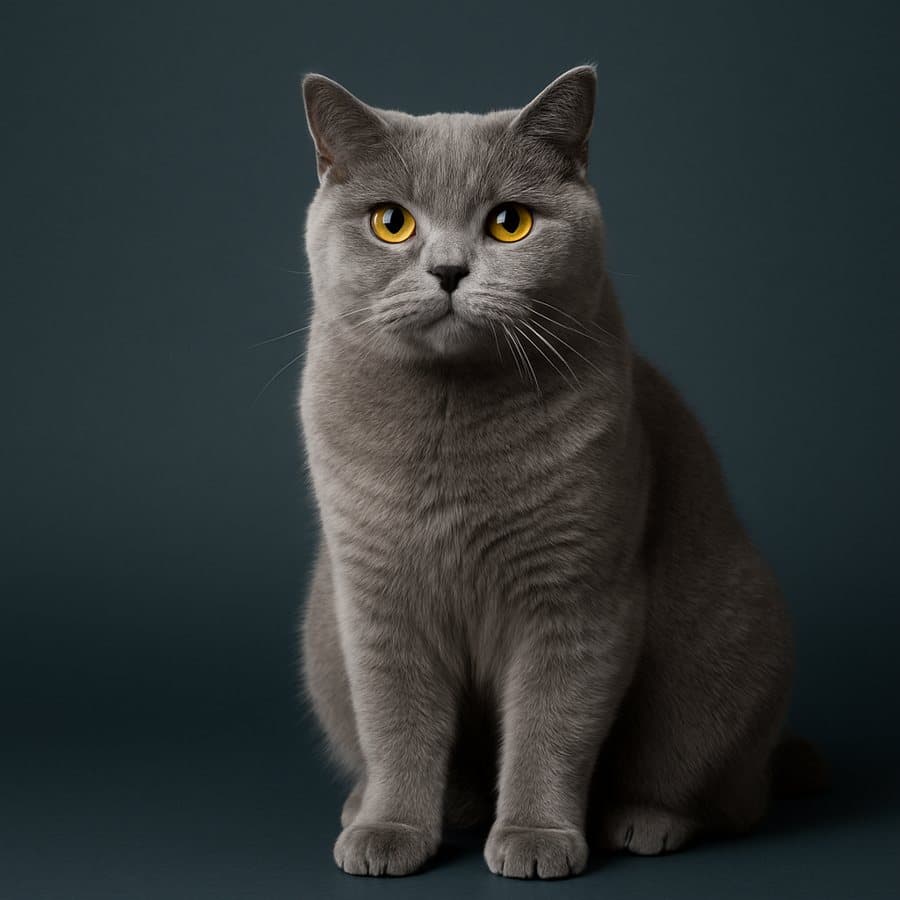
This is general guidance. Always ask your vet.
How big does a British Shorthair get?
An adult British Shorthair weighs 3.2 to 9 kg and stands 30 to 36 cm at the withers.
Males exhibit heavier boning, wider frames, and prominent jowls compared to females. The breed takes 3 to 5 years to complete physical growth and reach full adult frame size.
[S3][S5][S6][S8][S9][S10][S11][S12]How long does a British Shorthair live?
A British Shorthair lives 9.6 to 17 years.
UK vet data shows a median lifespan of 9.58 years with recorded ages exceeding 22 years, while general pet welfare sources report an expected lifespan of 12 to 17 years for indoor cats.
[S13][S14][S15]What health problems are common in the British Shorthair?
The most common in the British Shorthair are: Hypertrophic Cardiomyopathy (HCM), Polycystic Kidney Disease (PKD), Obesity and Secondary Joint Disease, Feline Lower Urinary Tract Disease (FLUTD).
Hypertrophic Cardiomyopathy (HCM) [S26][S27]
A cardiac condition where heart muscle walls thicken and hinder normal pumping efficiency.
Ask your vet about:
- Transthoracic echocardiogram by a veterinary cardiologist
Polycystic Kidney Disease (PKD) [S26][S28][S29]
An inherited genetic condition that forms fluid-filled cysts in renal tissue, disrupting kidney performance over time.
Ask your vet about:
- PKD1 DNA cheek swab or blood test
- Abdominal kidney ultrasound
Obesity and Secondary Joint Disease [S13][S29][S30][S31]
Excess weight accumulation linked to a sedentary lifestyle that stresses joints and metabolic stability.
Ask your vet about:
- Body condition scoring (BCS)
- Annual weight checks
- Fasting blood glucose test
- Urinalysis panel
Feline Lower Urinary Tract Disease (FLUTD) [S12][S29]
Discomfort and inflammation affecting the bladder and urethra, frequently aggravated by low water consumption.
Ask your vet about:
- Urinalysis for specific gravity and crystal sediment
- Abdominal radiographs
- Urinary bladder ultrasound
What is a British Shorthair's temperament like?
The British Shorthair is calm, quiet, and reserved. It prefers staying close to owners while keeping its paws on the floor, rarely vocalizing or demanding constant lap time.
[S6][S10][S16][S17][S18]How much exercise does a British Shorthair need?
A British Shorthair needs 15 to 30 minutes of exercise a day.
This cat prefers short play intervals followed by long naps. It is a clumsy jumper and favors ground toys or low perches over high climbing structures.
- Energy2 / 5
How does a British Shorthair handle heat and cold?
A thick, insulating coat shields the cat from cold drafts but leads to rapid overheating in hot conditions. During warm weather, the cat seeks cool floors and avoids laps.
- Handles heat1 / 5
- Handles cold4 / 5
How much does a British Shorthair shed, and how do you groom it?
Brush weekly with a steel comb or slicker brush, increasing to two or three times weekly during seasonal spring and autumn coat blowouts.
Short, exceptionally dense, firm, and crisp
- Shedding3 / 5
Is a British Shorthair good with children and other pets?
Their peaceful demeanor accommodates calm children who avoid picking them up. They share space well with cat-friendly dogs and other cats after gradual introductions, fitting smoothly into apartments.
- With children4 / 5
- With other pets4 / 5
- In an apartment5 / 5
Is a British Shorthair easy to train?
They learn quickly with positive reinforcement, clicker training, and food rewards. They take to litter boxes naturally and can accept leash walks if started between 3 and 9 months.
- Ease of training4 / 5
What does a British Shorthair eat at each life stage?
- KittenOffer growth formulas rich in animal protein, essential taurine, and DHA to fuel healthy brain and bone formation until 12 to 14 months of age.
- AdultProvide calorie-managed meals that include daily wet food to preserve lean muscle, maintain urinary tract hydration, and counteract weight gain as growth slows.
- SeniorSelect easily digestible proteins with balanced phosphorus and sodium levels to support renal function alongside omega-3 fatty acids for joint comfort.
Where does the British Shorthair come from?
Romans brought domestic cats to the British Isles to control pests, where they mixed with local European wildcats. Harrison Weir showcased the breed at London's Crystal Palace in 1871 during the first official cat show. After bloodlines dropped following the World Wars, breeders revitalized the population through outcrosses with Persians, Russian Blues, and French Chartreux before American registries recognized the breed around 1979 and 1980.
Country of origin: United Kingdom.
[S1][S2][S3][S4][S5][S6][S7]Fun facts about the British Shorthair
- John Tenniel modeled his classic illustrations of the Cheshire Cat in Alice's Adventures in Wonderland on the British Shorthair's round face and upturned mouth. [S17][S34]
- The 2007 viral internet meme 'I Can Has Cheezburger?' featured a blue British Shorthair named Happy Cat. [S34]
- At the first formal cat show in 1871 at London's Crystal Palace, a 14-year-old blue tabby British Shorthair won Best in Show. [S2]
- Fans refer to the breed as the 'Bulldog' or 'Teddy Bear' of cats due to its deep chest, broad head, and plush coat. [S3]
- The British Shorthair represents up to half of all annual feline registrations with the Governing Council of the Cat Fancy in the United Kingdom. [S6][S23][S34]
Tips by life stage and weather
- KittenStart harness and leash acclimation early between 3 and 9 months if you plan to walk your cat.
- KittenTeach family members and children to sit beside the kitten rather than picking it up, respecting its preference for ground contact.
- AdultEngage your cat in 15 to 30 minutes of interactive play every day using feather wands or puzzle feeders to prevent weight gain.
- AdultIncorporate daily wet food into meals to support urinary tract hydration and maintain a lean body build.
- SeniorKeep low perches and easily accessible resting stations close to the ground, avoiding high jumping spots.
- SeniorSchedule regular veterinary checkups for cardiac and kidney function evaluations along with dental examinations.
- Hot seasonProvide air-conditioned rooms and allow access to exposed tile floors where your cat can stretch out away from direct sunlight.
- Hot seasonDo not force lap contact or hold the cat when indoor temperatures rise, letting it remain on cool surfaces.
- Cold seasonRely on the cat's natural double coat for warmth while keeping sleeping cushions in draft-free indoor areas.
- Cold seasonMaintain weekly brushing with a slicker brush or steel comb to keep the dense undercoat clean and mat-free.
- Rainy seasonPlace ground-level food puzzle games inside your home to keep your cat physically active when outdoor time is restricted.
In the Kiba Vet app, your pet's breed profile shows a tip of the day based on its age and the weather where you live.
This is general guidance. Always ask your vet.
Checked against sources; veterinary review pending. Updated on September 29, 2026.
Written with the help of AI from the cited sources and checked fact by fact against them by a second model.
Sources
Every health fact and every number on this page comes from these sources. Identifiers from Wikidata (CC0).
- S1 British Shorthair History: From Working Cats to Show Icons
- S2 British Shorthair | VCA Animal Hospitals
- S3 British Shorthair | Cat Breed Identifier
- S4 Cat History: The Enduring Charm of the British Shorthair | Kathryn Hug – Cheshire & Wain
- S5 All about British Shorthair breed
- S6 British Shorthair Cats History - Stirling Bridge Cattery
- S7 Breed highlight: British Shorthair cat facts
- S8 cfa.org
- S9 British Shorthair cat | DinoAnimals.com
- S10 British shorthair: health, nutrition | Royal Canin AE
- S11 gccfcats.org
- S12 Best Food for British Shorthair Cats: Managing Weight and Health – GoofyTails
- S13 How Long Do British Shorthair Cats Live? Lifespan – La Petite Labs
- S14 How Long Do British Shorthair Cats Live? Average Lifespan Data & Facts — Catster
- S15 British Shorthair Age Calculator: Human Years (2026)
- S16 British Shorthair Cat Breed Facts and Personality Traits | Hill's Pet
- S17 British Shorthair Cats: What to Know
- S18 British Shorthair Characteristics & Temperament | Petopic
- S19 Do British Shorthair Cats Get Cold? Winter Care Guide
- S20 Do British Shorthair Cats Overheat in Summer? Heat Sensitivity Explained | Gumtree
- S21 British Shorthair Cat – a teddy bear with a big heart – Dr Malou
- S22 White British Shorthair Cats and Kittens: Color, Genetics, Price, and Care
- S23 BSH Breed Standard | Southern British Shorthair Cat Club
- S24 Ultimate Guide to British Shorthair Cat Training - Gatobritnico Farm
- S25 How to teach your cat walking with harness and leash – Bella the British Shorthair
- S26 zubairkhalid.com
- S27 Understanding Heart Health in the British Shorthair | Peqaboo
- S28 br-choku.com
- S29 British Shorthair - Healthy Paws Veterinary Clinic
- S30 British Shorthair Diet & Nutrition Guide: Portions, Feeding & Health -
- S31 British Shorthair Nutrition - PetArtica
- S32 baileyscbd.com
- S33 Cat Nutrition by Life Stage – How to Choose the Right Food
- S34 British Shorthair - Wikipedia