
This is general guidance. Always ask your vet.
How big does a Bull Terrier get?
An adult Bull Terrier weighs 20 to 36 kg and stands 48 to 61 cm at the withers.
Official kennel standards focus on maximum substance and quality rather than strict weight or height boundaries, though typical pet ranges exist.
[S1][S5][S6][S7]How long does a Bull Terrier live?
A Bull Terrier lives 11 to 14 years.
Large cohort studies demonstrate a median lifespan of 12 years.
[S6][S8][S9][S10][S11][S12][S13]What health problems are common in the Bull Terrier?
The most common in the Bull Terrier are: Hereditary Nephritis, Congenital Sensorineural Deafness, Heart Disease (Mitral Valve Dysplasia and Subaortic Stenosis), Patellar Luxation, Lethal Acrodermatitis (LAD), Atopic Dermatitis, Primary Lens Luxation (PLL).
Hereditary Nephritis [S8][S15][S22][S23][S24][S25]
A genetic condition causing progressive failure of the kidney filtering system.
Ask your vet about:
- Urine protein-to-creatinine (UPC) ratio test
- Kidney ultrasound
- Renal blood chemistry panel
Congenital Sensorineural Deafness [S24][S26][S27]
Inborn hearing loss resulting from nerve dysfunction within the inner ear.
Ask your vet about:
- Brainstem Auditory Evoked Response (BAER) hearing test
Heart Disease (Mitral Valve Dysplasia and Subaortic Stenosis) [S22][S24][S25][S28]
Congenital defects that affect valve structure or narrow blood flow out of the heart.
Ask your vet about:
- Auscultation examination by a veterinary cardiologist
- Doppler echocardiography
- OFA Advanced Cardiac clearance
Patellar Luxation [S21][S25][S29]
A developmental issue where the kneecap slips out of its normal groove.
Ask your vet about:
- Stifle joint physical palpation
- OFA patellar evaluation
Lethal Acrodermatitis (LAD) [S15][S21][S27]
A severe inherited condition impairing normal zinc processing and skin development.
Ask your vet about:
- MKLN1 genetic mutation DNA test
What is a Bull Terrier's temperament like?
The Bull Terrier is an affectionate, playful, and courageous companion with an obstinate streak. It forms deep attachments to its household and approaches daily life with lively humor.
[S1][S6][S7][S14]How much exercise does a Bull Terrier need?
A Bull Terrier needs 60 to 90 minutes of exercise a day.
You must supply at least one hour of physical exertion and mental enrichment daily to prevent destructive habits and compulsive tail chasing.
- Energy4 / 5
How does a Bull Terrier handle heat and cold?
The short single coat provides minimal insulation below 7°C. Muscular bodies retain warmth quickly under direct heat, and light-colored skin is prone to sunburn.
- Handles heat3 / 5
- Handles cold2 / 5
How much does a Bull Terrier shed, and how do you groom it?
Brush weekly using a soft bristle brush or hound glove, and bathe every 6 to 8 weeks with gentle shampoo.
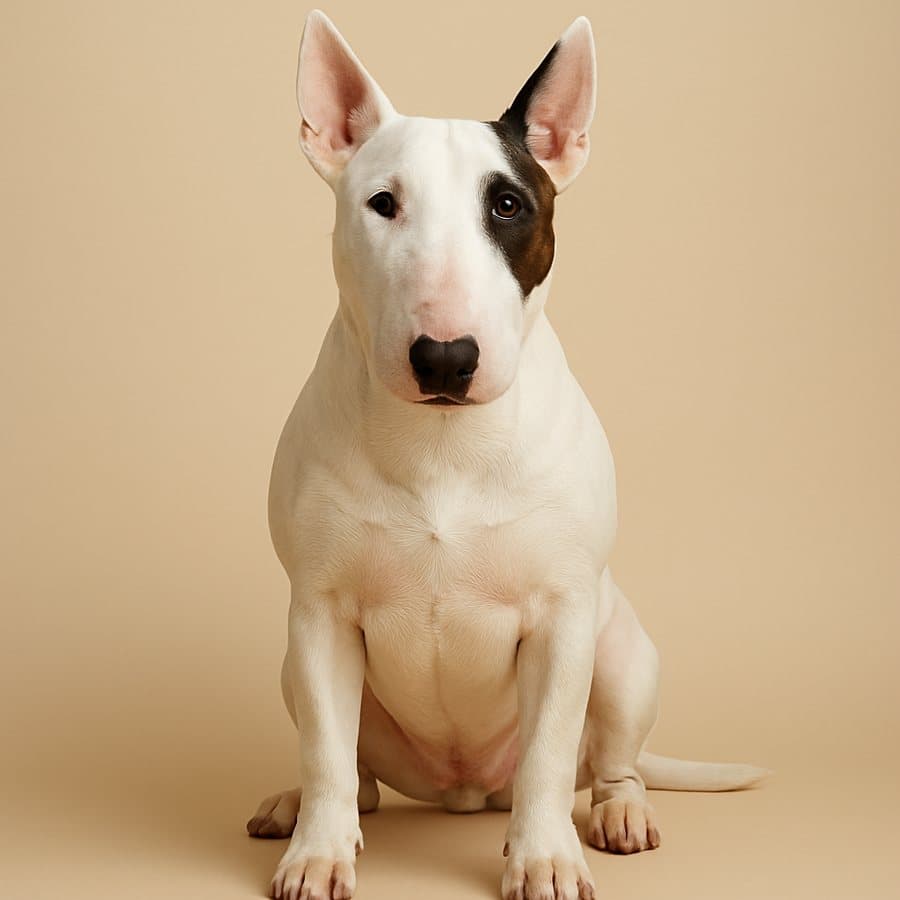
Short, flat, harsh coat with a glossy finish
- Shedding2 / 5
Is a Bull Terrier good with children and other pets?
Rambunctious play makes this dog best suited for older kids. Strong prey drive and dog-directed intolerance require careful management around smaller animals and other dogs. Apartments work well if you provide substantial outside exercise.
- With children3 / 5
- With other pets2 / 5
- In an apartment3 / 5
Is a Bull Terrier easy to train?
Independent thinking and stubbornness mean you must rely on short, varied sessions with positive reinforcement rather than punitive methods.
- Ease of training2 / 5
What does a Bull Terrier eat at each life stage?
- PuppyProvide food formulated for medium-to-large puppy growth with balanced calcium and phosphorus levels to support steady skeletal growth.
- AdultFeed an adult maintenance diet rich in quality proteins and omega fatty acids to maintain muscle mass and protect skin health.
- SeniorOffer mature dog food containing lower calorie density to manage weight alongside controlled phosphorus to protect kidneys.
Where does the Bull Terrier come from?
Developed in the early 19th century by crossing the Old English Bulldog with terriers, the breed was bred for pit fighting and vermin control. In the 1850s, James Hinks refined the dog into an all-white pet known as the White Cavalier, establishing its signature curved head.
Country of origin: Great Britain.
[S1][S2]Fun facts about the Bull Terrier
- The Bull Terrier is the only recognized dog breed featuring an unbroken, egg-shaped convex skull without a facial stop. [S1][S14]
- Standard purebred guidelines dictate that this breed has naturally triangular, obliquely placed eyes. [S5][S36]
- General George S. Patton traveled across Europe in World War II with a Bull Terrier named Willie who wore official dog tags. [S26][S37]
- A deaf Bull Terrier named Patsy Ann welcomed incoming ships in Juneau, Alaska during the 1930s and has a dockside bronze monument. [S26][S37]
- Famous pop-culture mascots include the 1980s advertising icon Spuds MacKenzie and Target's Bullseye. [S38]
Tips by life stage and weather
- PuppyEnroll your puppy in structured socialization classes between 8 and 16 weeks to build confidence around strange dogs.
- PuppyAsk your vet to review results for genetic tests like LAD before vigorous physical routines begin.
- AdultIncorporate interactive scent games and obedience drills into daily walks to burn off excess mental energy.
- AdultSchedule annual urine protein-to-creatinine testing with your vet to monitor kidney wellness.
- SeniorMonitor joint comfort closely and ask your veterinarian about adjusting exercise frequency to protect aging stifles.
- SeniorReview your dog's weight and kidney blood values regularly with your vet to adjust mature caloric needs.
- Hot seasonApply dog-safe sunscreen to unpigmented ear and muzzle skin before outdoor walks to prevent solar dermatitis.
- Hot seasonExercise your dog during the cooler morning or evening hours to prevent dangerous heat buildup in its dense body.
- Cold seasonPut an insulated coat or dog sweater on your pet during chilly mornings when temperatures fall under 7°C.
- Cold seasonLimit sedentary outdoor time during cold winter days because short coats offer little body warmth.
- Rainy seasonDry the paws, ears, and belly thoroughly with a clean towel after rainy walks to safeguard sensitive skin.
- Rainy seasonProvide indoor cognitive toys and scent puzzles when heavy afternoon downpours prevent full outdoor exercise.
In the Kiba Vet app, your pet's breed profile shows a tip of the day based on its age and the weather where you live.
This is general guidance. Always ask your vet.
Checked against sources; veterinary review pending. Updated on September 29, 2026.
Written with the help of AI from the cited sources and checked fact by fact against them by a second model.
Sources
Every health fact and every number on this page comes from these sources. Identifiers from Wikidata (CC0).
- S1 BULLEMA BULL TERRIERS
- S2 History
- S3 Breed Info – Animal Clinic of Hammonton
- S5 Bull Terrier | Breed Standards | The Kennel Club
- S6 How Long Do Bull Terriers Live? Lifespan & Longevity | VitaDog
- S7 Bull Terrier - Care-A-Lot Pet Supply
- S8 Bull Terrier Life Expectancy: Factors Affecting Your Dog's Longevity – Bull Terrier World
- S9 Dog Lifespan Chart by Breed | 155 Breeds Compared
- S10 Dog Breed Lifespan Research: A UK Study from 2024
- S11 Dog Age Calculator
- S12 How Long Does a Bull Terrier Live? Average Lifespan, Data & Care — Dogster
- S13 rvc.ac.uk
- S14 Bull Terrier Dogs Breed - Information, Temperament, Size & Price | Lancaster Puppies
- S15 Gladiator - Complete Breed Guide | Furry Critter Network
- S16 Can Bull Terriers Get Cold? Winter Care & Warmth Guide – Bull Terrier World
- S17 How to Keep Your Bull Terriers Safe During Summer
- S18 How to Keep Your Bull Terrier Cool in Summer Without a Pool – Bull Terrier World
- S19 Bull Terrier Grooming Guide – Wooffy
- S20 Why Is My Bull Terrier Shedding So Much? | Bull Terrier World
- S21 Bull Terrier | VCA Canada Animal Hospitals
- S22 Understanding the Health and Care of the Bull Terrier | Peqaboo
- S23 Bull Terrier Health Problems: Key Risks & Prevention Tips
- S24 HEALTH ISSUES | MBTCA
- S25 Bull Terrier - Canada's Guide to Dogs
- S26 BT Hall of Fame - BULL TERRIER CLUB of AMERICA
- S27 Miniature Bull Terrier Dogs Breed - Information, Temperament, Size & Price | Lancaster Puppies
- S28 Health Clinics - OFA
- S29 OFA CHIC Program - Staffordshire Bull Terrier Club of America
- S30 Bull Terrier Health Issues: The Complete Guide to Care & Genetics – Bull Terrier World
- S31 Order DNA Tests | OFA
- S32 Feeding a Bull Terrier Puppy: Nutritional Guide & Schedule – Bull Terrier World
- S33 Bull Terrier Dog Breed Health and Care | PetMD
- S34 Hair Today and Gone Tomorrow: The Ultimate Guide to Dog Deshedding
- S35 Raw Diet For Bull Terrier | Vital Essentials Raw Pet Food | Vital Essentials
- S36 kutya-tar.hu
- S37 Bull Terrier - Wikipedia
- S38 Famous Bull Terriers and Facts About the Breed