
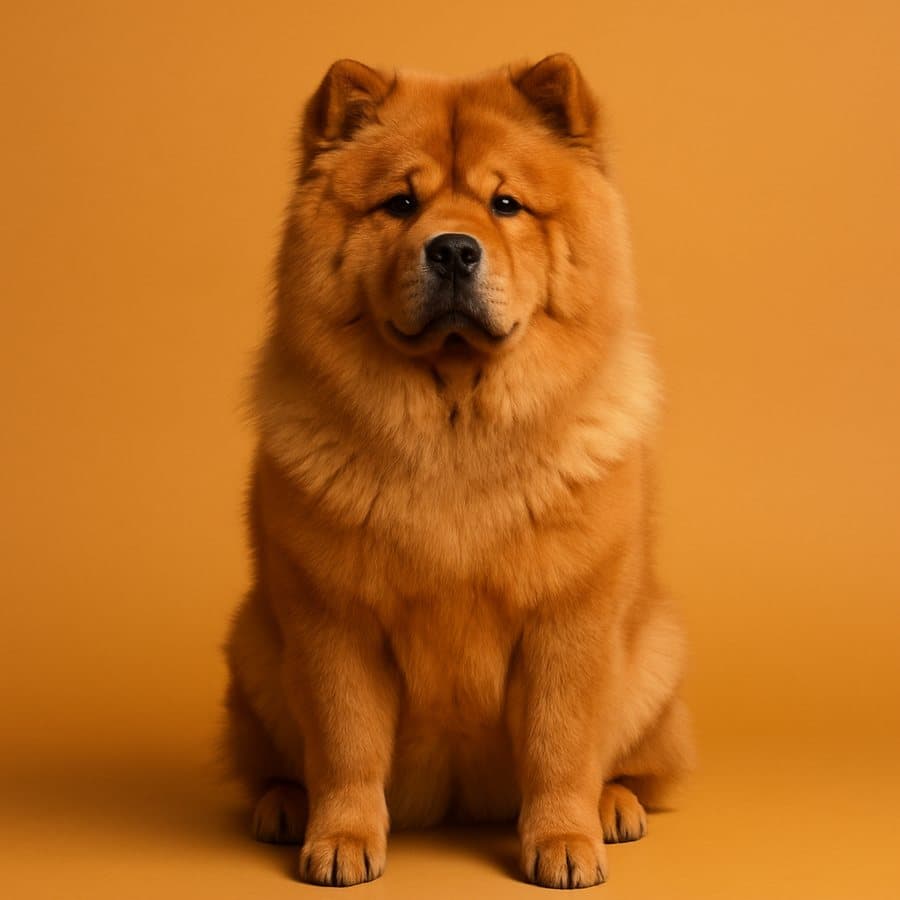
This is general guidance. Always ask your vet.
How long does a Chow Chow live?
A Chow Chow lives 8 to 15 years.
Large cohort studies report a median lifespan of 12.1 years, while broader veterinary references cite life spans ranging from 8 to 15 years.
[S2][S10][S12][S13][S14][S15][S16][S17]What health problems are common in the Chow Chow?
The most common in the Chow Chow are: Entropion, Hip Dysplasia, Elbow Dysplasia, Patellar Luxation, Autoimmune Thyroiditis, Gastric Carcinoma, Cruciate Ligament Rupture.
Entropion [S23][S24][S25][S26]
A genetic condition where the eyelid margins roll inward, causing the eyelashes to rub directly against the eye surface.
Ask your vet about:
- Annual ophthalmic exam by a specialist
- OFA Eye Certification registry (CAER) evaluation
Hip Dysplasia [S24][S25][S26]
An orthopedic malformation where the hip ball and socket fit together improperly, leading to joint wear and stiffness.
Ask your vet about:
- Pelvic radiographs evaluated by the OFA at 24 months
- PennHIP distraction index evaluation starting at 16 weeks
Elbow Dysplasia [S24][S25][S26]
An abnormal structural development of the elbow joint that causes pain and forelimb lameness.
Ask your vet about:
- Two-view flexed elbow survey evaluated by the OFA at 24 months
Patellar Luxation [S24][S25][S26]
A condition where the kneecap slips out of its normal anatomical groove during movement.
Ask your vet about:
- Physical stifle palpation by a licensed veterinarian
- OFA Patellar certification exam at 12 months
Autoimmune Thyroiditis [S24]
An immune-mediated dysfunction where the dog's body attacks the thyroid gland, leading to low thyroid hormone levels.
Ask your vet about:
- OFA Thyroid blood panel including free T4 by dialysis
- cTSH and thyroglobulin autoantibody (TgAA) screening
Gastric Carcinoma [S27][S28][S29][S30][S31]
A malignant cancer that develops in the tissues lining the dog's stomach wall.
Ask your vet about:
- Abdominal ultrasonography
- Upper gastrointestinal endoscopy with mucosal biopsies
Cruciate Ligament Rupture [S32]
A tearing of the primary stabilizing ligament within the knee joint, often related to the breed's straight rear legs.
Ask your vet about:
- Cranial drawer and tibial compression tests
- Stifle joint radiographs
What is a Chow Chow's temperament like?
The Chow Chow is an aloof, quiet, and devoted breed with an independent mind. It forms a deep bond with its family and stays naturally suspicious of unfamiliar people.
[S1][S4][S17][S18][S19][S20]How much exercise does a Chow Chow need?
A Chow Chow needs 45 to 60 minutes of exercise a day.
Chow Chows display a low to moderate energy level and behave calmly inside the home. They need steady daily walks to maintain their weight and protect their joints.
- Energy2 / 5
How does a Chow Chow handle heat and cold?
The dense double coat provides strong protection against cold weather. The breed handles heat poorly and shows high susceptibility to exertional heat illness.
- Handles heat1 / 5
- Handles cold5 / 5
How much does a Chow Chow shed, and how do you groom it?
Brush the coat two to three times each week with a slicker brush and metal greyhound comb down to the skin. Increase brushing to daily sessions when the dog sheds heavily.
Double coat (rough or smooth varieties)
- Shedding4 / 5
Is a Chow Chow good with children and other pets?
This breed tolerates apartment living well because it stays quiet and barks rarely indoors. It succeeds best around older, polite children who respect personal boundaries. Early socialization helps manage territorial aggression toward unfamiliar dogs and smaller animals.
- With children2 / 5
- With other pets2 / 5
- In an apartment4 / 5
Is a Chow Chow easy to train?
Chow Chows are intelligent and stubborn, resisting repetitive drills. Use consistent, positive reinforcement rather than physical force, and introduce early socialization from eight to sixteen weeks.
- Ease of training2 / 5
What does a Chow Chow eat at each life stage?
- PuppyProvide high-quality puppy food designed for steady physical growth. Consult your vet to choose a recipe matched to your puppy's development.
- AdultFeed a balanced adult diet suited to the breed's lower metabolic rate and moderate activity level to stop excess weight gain.
- SeniorSelect a complete senior formula that keeps your dog in a lean body condition. Ask your vet for diet evaluations during senior wellness visits.
Where does the Chow Chow come from?
Originating in northern China, the Chow Chow dates back over two thousand years to the Han Dynasty. Historically, people used these dogs for hunting game, guarding monasteries and estates, herding, and pulling carts. Merchant vessels brought the breed to Great Britain in the late eighteenth century, and kennel registries recognized it internationally during the twentieth century.
Country of origin: China.
[S1][S2][S3][S4][S5][S6]Fun facts about the Chow Chow
- A standard feature of the Chow Chow is its blue-black tongue and dark oral tissues; puppies are born with pink tongues that darken within eight to ten weeks. [S1][S4][S18]
- The breed has a characteristic straight-legged, stilted gait caused by very straight angles in the rear hocks and stifles. [S18][S19]
- In Chinese, this dog is called Songshi Quan, a name that translates directly to 'puffy-lion dog'. [S5][S19]
- Martha Stewart owned several Chow Chows, including one named Genghis Khan who won Best in Breed at Westminster in 2012. [S33]
Tips by life stage and weather
- PuppyExpose your puppy between 8 and 16 weeks of age to diverse sounds, people, surfaces, and handling to build confidence.
- PuppyPractice gentle, reward-based training early so your puppy learns cooperative habits without pushing resistance.
- AdultKeep a steady routine of 45 to 60 minutes of low-impact walking every day to support joint health.
- AdultBrush the double coat thoroughly two to three times each week to stop deep tangles and mats from forming.
- SeniorMonitor your older dog for signs of chronic vomiting or appetite drops, and take the dog to the vet for stomach checks.
- SeniorMaintain gentle daily movement to protect mobility without putting sharp strain on stiff stifle joints.
- Hot seasonWalk your dog only during early morning or late evening hours to protect it from dangerous heatstroke.
- Hot seasonKeep your dog inside climate-controlled rooms with plenty of shade and fresh water on warm days.
- Cold seasonLet your dog enjoy outdoor time safely, as its thick double coat provides natural insulation in cold temperatures.
- Cold seasonCheck skin and coat health beneath the dense fur after cold outings to make sure the undercoat remains dry.
- Rainy seasonDry the heavy undercoat down to the skin with a towel after rainy walks to prevent skin issues under the fur.
- Rainy seasonComb through the dense fur promptly after damp outings to stop wet undercoat hair from matting.
In the Kiba Vet app, your pet's breed profile shows a tip of the day based on its age and the weather where you live.
This is general guidance. Always ask your vet.
Checked against sources; veterinary review pending. Updated on September 29, 2026.
Written with the help of AI from the cited sources and checked fact by fact against them by a second model.
Sources
Every health fact and every number on this page comes from these sources. Identifiers from Wikidata (CC0).
- S1 LO STANDARD | Club Chow Chow
- S2 Chow Chow - Wikipedia
- S3 Chow Chow: Growth Chart, Milestones, and Training Tips - A-Z Animals
- S4 Chow Chow Dog Breed and Pet Insurance Guide | Healthy Paws
- S5 Chow Chow - PetPlace
- S6 CHOW CHOW
- S7 dogwellnet.com
- S8 pawlicy.com
- S9 Chow Chow Full Grown: Size and Weight Guide
- S10 Chow Chow Characteristics, Care & Photos | Chewy
- S11 Chow Chow Breed Guide: Characteristics & Care| Pedigree®
- S12 Dog Lifespan Chart by Breed | 155 Breeds Compared
- S13 Dog Breed Lifespan Research: A UK Study from 2024
- S14 Genetic, epigenetic, and environmental factors influencing dog lifespan: a systematic review - PMC
- S15 Chow Chow Life Expectancy and Health Issues
- S16 How long do Chow Chows live? - Adopt a Pet
- S17 Everything You Need to Know About Chow Chows | SMS Frederick
- S18 BREED STANDARD | Chow Chow Club NSW
- S19 Chow Chow Dog Guide | Complete Breed & Care Information
- S20 Breed standard - Chow Chow - Kennel Hjelme
- S21 mdpi.com
- S22 chowchowbreedcouncil.com
- S23 Tips and Tricks for Successful Entropion Repair | Veterian Key
- S24 chowhealth.org
- S25 OFA Health Testing - Iska Kennels
- S26 Canine Health (CHIC) — Barbet Club of America - Official Site
- S27 Animal Surgical Center of Michigan - Veterinarian in Flint, MI
- S28 Stomach Cancer in Dogs
- S29 Risk and characteristics of gastric carcinoma in the chow chow dog - PMC
- S30 Frontiers | Comparative epidemiological analysis of tumors of the digestive system in dogs and cats
- S31 researchgate.net
- S32 chowchowbreedcouncil.com
- S33 Chow Chow Breed Guide: Photos, Traits, & Care – BARK