
This is general guidance. Always ask your vet.
How big does a Dachshund get?
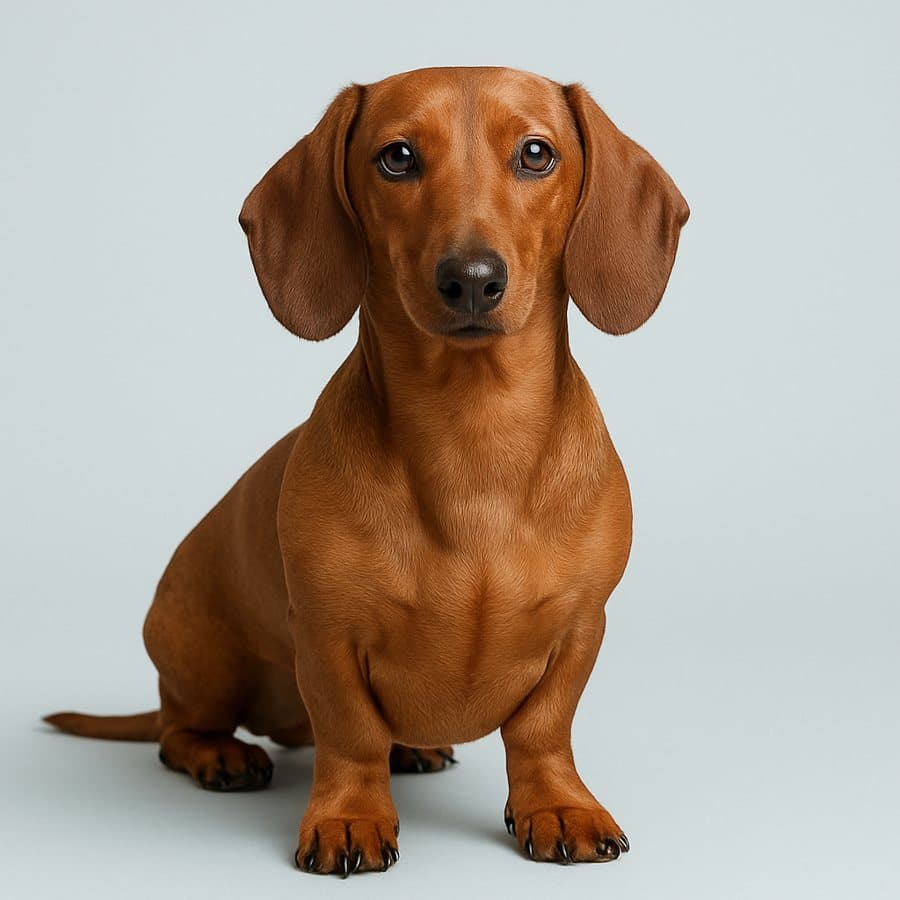
An adult Dachshund weighs 3.5 to 14.5 kg and stands 12.7 to 22.9 cm at the withers.
Kennel clubs do not set separate height or weight standards for males and females. Size classifications range across Standard, Miniature, and Rabbit varieties based on weight, height, or chest circumference.
[S8][S9][S10][S11][S12]How long does a Dachshund live?
A Dachshund lives 12 to 16 years.
General life expectancy spans 12 to 16 years, though variations occur across varieties and studies.
[S13][S14][S15][S16]What health problems are common in the Dachshund?
The most common in the Dachshund are: Intervertebral Disc Disease (IVDD), Progressive Retinal Atrophy, Patellar Luxation, Mitral Valve Disease and Congenital Heart Defects, Periodontal Disease.
Intervertebral Disc Disease (IVDD) [S16]
Spinal disc extrusion that causes pain and neurological problems.
Progressive Retinal Atrophy [S27][S28]
A genetic eye disorder that causes progressive vision loss.
Ask your vet about:
- OFA/CAER annual veterinary ophthalmologist examinations
- Commercial DNA gene mutation tests
Patellar Luxation [S28][S29]
A condition where the kneecap slips out of its normal groove.
Ask your vet about:
- OFA patellar palpation exam
Mitral Valve Disease and Congenital Heart Defects [S28][S29]
Structural or degenerative conditions that affect heart valve function.
Ask your vet about:
- Veterinary cardiac auscultation
- Echocardiography
Periodontal Disease [S30]
Bacterial inflammation and tooth decay resulting from crowded dental alignment.
What is a Dachshund's temperament like?
The Dachshund is a friendly, passionate hunter with an even temper and independent mind. It possesses a persistent prey drive and a strong, carrying bark.
[S1][S5][S8][S17]How much exercise does a Dachshund need?
A Dachshund needs 30 to 60 minutes of exercise a day.
Provide daily leashed walks and low-impact play on flat surfaces. Strictly avoid jumping on furniture or running down steep stairs to protect the spine.
- Energy3 / 5
How does a Dachshund handle heat and cold?
Low ground clearance puts the chest and belly close to hot pavement, damp grass, or cold ground. Minimal body mass causes rapid heat loss in cold or wet conditions.
- Handles heat3 / 5
- Handles cold2 / 5
How much does a Dachshund shed, and how do you groom it?
Smooth coats need weekly brushing with a curry mitt. Longhaired coats require brushing two to three times a week. Wirehaired coats need weekly combing and hand-stripping two to three times a year.
Smooth, longhaired, or wirehaired varieties
- Shedding3 / 5
Is a Dachshund good with children and other pets?
Dachshunds do well in apartments with daily walks, though you must manage their barking. They fit best with older children who handle them safely. Supervision is necessary around small animals due to their hunting drive.
- With children3 / 5
- With other pets3 / 5
- In an apartment4 / 5
Is a Dachshund easy to train?
Dachshunds are independent thinkers and require patience. Use positive reinforcement with food rewards and short sessions. Harsh methods cause defensive behavior.
- Ease of training2 / 5
What does a Dachshund eat at each life stage?
- PuppyFeed a complete, balanced small-breed puppy diet that meets growth standards. Monitor calorie intake closely to prevent rapid weight gains that stress the spine.
- AdultOffer adult maintenance food with moderate calorie density and quality protein to maintain a lean body score. Keep treats under ten percent of total daily calories.
- SeniorProvide a senior or weight-management formula with lower calorie density for a slowing metabolism. Choose foods with omega-3 fatty acids for joint and spine support.
Where does the Dachshund come from?
Developed in Germany with records reaching back to the Middle Ages, the Dachshund originated from scent hounds to hunt badgers and foxes underground. The Deutsche Teckelklub e.V. was formed in 1888, and the American Kennel Club recognized the breed in 1885.
Country of origin: Germany.
[S1][S2][S3][S5][S6]Fun facts about the Dachshund
- A Dachshund named Waldi served as the first official Olympic mascot at the 1972 Munich Games. [S3][S37][S38]
- The marathon course of the 1972 Munich Olympic Games was mapped out in the shape of a Dachshund. [S37][S39]
- The breed's short legs come from an expressed FGF4 retrogene insertion that causes dwarfism for underground hunting. [S1][S30]
- The name 'hot dog' comes from 19th-century German immigrant sausages known as Dachshundwurst that resembled the breed. [S4]
Tips by life stage and weather
- PuppySupport your puppy's chest and hindquarters every time you lift it to protect its back.
- PuppyEstablish a consistent housebreaking and crate schedule early to help with stubborn habits.
- AdultPlace ramps next to sofas and beds so your dog does not jump off elevated surfaces.
- AdultKeep daily walks on flat terrain and incorporate scent games to meet hunting needs safely.
- SeniorMonitor your older dog's weight carefully to eliminate extra physical strain on its long back.
- SeniorHave your veterinarian perform routine dental checks to manage crowded teeth.
- Hot seasonWalk your dog in early mornings or evenings because its belly is close to hot street pavement.
- Hot seasonProvide clean drinking water and shady resting spots to prevent overheating on warm afternoons.
- Cold seasonDress your Dachshund in a warm sweater on cold days to prevent rapid body heat loss.
- Cold seasonKeep cold walks brief since the dog's low chest and abdomen touch freezing ground.
- Rainy seasonDry your dog's chest and belly thoroughly after walks to avoid chills from wet ground.
- Rainy seasonInspect and clean its folded ears every week to keep moisture from causing ear canal issues.
In the Kiba Vet app, your pet's breed profile shows a tip of the day based on its age and the weather where you live.
This is general guidance. Always ask your vet.
Checked against sources; veterinary review pending. Updated on September 29, 2026.
Written with the help of AI from the cited sources and checked fact by fact against them by a second model.
Sources
Every health fact and every number on this page comes from these sources. Identifiers from Wikidata (CC0).
- S1 fci.be
- S2 dogsglobal.com
- S3 insidethegames.biz
- S4 Dachshund History: The Badger Dog's Fascinating Past – American Kennel Club
- S5 Dachshund — Breed Guide, History & Characteristics | Prestige Breed
- S6 dachshundclubofamerica.org
- S8 akc.org
- S9 Dog Breed Guide: Dachshunds | Pets Best
- S10 Dachshund - Wikipedia
- S11 fandom.com
- S12 working-dog.com
- S13 Dachshund Lifespan: How Long They Live and What Affects It
- S14 How Long Do Standard Dachshunds Live? Lifespan & Longevity | VitaDog
- S15 Dachshund Lifespan: 13.2 Years, Health Score 79/100 | Breed Health Score
- S16 How long do Dachshunds live? - VetCompass data
- S17 The Dachshund Breed Standard - The Dachshund Club of NSW Inc
- S18 Yorkshire Terrier: Complete Care Guide for New Owners - Busy Pet Parent
- S19 Dachshund Breed: Characteristics, Care & Photos | Chewy
- S20 Dachshund | Petland Novi, Michigan
- S21 Dachshund Lifespan & Care | How Long Do Dachshunds Live – Fitwarm
- S22 Dachshund Dog Breed Information and Pictures
- S24 Dachshund Sizes & Coats — Dachshunds Unlimited
- S25 Do Dachshunds Shed? Coat Types, Seasons, and Grooming Tips
- S26 15 Long Haired Dogs Breeds For All Pet Lovers
- S27 Explanation of Required Tests – American Shetland Sheepdog Association
- S28 Health Screening
- S29 FAQs | OFA
- S30 Best Dog Food for Dachshunds (2026): Vet-Backed Guide
- S31 Raising A Dachshund? Bookmark This Feeding Chart - Canine Journal
- S32 How to Choose the Best Dog Food for Dachshunds – The Honest Kitchen
- S33 Dachshund Feeding Chart by Age & Weight (2026)
- S34 How Much Should My Dachshund Eat? Feeding Chart By Age
- S35 petco.com
- S36 What Age Should I Feed Senior Dog Food? (And 9 More FAQs) - Dr. Buzby's ToeGrips for Dogs
- S37 7 Facts About Waldi, the First Official Olympic Mascot (1972)
- S38 Olympic mascot Facts for Kids
- S39 Olympic Mascots: Meet them all in our wild and wacky photo gallery