
This is general guidance. Always ask your vet.
How big does a Doberman get?
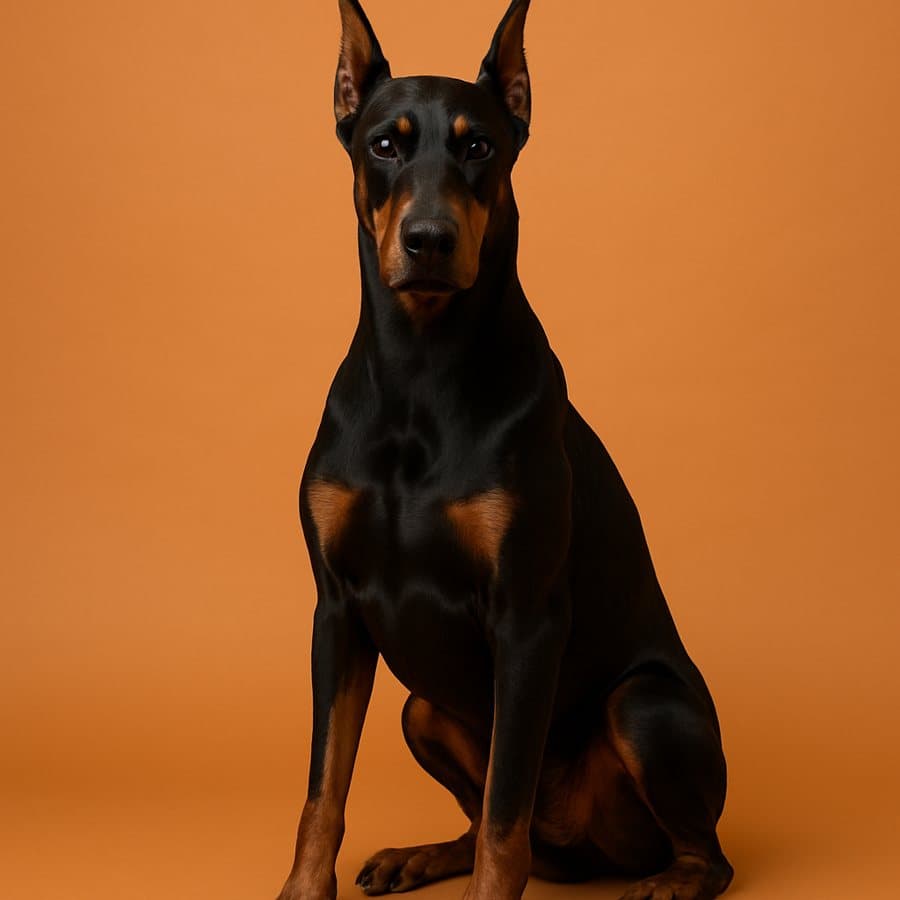
An adult Doberman weighs 27.2 to 45.4 kg and stands 61 to 71.1 cm at the withers.
Males average around 69.9 cm at the withers and females average around 64.8 cm, with females being lighter and slightly smaller.
[S7][S8]How long does a Doberman live?
A Doberman lives 10 to 12 years.
General kennel club registries report 10 to 12 years, though large population health studies report lower median survival times between 7.7 and 8.7 years due to cardiac pathology.
[S9][S10][S11][S12][S13][S14]What health problems are common in the Doberman?
The most common in the Doberman are: Dilated Cardiomyopathy (DCM), Von Willebrand Disease (vWD Type 1), Gastric Dilatation-Volvulus (GDV / Bloat), Cervical Spondylomyelopathy (Wobbler Syndrome), Hip Dysplasia.
Dilated Cardiomyopathy (DCM) [S18][S20][S21][S22]
A severe heart disease where the heart muscle enlarges and weakens, reducing its pumping efficiency.
Ask your vet about:
- Annual 24-hour ambulatory Holter monitoring
- Echocardiogram evaluation
- DNA testing for DCM1 and DCM2 mutations
Von Willebrand Disease (vWD Type 1) [S18][S23][S24][S25]
An inherited bleeding disorder caused by a deficiency in a clotting protein.
Ask your vet about:
- DNA test for the VWF gene mutation
- Plasma von Willebrand factor antigen (vWF:Ag) testing
Gastric Dilatation-Volvulus (GDV / Bloat) [S27]
A rapid life-threatening condition where the stomach fills with gas and twists on its axis.
Ask your vet about:
- Prophylactic gastropexy surgery
- Right lateral abdominal radiographs
Cervical Spondylomyelopathy (Wobbler Syndrome) [S26]
A spinal cord compression in the neck region that leads to uncoordinated walking and limb weakness.
Ask your vet about:
- Neurological evaluation
- Spinal imaging
Hip Dysplasia [S18][S24][S28]
An abnormal development of the hip joints leading to joint laxity and degenerative wear.
Ask your vet about:
- OFA certified hip radiographs at or after 24 months
- PennHIP distraction index evaluation
What is a Doberman's temperament like?
Dobermans are alert, watchful, courageous, and deeply attached to their families, earning the label of velcro dogs. They are confident and aloof toward strangers while remaining fiercely loyal at home.
[S1][S2][S4][S5][S7][S8][S9]How much exercise does a Doberman need?
A Doberman needs 60 to 120 minutes of exercise a day.
This high-energy working breed needs 1 to 2 hours of vigorous exercise daily. They excel at agility, tracking, and obedience, and need mental challenges to prevent restless behavior.
- Energy5 / 5
How does a Doberman handle heat and cold?
Their single coat lacks an insulating undercoat, making them very vulnerable to cold. They tolerate moderate heat, but dark coats and a deep chest increase heat exhaustion risks during hard work.
- Handles heat3 / 5
- Handles cold1 / 5
How much does a Doberman shed, and how do you groom it?
Weekly brushing with a rubber curry comb or hound glove removes dead hair. They need occasional baths, ear checks, and nail trims every two to three weeks.
Short, hard, thick, and closely lying single coat with no undercoat.
- Shedding2 / 5
Is a Doberman good with children and other pets?
They are protective and gentle with family children, though supervision is needed around young kids due to their size. They often display same-sex dog aggression and high prey drive. They can manage apartment life only with substantial exercise.
- With children4 / 5
- With other pets2 / 5
- In an apartment2 / 5
Is a Doberman easy to train?
Dobermans learn quickly with positive reinforcement methods that reward engagement. Harsh physical corrections cause them to shut down or show defiance. Establish clear boundaries early.
- Ease of training4 / 5
What does a Doberman eat at each life stage?
- AdultDivide daily food into at least two separate meals and avoid vigorous running one hour before and two hours after eating to reduce bloat risk.
- SeniorAdjust caloric density with your veterinarian to match reduced senior activity and prevent extra weight on aging joints.
Where does the Doberman come from?
Developed during the 1870s to 1890s in Apolda by Friedrich Louis Dobermann, a tax collector and dog catcher who needed a fearless personal protection dog. Foundation stock included butcher's dogs, Thuringian sheepdogs, and the German Pinscher, leading to police service recognition by the early 20th century.
Country of origin: Germany.
[S1][S2][S3][S4][S5]Fun facts about the Doberman
- In the 1944 Battle of Guam, a Doberman named Kurt warned his marine platoon of ambushing forces, becoming the first canine casualty buried in the National War Dog Cemetery. [S8][S30][S31]
- The United States Marine Corps selected the Doberman Pinscher as their official combat war dog during World War II. [S8][S31]
- The breed name uses a single 'n' in the United States, but uses a double 'n' in Germany and international kennel registries to honor creator Louis Dobermann. [S1][S6][S12]
- Early German police forces used Dobermans so extensively that the public nicknamed them 'Gendarme dogs'. [S1][S2][S3]
- The American Kennel Club introduced a 'Z-factor' tracking letter in pedigree numbers to help identify carriers of albinism originating from a female named Sheba. [S18][S25]
Tips by life stage and weather
- PuppyBegin gentle socialization and positive training immediately to build confidence around new environments.
- PuppyAsk your vet to check for clotting issues like von Willebrand disease before your puppy undergoes spay or neuter surgery.
- AdultProvide at least an hour of structured running, agility, or scent games every day to channel their high drive.
- AdultSchedule regular heart health checks, including Holter monitor screenings, during annual vet visits.
- SeniorMonitor your older dog's gait and ask your vet about joint mobility and neck comfort if you spot wobbling.
- SeniorKeep senior dogs warm indoors on cold evenings and tailor their meal portions to prevent excess weight gain.
- Hot seasonProvide shaded outdoor resting areas and fresh water to avoid heat exhaustion during hot afternoons.
- Cold seasonDress your dog in an insulated coat or sweater during cold morning walks, as they lack an undercoat.
- Cold seasonKeep your Doberman indoors overnight rather than leaving them outside in chilly temperatures.
- Rainy seasonTowel-dry their sleek coat thoroughly after wet walks to keep their skin clean and dry.
- Rainy seasonShift intense exercise indoors with cognitive games or food puzzles when heavy downpours stop outdoor runs.
In the Kiba Vet app, your pet's breed profile shows a tip of the day based on its age and the weather where you live.
This is general guidance. Always ask your vet.
Checked against sources; veterinary review pending. Updated on September 29, 2026.
Written with the help of AI from the cited sources and checked fact by fact against them by a second model.
Sources
Every health fact and every number on this page comes from these sources. Identifiers from Wikidata (CC0).
- S1 fci.be
- S2 DOBERMANN: FCI-Standard Nb 143 / EN
- S3 fci.be
- S4 The Standards, History & Military War Dogs
- S5 Doberman Pinscher | VCA Animal Hospitals
- S6 DOBERMANN
- S7 akc.org
- S8 Facts About the Doberman Pinscher That You May Not Know
- S9 Doberman Pinscher - The Westminster Kennel Club
- S10 Doberman Pinscher Dog Breed Health and Care | PetMD
- S11 How Long Do Dobermans Live? Average Lifespan, Data & Care — Dogster
- S12 Dobermann - Wikipedia
- S13 Premature mortality analysis of 52,000 deceased cats and dogs exposes socioeconomic disparities - PMC
- S14 Cavalier King Charles Spaniels Health Overview
- S15 Dobermann | Breeds A to Z | The Kennel Club
- S16 Doberman Pinscher Dog Breed Information - Continental Kennel Club
- S17 bellafortedobermans.com
- S18 Doberman Pinscher | VCA Animal Hospitals
- S19 rover.com
- S20 How Long Do Dobermans Live? Average Lifespan & Care Tips – K9 Carts
- S21 Dog Health Testing Before Breeding: OFA, CHIC & DNA Guide - Pair My Pet
- S22 ucdavis.edu
- S23 Doberman Health Concerns
- S24 What OFA Testing & CHIC Numbers Mean For Your Dog’s Health
- S25 The Doberman - DOBERMAN PRESERVATION PROJECT
- S26 6 Mobility and Health Conditions Impacting the Doberman Pinscher – Walkin' Pets
- S27 8 Common Health Problems in Dobermans: Vet-Verified Facts to Know — Dogster
- S28 Canine Health (CHIC) — Barbet Club of America - Official Site
- S29 Aging in dogs - Wikipedia
- S30 10 Smart Facts About Dobermans
- S31 War Dogs in the Battle of Guam (U.S. National Park Service)