
This is general guidance. Always ask your vet.
How big does a English Bulldog get?
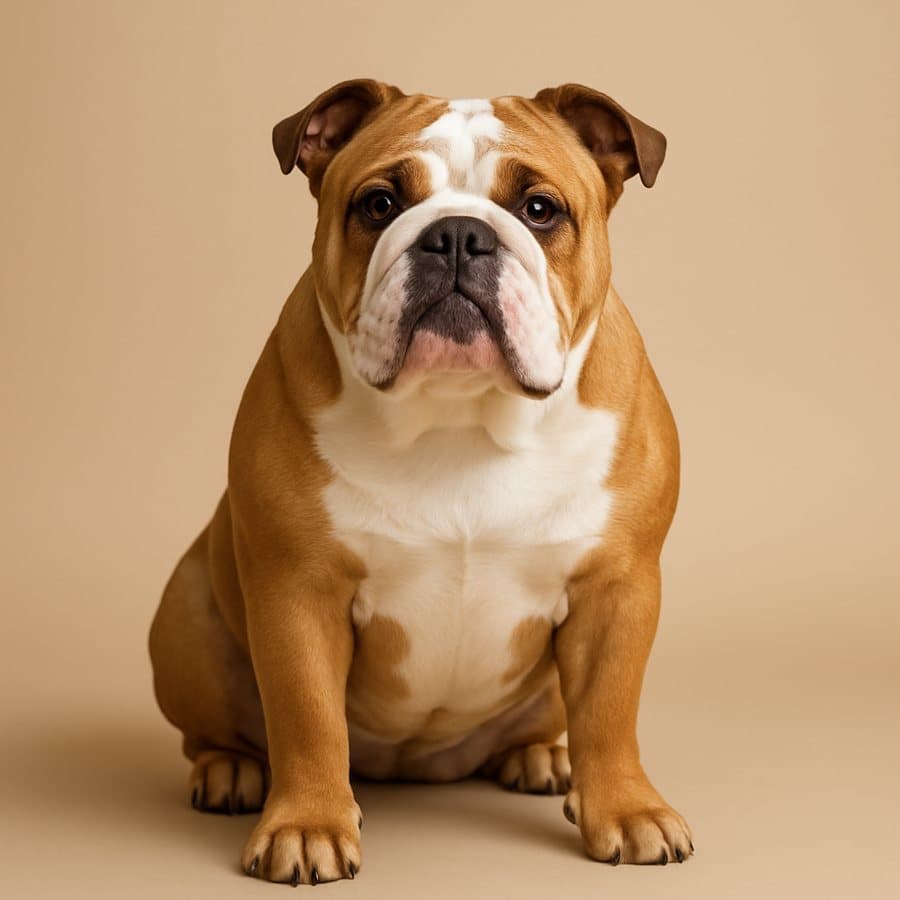
An adult English Bulldog weighs 18.1 to 25 kg and stands 35.6 to 38.1 cm at the withers.
FCI Standard No. 149 specifies desired weights of 25 kg for males and 23 kg for females, without setting a shoulder height. AKC standards list mature weights around 50 lbs (22.7 kg) for males and 40 lbs (18.1 kg) for females, noting typical heights between 35.6 and 38.1 cm.
[S1][S2][S6][S7][S8]How long does a English Bulldog live?
A English Bulldog lives 7.2 to 10 years.
Large-scale UK epidemiological studies found average life spans between 7.2 and 7.4 years, while a 2024 UK study reported a median of 9.8 years. The AKC lists a general range of 8 to 10 years.
[S2][S8][S9][S10][S11][S12][S13]What health problems are common in the English Bulldog?
The most common in the English Bulldog are: Brachycephalic Airway Syndrome, Hypoplastic Trachea, Patellar Luxation, Hip Dysplasia, Hyperuricosuria and Urate Urolithiasis, Ocular Conditions (Cherry Eye and Entropion), Skin Fold Dermatitis (Intertrigo).
Brachycephalic Airway Syndrome [S16][S17][S20][S21]
Anatomical restrictions in shortened airways cause noisy breathing and exercise intolerance.
Ask your vet about:
- Respiratory Function Grading (RFG) scheme
- Veterinary airway examination under sedation
- Fluoroscopy
Hypoplastic Trachea [S21][S22][S23]
A congenital narrowing of the windpipe that impairs normal airflow.
Ask your vet about:
- Thoracic radiographs measuring tracheal diameter
- OFA Tracheal Hypoplasia radiographic evaluation
Patellar Luxation [S15][S22][S23]
The kneecap slips out of its normal groove, causing lameness.
Ask your vet about:
- Manual orthopedic palpation
- OFA Patella certification after 12 months
Hip Dysplasia [S15][S16][S23]
Abnormal formation of the hip joint leads to laxity and progressive arthritis.
Ask your vet about:
- PennHIP distraction index evaluation
- OFA standard pelvic radiographs
Hyperuricosuria and Urate Urolithiasis [S23][S24]
An inherited metabolic defect causes excessive uric acid excretion, forming bladder stones.
Ask your vet about:
- DNA testing for the SLC2A9 gene mutation
- Urinalysis for urate crystals
Ocular Conditions (Cherry Eye and Entropion) [S9][S15][S23]
Prolapse of the third eyelid gland or inward rolling of the eyelids irritates the eye surface.
Ask your vet about:
- Slit-lamp ophthalmic examination
- Fluorescein dye staining
- OFA/CAER annual eye evaluation
What is a English Bulldog's temperament like?
Bulldogs show a peaceful, affectionate, and equable nature at home. They develop deep bonds with family members, maintaining a resolute and docile character with minimal unwarranted aggression.
[S1][S7]How much exercise does a English Bulldog need?
The breed has low to moderate energy levels. It requires moderate daily exercise while avoiding high-impact running to protect joints and airways.
- Energy2 / 5
How does a English Bulldog handle heat and cold?
Short airways severely limit heat regulation, creating high vulnerability to fatal heatstroke in warm or humid conditions. The breed requires air-conditioned living spaces and walks during cool periods.
- Handles heat1 / 5
- Handles cold2 / 5
How much does a English Bulldog shed, and how do you groom it?
Brush two to three times weekly using a rubber curry or soft-bristle brush. Clean and thoroughly dry all skin folds several times per week, and routinely inspect ears and paw pads.
Short, flat, smooth, and close-lying
- Shedding3 / 5
Is a English Bulldog good with children and other pets?
Patient behavior makes Bulldogs reliable family companions around children. Low barking tendencies and modest exercise demands suit apartment living.
- With children5 / 5
- With other pets4 / 5
- In an apartment5 / 5
What does a English Bulldog eat at each life stage?
- PuppyProvide balanced puppy nutrition and consult your veterinarian regarding genetic screening for the SLC2A9 mutation, which requires purine-restricted choices and high moisture intake.
- AdultSelect a nutrient-dense diet with controlled calories to prevent excess weight, which strains the airways and joints. Ask your veterinarian about purine management if your dog carries the SLC2A9 mutation.
- SeniorMaintain strict caloric control to keep your older dog lean, minimizing breathing resistance and orthopedic pain. Review your dog's ongoing hydration and urinary health with your veterinarian.
Where does the English Bulldog come from?
The Bulldog descended from ancient mastiff-type dogs in Great Britain and was used in bull-baiting. After the Cruelty to Animals Act of 1835 banned the sport, breeders eliminated ferocity to shape a calm companion. The breed entered dog shows in 1860, received AKC recognition in 1886, and gained FCI recognition in 1955.
Country of origin: Great Britain.
[S1][S2][S3][S4][S5]Fun facts about the English Bulldog
- Bulldogs are poor natural swimmers due to heavy bone density, large heads, and short limbs. [S4][S14]
- Between 80% and 90% of Bulldog litters require cesarean delivery because of puppy head size and maternal pelvis shape. [S15][S21]
- An English Bulldog named Tillman held a Guinness World Record for completing a 100-meter skateboard run in 19.678 seconds. [S2]
- The breed served as a prominent British symbol of national resilience during World War II alongside Winston Churchill. [S1][S19]
- Shortened facial structure causes Bulldogs to swallow excess air during breathing and eating, resulting in frequent snoring and flatulence. [S9]
Tips by life stage and weather
- PuppyAsk your veterinarian to evaluate your puppy's nostrils, elongated soft palate, and heart during early checkups.
- PuppyBegin daily cleaning and drying of facial folds early so your puppy becomes comfortable with wrinkle hygiene.
- AdultKeep daily exercise moderate and avoid running sessions that stress airways and joints.
- AdultMonitor body condition closely with your veterinarian to prevent weight gain that worsens breathing effort.
- SeniorSchedule regular orthopedic evaluations to monitor joint mobility and comfort during routine walks.
- SeniorInspect the tail pocket and deep facial folds frequently for redness, irritation, or moisture accumulation.
- Hot seasonKeep your Bulldog indoors in air-conditioned rooms during hot Mexican days to prevent heatstroke.
- Hot seasonSchedule necessary outdoor walks only during the coolest morning or late evening hours.
- Cold seasonProvide warm indoor resting spaces away from drafts during cold northern winter nights.
- Cold seasonLimit outdoor exposure during sudden temperature drops to protect your dog's airway stability.
- Rainy seasonDry your dog's facial wrinkles, tail fold, and paws thoroughly after walks in wet weather to avoid dermatitis.
- Rainy seasonInspect the spaces between paw pads regularly during rainy spells to catch interdigital cysts early.
In the Kiba Vet app, your pet's breed profile shows a tip of the day based on its age and the weather where you live.
This is general guidance. Always ask your vet.
Checked against sources; veterinary review pending. Updated on September 29, 2026.
Written with the help of AI from the cited sources and checked fact by fact against them by a second model.
Sources
Every health fact and every number on this page comes from these sources. Identifiers from Wikidata (CC0).
- S1 ingilizbulldogdernegi.org
- S2 8 Fun Facts You Probably Didn't Know About English Bulldogs
- S3 11 Solid Facts About the English Bulldog
- S4 Facts About the Bulldog That You May Not Know
- S5 BULLDOG
- S6 Bulldog | Breed Standards | The Kennel Club
- S7 The Bulldog Breed Standard - The Bulldog Club of America
- S8 17 Types of Bulldogs: Guide – KUOSER
- S9 rvc.ac.uk
- S10 rvc.ac.uk
- S11 New research aids in understanding of the canine life expectancy | dvm360
- S12 Research study reveals short lives of brachycephalic dogs
- S13 New research calculates a dog’s life expectancy - ARU
- S14 dogfriendlyco.com
- S15 Bulldog (English Bulldog) Dog Breed Health and Care | PetMD
- S16 American Express
- S17 Health Observations and structure Standards - Bruiser BulldogsBruiser Bulldogs
- S18 nationalkennelclub.com
- S19 rover.com
- S20 researchgate.net
- S21 Fact Sheet Dog Breed (English) Bulldog - QUEN Qualzucht-Database
- S22 Health Testing - The Bulldog Club of America
- S23 Genetic Health Testing for Bulldogs - Embark for Breeders – Embark Vet
- S24 ucdavis.edu
- S25 rvc.ac.uk