
This is general guidance. Always ask your vet.
How big does a German Shepherd get?
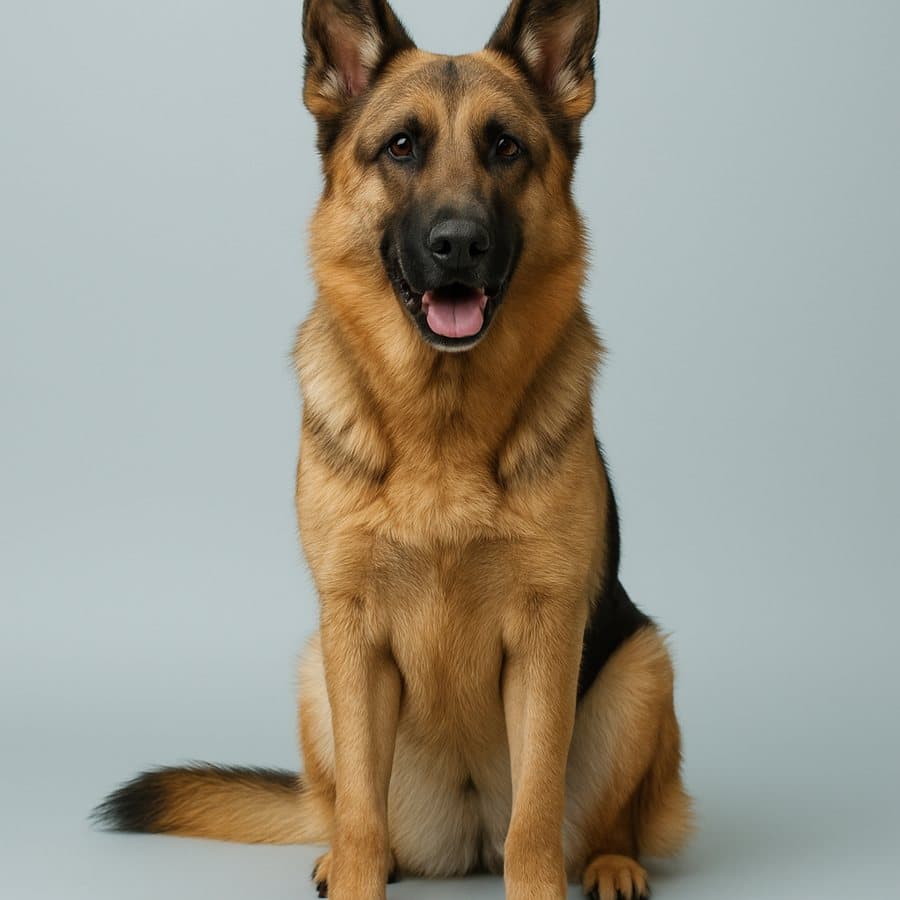
An adult German Shepherd weighs 22 to 40.8 kg and stands 55 to 66 cm at the withers.
FCI standard No. 166 records male height at 60 cm to 65 cm and weight at 30 kg to 40 kg, with females at 55 cm to 60 cm and 22 kg to 32 kg. AKC standards list males at 61 cm to 66 cm and 29.5 kg to 40.8 kg, with females at 56 cm to 61 cm and 22.7 kg to 31.8 kg.
[S4][S5]How long does a German Shepherd live?
A German Shepherd lives 7 to 13 years.
A UK study of 584,734 dogs found a median survival time of 11.3 years, while an RVC VetCompass study found an average lifespan of 10.3 years. Kennel club and breed health summaries report typical lifespans between 7 and 13 years.
[S6][S7][S8][S9]What health problems are common in the German Shepherd?
The most common in the German Shepherd are: Hip and Elbow Dysplasia and Secondary Osteoarthritis, Degenerative Myelopathy, Exocrine Pancreatic Insufficiency, Hemangiosarcoma.
Hip and Elbow Dysplasia and Secondary Osteoarthritis [S8][S15][S16][S17]
Malformation of the hip or elbow joints that causes abnormal wear. This condition can lead to secondary osteoarthritis and joint pain.
Ask your vet about:
- Pelvic and elbow radiographs
- PennHIP distraction index evaluation
- OFA joint certification radiographs
Degenerative Myelopathy [S18][S19][S20][S21]
A progressive neurological spinal cord disorder. It causes progressive loss of coordination and weakness in the hind limbs.
Ask your vet about:
- DNA screening for the SOD1 gene mutation
- Spinal MRI
- Cerebrospinal fluid analysis
- Veterinary neurological examination
Exocrine Pancreatic Insufficiency [S22]
An inability of the pancreas to produce digestive enzymes. This leads to maldigestion and nutrient absorption problems.
Ask your vet about:
- Serum Trypsin-Like Immunoreactivity (cTLI) blood test
- Serum cobalamin (Vitamin B12) evaluation
- Serum folate evaluation
Hemangiosarcoma [S23][S24]
A vascular cancer that targets internal blood vessels. It predominantly forms tumors in organs such as the spleen, liver, or heart.
Ask your vet about:
- Abdominal ultrasonography
- Echocardiography
- Complete blood counts
- Chest radiographs
What is a German Shepherd's temperament like?
The breed is self-assured, courageous, and tractably obedient with high situational awareness. They show devotion to their owners and maintain a natural aloofness toward strangers while remaining approachable.
[S10][S11][S12][S13]How does a German Shepherd handle heat and cold?
The breed possesses a dense, double-layered, weather-resistant coat that offers protection against cold temperatures, wind, and rain.
- Handles cold5 / 5
How much does a German Shepherd shed, and how do you groom it?
Dense, double-layered, weather-resistant coat
[S10]Is a German Shepherd good with children and other pets?
German Shepherds live harmoniously with children when socialized, acting as loyal guardians and affectionate companions.
- With children5 / 5
What does a German Shepherd eat at each life stage?
- PuppyOffer a formulated large-breed puppy diet with balanced caloric density and precise calcium-to-phosphorus ratios to encourage steady skeletal growth. Divide meals into 3 to 4 daily feedings, transitioning to 2 meals daily around 6 months of age.
- AdultProvide a high-quality maintenance diet with sufficient animal-based protein and moderate fats to maintain lean muscle mass while preventing obesity. Divide feeding into 2 meals per day.
- SeniorFeed calorie-controlled diets with higher fiber to prevent weight gain as your dog's activity declines. Include formulations with added omega-3 fatty acids, glucosamine, and chondroitin to support joint mobility.
Where does the German Shepherd come from?
Captain Max von Stephanitz and Arthur Meyer developed the breed in 1899 using native herding dogs from central and southern Germany. Von Stephanitz bought the foundation dog, Hektor Linksrhein, renamed him Horand von Grafrath, and registered him as SZ 1. The parent club Verein für Deutsche Schäferhunde formed in Frankfurt am Main on September 20, 1899, establishing the breed standard.
Country of origin: Germany.
[S1][S2][S3]Fun facts about the German Shepherd
- The very first dog registered in the official German Shepherd Dog studbook was named Horand von Grafrath, cataloged as registration number SZ 1. [S3]
- Corporal Lee Duncan rescued a German Shepherd named Rin Tin Tin from a World War I battlefield in France, who then became a major silent film star in Hollywood. [S31]
- The parent club Verein für Deutsche Schäferhunde was founded on September 20, 1899, in Frankfurt am Main. [S1][S2]
- Horand von Grafrath worked as a four-year-old sheepdog under the original name Hektor Linksrhein before his purchase by Max von Stephanitz. [S3]
Tips by life stage and weather
- PuppyAsk your vet to evaluate your puppy's joints using the PennHIP distraction index as early as 16 weeks of age.
- PuppySocialize your puppy early with family members and children to build a stable, calm household companion.
- AdultSchedule official OFA hip and elbow radiograph evaluations with your veterinarian after your dog reaches 24 months of age.
- AdultAsk your veterinarian to check fasted cTLI, cobalamin, and folate levels if your dog shows digestive issues between 1 and 5 years.
- SeniorRequest abdominal ultrasound and echocardiogram screenings from your vet to inspect the spleen and heart once your dog reaches 6 to 8 years of age.
- SeniorConsult your vet regarding neurological checks and DNA testing for the SOD1 gene mutation as your dog approaches 8 to 10 years of age.
- Hot seasonMonitor your dog closely during hot Mexican afternoons, as their dense double coat limits heat dispersion.
- Hot seasonProvide shaded outdoor resting areas and consult your vet about hydration routines during intense heat waves.
- Cold seasonRely on the dog's natural double-layered coat to provide insulation during cold snaps in high-altitude regions of Mexico.
- Cold seasonAsk your veterinarian about managing joint stiffness in colder weather if your dog has radiographic evidence of hip dysplasia.
- Rainy seasonDry your dog's dense, weather-resistant outer coat thoroughly after walks during the Mexican rainy season to keep skin dry.
- Rainy seasonCheck your dog's paws and coat for damp debris and dirt after walks on wet, muddy days.
In the Kiba Vet app, your pet's breed profile shows a tip of the day based on its age and the weather where you live.
This is general guidance. Always ask your vet.
Checked against sources; veterinary review pending. Updated on September 29, 2026.
Written with the help of AI from the cited sources and checked fact by fact against them by a second model.
Sources
Every health fact and every number on this page comes from these sources. Identifiers from Wikidata (CC0).
- S1 fci.be
- S2 Internationally Recognized FCI SV Breed Standard | German Shepherd Dog
- S3 10 Most Interesting German Shepherd Facts – timberwolfpet
- S4 GERMAN SHEPHERD BREED STANDARD | Vom Geliebten Haus
- S5 German Shepherd Height and Weight Guide for Healthy Growth
- S6 German Shepherd Dog Lifespan: 11.3 Years, Health Score 59/100 | Breed Health Score
- S7 Dog Breed Lifespan Research: A UK Study from 2024
- S8 rvc.ac.uk
- S9 German Shepherd Lifespan: 9-13 Years | Full Guide & Factors
- S10 German Shepherd Dog | Breed Standards | The Kennel Club
- S11 akc.org
- S12 Breed Standards - United Schutzhund Clubs of America
- S13 German Shepherd | VCA Animal Hospitals
- S14 German Shepherd Dog Breed Guide
- S15 Buying a German Shepherd Puppy? The Health Clearances Every Buyer Must Verify
- S16 Dog Health Testing Before Breeding: OFA, CHIC & DNA Guide - Pair My Pet
- S17 Canine Health (CHIC) — Barbet Club of America - Official Site
- S18 Common Non-Surgical Diseases of the Canine Spine - WSAVA2008 - VIN
- S19 Degenerative myelopathy | Cornell University College of Veterinary Medicine
- S20 Degenerative Myelopathy & Hemangiosarcoma in Boxers | Purina Pro Club
- S21 Understanding Degenerative Myelopathy | WI Veterinary Neurology
- S22 Exocrine Pancreatic Insufficiency in Dogs | VCA Animal Hospitals
- S23 Canine Hemangiosarcoma - The Road from Despair to Hope | AKC Canine Health Foundation
- S24 Visceral Vascular Tumors | VCA Animal Hospitals
- S26 Farmina Pet Foods - Genius tips - Puppy, Adult, & Senior: Adjusting Nutrition Through Life Stages
- S27 Best Diet Plan for German Shepherd Dogs (Puppy to Senior)
- S28 German Shepherd Nutrition - German Shepherd Breeder
- S29 German Shepherd Diet: Feeding Guide for Every Life Stage - Shepherd Kingdom
- S30 Puppy, Adult & Senior Dog Nutrition | Hill’s Pet US
- S31 10 Interesting Facts About German Shepherds | Lucy Pet