
This is general guidance. Always ask your vet.
How big does a Great Dane get?
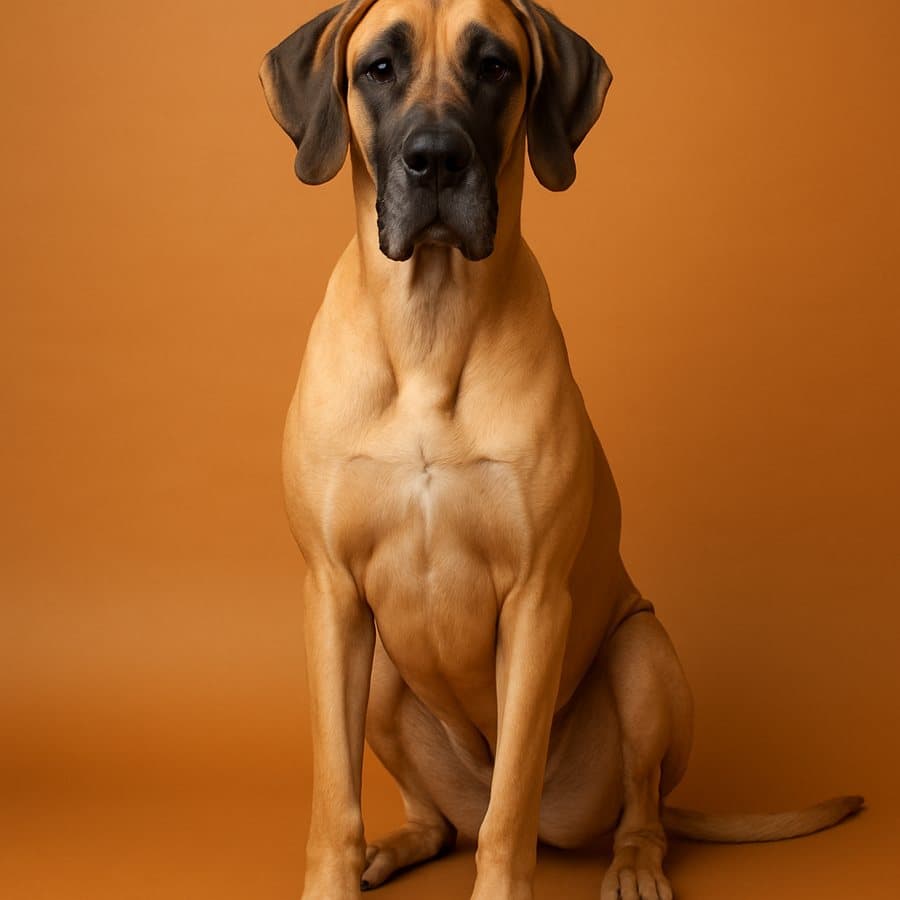
An adult Great Dane weighs 49.9 to 79.4 kg and stands 71.1 to 90 cm at the withers.
FCI standard No. 235 sets male height at 80 to 90 cm and female height at 72 to 84 cm with up to 1 cm above maximum permitted, without listing specific weights. AKC sets minimum heights of 76.2 cm for males and 71.1 cm for females, with weight ranges of 63.5 to 79.4 kg for males and 49.9 to 63.5 kg for females.
[S2][S3][S5][S6][S7]How long does a Great Dane live?
A Great Dane lives 7 to 10.6 years.
[S2][S4][S8][S9][S10]What health problems are common in the Great Dane?
The most common in the Great Dane are: Gastric Dilatation-Volvulus (Bloat), Dilated Cardiomyopathy (DCM), Wobbler Syndrome (Cervical Spondylomyelopathy), Hip Dysplasia, Autoimmune Thyroiditis, Osteosarcoma.
Gastric Dilatation-Volvulus (Bloat) [S22][S23]
The stomach fills with gas and twists on its axis, cutting off blood circulation and creating a rapid medical emergency.
Ask your vet about:
- Emergency abdominal radiographs
- Prophylactic gastropexy surgery
Dilated Cardiomyopathy (DCM) [S24][S25][S26][S27]
The heart muscle stretches and weakens, reducing its capacity to pump blood efficiently.
Ask your vet about:
- OFA Advanced Cardiac Examination
- Echocardiogram by a cardiologist
- 24-hour ambulatory Holter ECG monitor
Wobbler Syndrome (Cervical Spondylomyelopathy) [S28][S29][S30]
Bone malformation in the neck compresses the spinal cord, leading to unsteadiness and gait weakness.
Ask your vet about:
- Full neurological examination
- Magnetic Resonance Imaging (MRI) of cervical spine
- Computed Tomography (CT) scan
Hip Dysplasia [S25][S26][S29][S31]
The hip ball and socket fit together loosely, triggering progressive joint wear and degenerative arthritis.
Ask your vet about:
- OFA pelvic radiography certification
- PennHIP distraction laxity evaluation
Autoimmune Thyroiditis [S23][S25][S26]
Immune antibodies target thyroid tissue, reducing systemic thyroid hormone production.
Ask your vet about:
- OFA thyroid panel
- Free T4 and total T4 blood test
- Antithyroglobulin autoantibodies (TgAA) assay
Osteosarcoma [S23]
A malignant primary bone cancer that breaks down skeletal bone matrix, commonly on the limbs.
Ask your vet about:
- Orthopedic limb examination
- Bone radiographs
- Fine-needle aspirate or bone biopsy
What is a Great Dane's temperament like?
The Great Dane combines a calm, friendly, and affectionate indoor nature with courage and dependable loyalty. The breed shows devoted attachment to family members and maintains a dignified reserve around strangers.
[S1][S3][S5][S11]How much exercise does a Great Dane need?
A Great Dane needs 60 to 90 minutes of exercise a day.
Great Danes possess moderate daily energy and thrive on controlled walks and secure yard play. High-impact jumping and forced running on hard ground must be avoided during skeletal growth.
- Energy3 / 5
How does a Great Dane handle heat and cold?
A massive body mass makes cooling difficult in hot environments, while a thin, single coat and low body fat provide little defense against freezing temperatures.
- Handles heat2 / 5
- Handles cold2 / 5
How much does a Great Dane shed, and how do you groom it?
Weekly brushing with a firm bristle brush, rubber curry comb, or hound mitt clears loose hair. Maintain weekly ear cleaning, regular tooth brushing, and frequent nail trims to protect heavy feet from strain.
Short single coat
- Shedding3 / 5
Is a Great Dane good with children and other pets?
Great Danes interact gently with family children, though large tails and bodies can knock toddlers over. Early socialization fosters peaceful coexistence with cats and dogs, and calm indoor behavior allows apartment living if daily exercise needs are met.
- With children4 / 5
- With other pets4 / 5
- In an apartment3 / 5
Is a Great Dane easy to train?
Train manners and leash walking early while the dog is small. Great Danes respond best to positive reinforcement with food and praise, whereas harsh methods cause anxiety.
- Ease of training4 / 5
What does a Great Dane eat at each life stage?
- PuppyFeed exclusively a validated giant-breed growth formula to promote steady skeletal growth instead of rapid weight gain. Avoid adding calcium, vitamin D, or bone supplements to balanced puppy food.
- AdultOffer a giant-breed adult maintenance formula divided into at least two meals daily to support muscle and lower bloat risk. Keep the dog resting for 45 to 60 minutes before and after every meal.
- SeniorProvide a senior formula tailored for lower metabolic energy demands to prevent excess weight on mature joints. Select foods with dietary fiber to support digestion and omega-3 fatty acids for joint and heart health.
Where does the Great Dane come from?
European catch-dogs, boarhounds, and the Bullenbeisser formed the foundation of the Great Dane through crosses with agile sighthounds like Greyhounds. In 1878, a committee in Berlin united regional types under the name Deutsche Dogge, leading to the first breed standard in 1880. Otto von Bismarck kept and championed these dogs, and the American Kennel Club officially recognized the breed in 1887.
Country of origin: Germany.
[S1][S2][S3]Fun facts about the Great Dane
- A Great Dane named Zeus from Michigan holds the Guinness World Record as the tallest dog ever documented, standing 111.8 cm at the withers. [S37][S38]
- The classic Hanna-Barbera animated mystery hound Scooby-Doo is designed as a Great Dane. [S21]
- Great Danes frequently execute the 'Dane Lean,' deliberately resting their full body weight against your legs to show affection. [S11][S14]
- The breed serves as the official national dog breed of Germany under the native name Deutsche Dogge. [S1][S37]
- Brad Anderson created the internationally syndicated comic strip dog Marmaduke as a Great Dane in 1954. [S21]
Tips by life stage and weather
- PuppyTeach loose-leash walking and stop jumping up while your puppy is small enough to guide comfortably.
- PuppyAvoid repetitive running or high jumps on hard surfaces until your puppy reaches 18 to 24 months to protect growth plates.
- AdultSeparate your dog's daily ration into at least two separate feeding sessions.
- AdultRestrict vigorous exercise for 45 to 60 minutes before and after every meal.
- SeniorProvide thick, cushioned bedding to relieve pressure on large joints during indoor rest.
- SeniorSchedule regular veterinary checkups to monitor heart function and thyroid levels in aging adults.
- Hot seasonSchedule outdoor walks in early morning or late evening hours to avoid midday sun.
- Hot seasonProvide constant access to cool indoor spaces and shade to help your dog dissipate body heat.
- Cold seasonFit your dog with a protective coat or sweater during cold weather outings.
- Cold seasonSet up a heavily cushioned, draft-free indoor sleeping area to protect thin-coated skin from cold floors.
- Rainy seasonDry your dog's paws and body thoroughly after wet walks to maintain skin comfort.
- Rainy seasonKeep outdoor exercise on controlled leash walks to prevent slipping on muddy or slick ground.
In the Kiba Vet app, your pet's breed profile shows a tip of the day based on its age and the weather where you live.
This is general guidance. Always ask your vet.
Checked against sources; veterinary review pending. Updated on September 29, 2026.
Written with the help of AI from the cited sources and checked fact by fact against them by a second model.
Sources
Every health fact and every number on this page comes from these sources. Identifiers from Wikidata (CC0).
- S1 Great Dane History: Where the Breed Originated
- S2 Great Dane - Wikipedia
- S3 fci.be
- S4 Understanding the Lifespan of Great Danes: Senior Pet Care Insights | CodaPet
- S5 akc.org
- S6 pawlicy.com
- S7 Great Dane growth chart: male and female weight by age
- S8 Great Dane Lifespan in Human Years: Simple Age Comparison Guide
- S9 dogstrust.org.uk
- S10 Giant dog breeds under primary veterinary care in the UK: demography, common disorders and mortality - PMC
- S11 Great Dane Breed: Characteristics, Care & Photos | Chewy
- S12 Should I Get a Great Dane? All Your Questions, Answered. - Antry Danes
- S13 Great Dane - Dog Breed Health
- S14 Great Dane - Care-A-Lot Pet Supply
- S15 Great Dane Dogs Breed - Information, Temperament, Size & Price | Lancaster Puppies
- S16 Great Dane Breed Overview: Temperament, Health & Training – Petsworld
- S17 Muscle Disorders in Dogs - Dog Owners - Merck Veterinary Manual
- S18 Everything about the Great Dane dog breed – Origin, Physical Characteristics, Character and Care Guide
- S19 Great dane Dog Breed Guide | Lemonade
- S20 Great Danes Care Tips Guide | Atlas Pet Hospital
- S21 15 Facts About Great Danes
- S22 Gastric dilatation volvulus (GDV) or “bloat” | Cornell University College of Veterinary Medicine
- S23 Great Dane Vet Costs: Bloat, Heart Disease & $21,000 Bill
- S24 Heart Disease in Dogs | VCA Animal Hospitals
- S25 gdcww.org
- S26 Health And Research
- S27 Health Testing at Meraki Great Danes - MERAKI GREAT DANES
- S28 Wobbler Syndrome - Veterinary Medical Teaching Hospital
- S29 Wobbler Syndrome in Great Danes — Sage Veterinary Imaging
- S30 Perspective on Cervical Vertebral Malformation/Malarticulation (Wobblers Disease) - WSAVA 2001 - VIN
- S31 zubairkhalid.com
- S33 Large Breed Puppy Food and Calcium for Goldens
- S34 vin.com
- S35 Great Dane Dog Breed Guide
- S36 The best supplements for a Great Dane: a breed-specific guide
- S37 trupanion.com
- S38 Giant George - Wikipedia