
This is general guidance. Always ask your vet.
How big does a Maine Coon get?
An adult Maine Coon weighs 3.6 to 11.3 kg and stands 20.3 to 40.6 cm at the withers.
Maine Coons are slow-maturing cats that take 3 to 5 years to reach their full structural size.
[S2][S8][S9][S10][S11][S12]How long does a Maine Coon live?
A Maine Coon lives 9.7 to 15 years.
General registry profiles cite a lifespan of 12 to 15 years, while UK veterinary population data reports an average lifespan of 9.71 years.
[S13][S14][S16][S17][S18]What health problems are common in the Maine Coon?
The most common in the Maine Coon are: Hypertrophic Cardiomyopathy (HCM), Feline Hip Dysplasia (HD), Spinal Muscular Atrophy (SMA), Pyruvate Kinase Deficiency (PKDef), Polycystic Kidney Disease (PKD).
Hypertrophic Cardiomyopathy (HCM) [S24][S25][S26][S27]
This condition causes the muscular walls of the heart to thicken, reducing cardiac efficiency.
Ask your vet about:
- Direct genetic DNA testing for the A31P mutation in the MYBPC3 gene
- Annual screening echocardiogram with a board-certified veterinary cardiologist
Feline Hip Dysplasia (HD) [S28][S29][S30]
The hip joint develops abnormally, leading to joint laxity, stiffness, and reduced mobility.
Ask your vet about:
- Ventrodorsal pelvic radiographs at 10 to 12 months of age or older
- Submission of pelvic radiographs to OFA or PawPeds screening registries
Spinal Muscular Atrophy (SMA) [S14][S31]
This inherited disease causes loss of spinal neurons, leading to muscle weakness and an unsteady hind limb gait.
Ask your vet about:
- Autosomal recessive DNA test for the deletion mutation in the LIX1 gene
Pyruvate Kinase Deficiency (PKDef) [S31]
This inherited red blood cell enzyme disorder leads to episodes of hemolytic anemia.
Ask your vet about:
- Direct DNA saliva or blood swab test for the PKLR gene mutation
What is a Maine Coon's temperament like?
The Maine Coon has an even-tempered, amiable disposition and bonds closely with owners. It communicates using quiet trills and chirps.
[S1][S4][S9][S19][S20][S21]How much exercise does a Maine Coon need?
A Maine Coon needs 20 to 45 minutes of exercise a day.
The breed pairs brief athletic play sessions with long periods of lounging. Two to three interactive play sessions lasting 10 to 15 minutes each meet daily activity needs.
- Energy3 / 5
How does a Maine Coon handle heat and cold?
The breed handles freezing temperatures with its dense double coat, tufted paws, and heavily furred tail. The thick undercoat makes the cat prone to heat stress in hot environments.
- Handles heat2 / 5
- Handles cold5 / 5
How much does a Maine Coon shed, and how do you groom it?
Brush two to three times per week using a stainless steel comb and a slicker brush to remove loose undercoat and prevent matting.
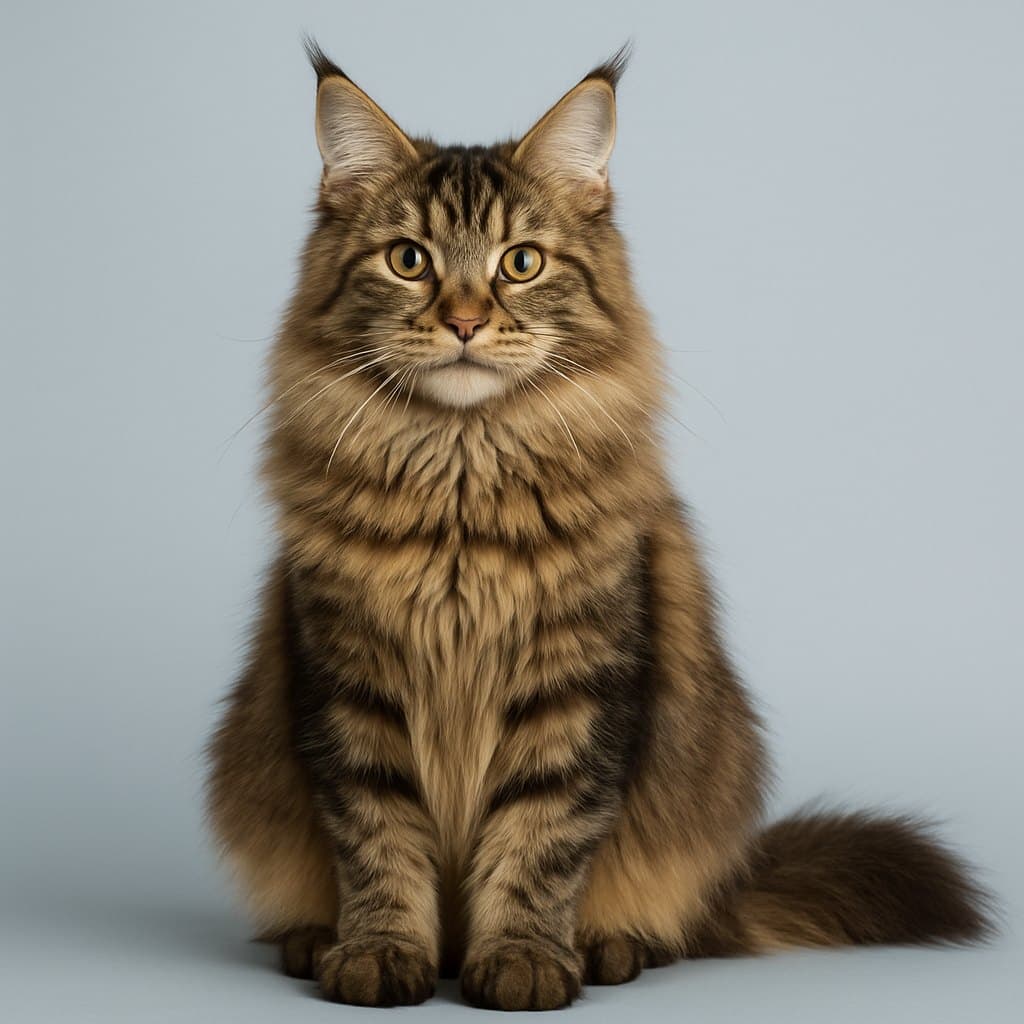
Semi-long double coat
- Shedding3 / 5
Is a Maine Coon good with children and other pets?
Maine Coons adapt to apartment living when you supply vertical perches, scratching units, and interactive play. Their non-confrontational nature supports living with other cats and friendly dogs.
- With children5 / 5
- With other pets5 / 5
- In an apartment4 / 5
Is a Maine Coon easy to train?
Maine Coons pick up basic cues such as sit, come, and high five. Many individuals naturally play games of fetch.
- Ease of training4 / 5
What does a Maine Coon eat at each life stage?
- KittenProvide nutrient-dense kitten food rich in quality animal protein, taurine, and DHA/EPA to support long musculoskeletal growth up to 18 months of age.
- AdultOffer a balanced maintenance diet high in lean animal protein and low in fillers, using large-breed kibble to encourage chewing and avoid extra weight on joints.
- SeniorFeed easily digestible proteins to preserve muscle mass, incorporate omega-3 fatty acids for joint and kidney function, and supply wet food to boost hydration.
Where does the Maine Coon come from?
The Maine Coon developed as a natural working landrace in Maine, where it served as a barn mouser and ship's ratter. A female named Cosey won Best in Show at America's first major cat show at Madison Square Garden in 1895. The Central Maine Cat Club formed in the 1950s to create breed standards and revive the breed after numbers dropped. The Cat Fanciers' Association granted championship status in 1976, and Maine named it the official State Cat in 1985.
Country of origin: United States.
[S1][S2][S5][S6][S7]Fun facts about the Maine Coon
- A Maine Coon named Barivel measured 120 cm in 2018, securing the Guinness World Record for the longest domestic cat. [S36]
- A Maine Coon named Cygnus Regulus Powers set the Guinness World Record for the longest tail on a domestic cat at 44.66 cm in 2016. [S37]
- Maine Coons often play in running water, paw at water bowls, and join owners near showers due to their water-resistant coats. [S9]
- Historically, up to 40 percent of native Maine Coons possessed extra toes that acted as natural snowshoes in deep winter snow. [S21][S37]
- The Maine Coon took top honors at North America's first major cat exhibition in 1895, making it America's first native show cat. [S5][S27]
Tips by life stage and weather
- KittenSelect wide-based, reinforced cat trees so your growing kitten can climb safely as body mass increases.
- KittenBegin weekly comb and slicker brush routines early so your kitten accepts regular coat care.
- AdultSchedule two to three 10-minute interactive play sessions every day to keep your adult cat active and prevent excess weight.
- AdultProvide heavy, wide scratching posts that allow your cat to stretch its entire body length without tipping the post.
- SeniorPlace step ramps near elevated beds and lounging perches to ease joint impact during climbing.
- SeniorOffer wet food at regular intervals to maintain hydration and protect aging kidneys.
- Hot seasonKeep your cat inside air-conditioned rooms and supply multiple shaded resting spots during hot Mexican afternoons.
- Hot seasonDistribute multiple fresh water bowls throughout your home to protect your cat from heat stress.
- Cold seasonPosition comfortable sleeping beds away from drafty exterior doors during cold winter nights.
- Cold seasonUse a stainless steel comb during winter to clear dense undercoat fur and stop tangles before they mat.
- Rainy seasonDry your cat's long belly fur and britches with a towel if your pet steps onto wet patio areas.
- Rainy seasonBrush the coat frequently during humid rainy weeks to clear trapped moisture and loose undercoat.
In the Kiba Vet app, your pet's breed profile shows a tip of the day based on its age and the weather where you live.
This is general guidance. Always ask your vet.
Checked against sources; veterinary review pending. Updated on September 29, 2026.
Written with the help of AI from the cited sources and checked fact by fact against them by a second model.
Sources
Every health fact and every number on this page comes from these sources. Identifiers from Wikidata (CC0).
- S1 Maine Coon - Wikipedia
- S2 Maine Coon Cat Breed - Size, Facts and Traits | Hill's Pet UK
- S4 Maine Coon | VCA Animal Hospitals
- S5 Maine Coon Cat Article - The Cat Fanciers' Association
- S6 Maine Coon History: Myths, Facts and Breed Recognition
- S7 Maine Coon History | Discover Their Origins — Artemis Moon Coons
- S8 Maine Coon Size: Weight Charts, Height, and Growth Timeline
- S9 The Maine Coon Breed Standard: Everything You Need to
- S10 Maine Coon Cat Size: Info, Pictures & Height Comparison Chart (Vet-Verified) — Catster
- S11 How Big Do Maine Coon Cats Actually Get? Size Guide
- S12 Maine Coon Cat: A Complete Breed Profile | WHISKAS® UK
- S13 Maine Coon Lifespan: How Long Do Maine Coons Live?
- S14 Maine Coon Lifespan: How Long Do They Live?
- S16 rvc.ac.uk
- S17 The average cat lives 11.74 years, according to new research
- S18 fanpage.it
- S19 Maine Coon Cat Breed Information | Maine Coon Cat Characteristics, Grooming, Temperament Breed Information & Insights | Basepaws
- S20 Maine Coon Breed: Characteristics, Care & Photos | Chewy
- S21 Maine Coon Cat Breed Health and Care | PetMD
- S22 burgesspetcare.com
- S23 How Much Exercise Does A Maine Coon Need? Daily Activity Guide – Maine Coon Central
- S24 Common Maine Coon Health Issues and How to Prevent Them
- S25 Maine Coon Cat Hypertrophic Cardiomyopathy (HCM) | Veterinary Hospital
- S26 Common Genetic Disorders of Dogs and Cats - TUFTSBG2007 - VIN
- S27 The Origin & Evolution of the Maine Coon Cat — Lake View Maine Coons
- S28 Hip Dysplasia in Maine Coon Cats
- S29 Hip dysplasia in Maine Coon cats - EveryCat Health Foundation
- S30 Maine Coon Health Testing | Responsible Breeder Guide | LMCoonCat
- S31 Common Maine Coon Health Problems: Diseases They Are Prone To and Resistant To
- S32 Maine Coon | Royal Canin NZ
- S33 Maine Coon Diet and Feeding Guide: Portions, Life Stages & Nutrition
- S34 purina.com
- S35 Maine Coon | Royal Canin AU
- S36 5 cool facts about Maine Coons
- S37 trupanion.com