
This is general guidance. Always ask your vet.
How big does a Miniature Pinscher get?
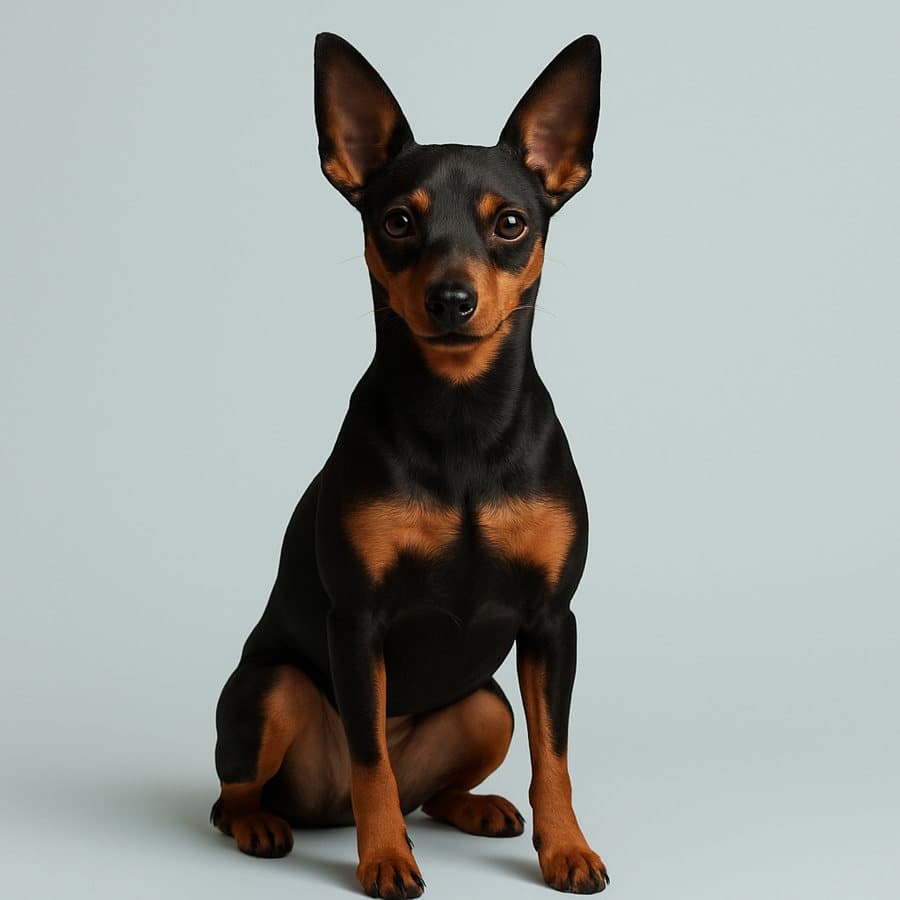
An adult Miniature Pinscher weighs 3.6 to 6 kg and stands 25 to 31.8 cm at the withers.
FCI Standard No. 185 designates a height of 25 to 30 cm and weight of 4 to 6 kg for both sexes. The AKC standard outlines a height range of 25.4 to 31.8 cm and a typical weight of 3.6 to 4.5 kg.
[S1][S7][S11]How long does a Miniature Pinscher live?
A Miniature Pinscher lives 12 to 16 years.
Major kennel clubs cite an expected lifespan of 12 to 16 years, with peer-reviewed population studies recording a median age of 13.7 years.
[S11][S12][S13][S14][S15][S16]What health problems are common in the Miniature Pinscher?
The most common in the Miniature Pinscher are: Patellar Luxation, Legg-Calve-Perthes Disease, Eye Disorders (PRA and Hereditary Cataracts), Mucopolysaccharidosis (MPS VI).
Patellar Luxation [S6][S25][S26][S27]
The kneecap slips out of its normal anatomical groove. This movement causes intermittent skipping or hindlimb lameness.
Ask your vet about:
- Physical joint palpation to grade laxity
- OFA patellar evaluation at or after 12 months
Legg-Calve-Perthes Disease [S27][S28][S29]
Blood supply to the femoral head declines, leading to bone death in the hip joint. The condition generates pain and progressive stiffness in the hind leg.
Ask your vet about:
- Extended ventrodorsal pelvic radiographs
- OFA Legg-Calve-Perthes evaluation
Eye Disorders (PRA and Hereditary Cataracts) [S30][S31][S32]
Genetic conditions cause retinal degradation or lens opacification. These progressive changes lead to gradual loss of visual acuity.
Ask your vet about:
- Annual ACVO ophthalmologist eye exam
- DNA screening tests for known retinal mutations
Mucopolysaccharidosis (MPS VI) [S23][S33][S34][S35]
A genetic metabolic storage disease impedes cellular function. Affected dogs exhibit severe systemic and skeletal abnormalities.
Ask your vet about:
- DNA mutation screening via blood or cheek swab
- OFA-recognized laboratory testing
What is a Miniature Pinscher's temperament like?
The Miniature Pinscher is fearless, spirited, and alert with an assertive demeanor. The dog attaches loyally to immediate household members while maintaining a watchful wariness toward unfamiliar people.
[S2][S4][S5][S6][S9][S11][S16][S17]How much exercise does a Miniature Pinscher need?
A Miniature Pinscher needs 30 to 60 minutes of exercise a day.
Active daily exercise such as brisk leash walks combined with fetch or agility fulfills their athletic drive. Puzzle toys and secure fencing keep this inquisitive breed safe and mentally satisfied.
- Energy4 / 5
How does a Miniature Pinscher handle heat and cold?
Lacking an undercoat and insulating body fat, these dogs chill rapidly in cold weather and require protective clothing. They handle warm temperatures with greater ease, though intense sun can cause them to overheat.
- Handles heat3 / 5
- Handles cold1 / 5
How much does a Miniature Pinscher shed, and how do you groom it?
Weekly brushing with a soft bristle brush or hound mitt clears loose hair and preserves natural gloss. Regular nail trimming, ear inspections, and consistent dental cleaning complete the grooming routine.
Short, smooth, hard, and lustrous with no undercoat
- Shedding2 / 5
Is a Miniature Pinscher good with children and other pets?
Their small stature suits apartment homes when given adequate exercise, though vocal alerting requires consistent training. They fare best around older children who treat them gently, while their sharp predatory instincts require caution near small animals.
- With children3 / 5
- With other pets2 / 5
- In an apartment4 / 5
Is a Miniature Pinscher easy to train?
The breed learns quickly through high intelligence, paired with an independent mindset. Positive reinforcement with praise and treats yields positive results, and early socialization reduces reactive barking.
- Ease of training3 / 5
What does a Miniature Pinscher eat at each life stage?
- PuppyOffer a balanced commercial toy-breed puppy recipe with appropriate calorie density. Feed tiny-sized kibble divided across 3 to 4 daily meals to protect your pup from juvenile hypoglycemia.
- AdultFeed a measured diet of adult small-breed maintenance food containing balanced proteins and fats. Maintain strict portion control to keep excess weight off fine bones, hips, and patellas.
- SeniorProvide a small-breed senior formula with lower energy density to match a slowing metabolic rate. Select foods enriched with omega-3 fatty acids to help support joint mobility.
Where does the Miniature Pinscher come from?
Developed centuries ago to control vermin in German homes and barns, the breed evolved through crosses of the German Pinscher, Italian Greyhound, and Dachshund. The dog predates the Doberman Pinscher by decades, gained widespread popularity by the early 20th century, and received definitive FCI acceptance in 1955.
Country of origin: Germany.
[S1][S2][S3][S4][S5][S6][S7][S8][S9][S10]Fun facts about the Miniature Pinscher
- The breed holds the historic moniker "King of Toys" because of its bold, confident, and regal attitude. [S2][S4]
- Min Pins display a distinctive "hackney gait" where they lift their front feet high, resembling a carriage horse. [S6][S9][S11]
- Despite looking like a tiny Doberman Pinscher, historical records prove the Miniature Pinscher is an older breed developed decades earlier. [S4][S5][S6]
- They possess an ability to scale heights, squeeze through narrow gaps, and navigate door latches to wander outside. [S6][S19]
- The FCI places the Miniature Pinscher in Group 2 alongside large pinschers and molossoid breeds rather than in the Toy Group. [S8][S10][S19]
Tips by life stage and weather
- PuppyDistribute your puppy's meals into 3 to 4 scheduled feedings each day to maintain stable energy levels.
- PuppyExpose your young dog to varied sights and sounds early to reduce territorial barking toward unfamiliar humans.
- AdultProvide daily interactive exercise such as fetch, agility games, and scent puzzles to fulfill energy needs.
- AdultPerform weekly brushing using a soft bristle brush or hound mitt while checking ears and teeth regularly.
- SeniorSchedule regular veterinary checkups to monitor joint health and screen the mobility of knees and hips.
- SeniorFeed controlled portions of senior food with lower caloric density to prevent strain on aging bones.
- Hot seasonWalk your dog during early morning or evening hours to protect its compact body from rapid heat accumulation.
- Hot seasonProvide constant access to cool shade and fresh drinking water during outdoor play on sunny afternoons.
- Cold seasonDress your dog in a warm sweater or protective coat before stepping outdoors during chilly mornings.
- Cold seasonKeep outdoor exercise sessions brief when temperatures drop to shield its thin, single coat from hypothermia.
- Rainy seasonDry your dog thoroughly with a clean towel after every walk in damp conditions to prevent it from chilling.
- Rainy seasonDirect energy toward indoor scent mazes and basic trick training when heavy rain limits yard outings.
In the Kiba Vet app, your pet's breed profile shows a tip of the day based on its age and the weather where you live.
This is general guidance. Always ask your vet.
Checked against sources; veterinary review pending. Updated on September 29, 2026.
Written with the help of AI from the cited sources and checked fact by fact against them by a second model.
Sources
Every health fact and every number on this page comes from these sources. Identifiers from Wikidata (CC0).
- S1 Miniature Pinscher - Wikipedia
- S2 Miniature Pinscher Profile: Behavior, Shedding, and Health | ASPCA Pet Health Insurance
- S3 petstock.co.nz
- S4 Miniature Pinscher - All About Dogs | Orvis
- S5 Miniature Pinscher Life Expectancy & 10 Things to Know | Lancaster Puppies
- S6 Miniature Pinscher supplements: a practical guide for the King of Toys
- S7 Miniature Pinscher Breed Guide & Pet Insurance Plan | Healthy Paws
- S8 fci.be
- S9 kusa.co.za
- S10 ZWERGPINSCHER
- S11 PPVC Breed Specific: The Determined Miniature Pinscher
- S12 How Long Do Miniature Pinschers Live? Lifespan & Longevity | VitaDog
- S13 Dog Lifespan Chart by Breed | 155 Breeds Compared
- S14 Dog Breed Lifespan Research: A UK Study from 2024
- S15 rvc.ac.uk
- S16 Miniature Pinscher Dog Breed Guide | BorrowMyDoggy
- S17 Miniature Pinscher standard – Kennel Be Pawsitive
- S18 Miniature Pinscher | Breed Guide | Scrumbles – Scrumbles: Natural Pet Food
- S19 showsightmagazine.com
- S20 Miniature Pinscher - Dog Breed Information Guide | Pro Plan
- S21 Miniature Pinscher Breed Guide | PupPilot
- S22 Miniature Pinscher | National Kennel Club
- S23 Miniature Pinscher Dogs Breed - Information, Temperament, Size & Price | Lancaster Puppies
- S24 Miniature Pinscher Breed Details | Waggles Puppy Boutique
- S25 Miniature Pinscher Lifespan - What to Expect & How to Help a Miniature Pinscher Live Longer - iHeartDogs.com
- S26 Miniature Pinschers: Traits, Care, Health Issues, and More
- S27 How To Interpret OFA Numbers | OFA
- S28 Legg-Calve-Perthes | OFA
- S29 Canine Legg-Calve-Perthes Disease & Breeds at Risk - LOST TEMPLE PETS: Guides, Fitness & Rehab
- S30 Dog Health Testing Before Breeding: OFA, CHIC & DNA Guide - Pair My Pet
- S31 Miniature Pinscher: All the Facts | MetLife Pet Insurance
- S32 OFA-CHIC Health Testing Requirements – Australian Cattle Dog Club of America
- S33 Disease Statistics by Breed | OFA
- S34 All Dna Tests - OFA
- S35 OUR DOGS
- S36 Miniature Pinscher Lifespan: How Long Do These Dogs Live? - A-Z Animals