
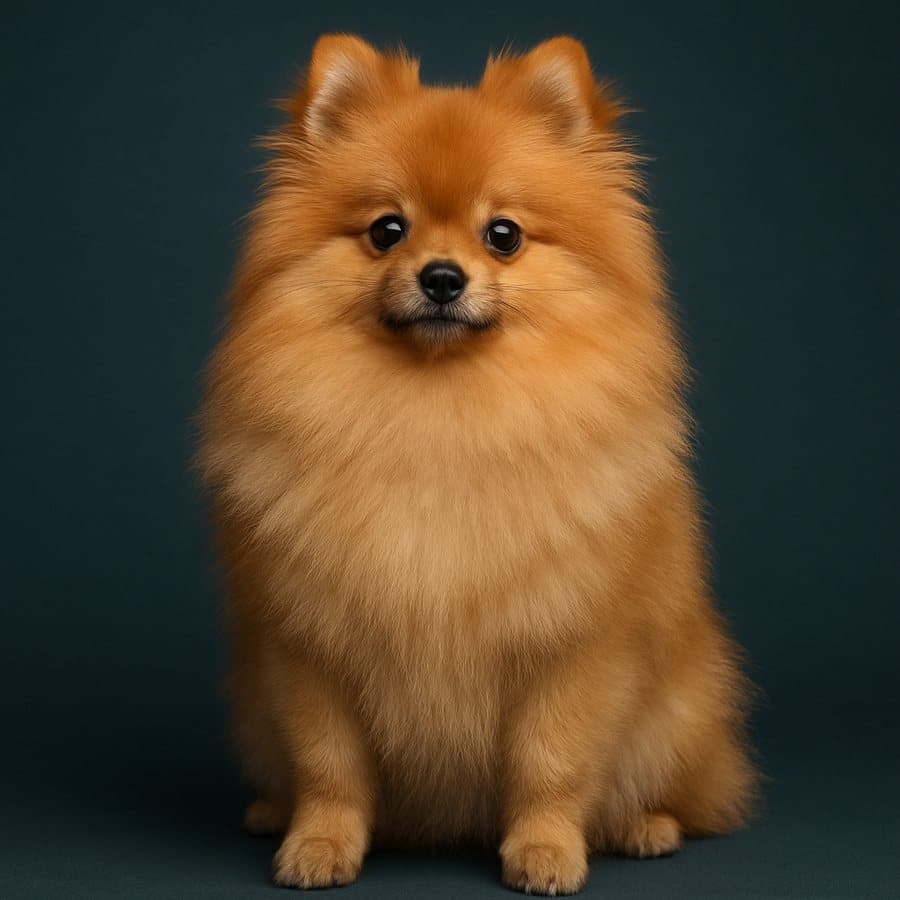
This is general guidance. Always ask your vet.
How big does a Pomeranian get?
An adult Pomeranian weighs 1.4 to 3.2 kg and stands 18 to 24 cm at the withers.
FCI standard No. 97 specifies an ideal height of 21 cm with a tolerance of 18 cm to 24 cm for both sexes. The AKC lists adult weights between 1.36 kg and 3.18 kg. The Kennel Club standard outlines ideal weights of 1.8 kg to 2.0 kg for males and 2.0 kg to 2.5 kg for females.
[S8][S9][S10]How long does a Pomeranian live?
A Pomeranian lives 12 to 16 years.
The breed standard cites longevity between 12 and 16 years. Large-scale cohort and veterinary primary-care records report median survival between 12 and 14 years.
[S11][S12][S13][S14][S15]What health problems are common in the Pomeranian?
The most common in the Pomeranian are: Patellar Luxation, Tracheal Collapse, Alopecia X, Periodontal Disease.
Patellar Luxation [S25][S26][S27]
A condition where the kneecap slips out of its normal anatomical groove.
Ask your vet about:
- Annual orthopedic physical palpation and grading
- OFA Patellar certification
- Stifle radiographs
Tracheal Collapse [S28][S29]
A progressive weakening and flattening of the tracheal cartilage rings that leads to airway narrowing.
Ask your vet about:
- Physical airway palpation
- Dynamic cervical and thoracic radiographs
- Fluoroscopy
- Tracheoscopy
What is a Pomeranian's temperament like?
Pomeranians are lively, cheerful, and devoted companions with curious minds. They display strong watchdog instincts and sound quick alarm barks when visitors approach.
[S3][S9][S16][S17][S18]How much exercise does a Pomeranian need?
A Pomeranian needs 30 to 45 minutes of exercise a day.
The breed requires moderate exercise through daily walks and indoor play. Cognitive activities such as canine puzzle toys and trick training help satisfy their mental energy.
- Energy3 / 5
How does a Pomeranian handle heat and cold?
Their dense double coat provides strong protection in cold weather. Their tolerance for high heat and humidity is poor, making them vulnerable to heat exhaustion.
- Handles heat2 / 5
- Handles cold4 / 5
How much does a Pomeranian shed, and how do you groom it?
Line-brush the coat down to the skin at least 2 to 3 times per week to prevent mats. Avoid close shaving down to the skin to protect hair follicles from post-clipping alopecia.
Double coat with a short soft undercoat and a harsh long outer coat
- Shedding3 / 5
Is a Pomeranian good with children and other pets?
Their size suits apartment living when alert barking is addressed. They live well with indoor cats and small dogs, but they require careful supervision around large dogs.
- With children3 / 5
- With other pets4 / 5
- In an apartment5 / 5
Is a Pomeranian easy to train?
Their high intelligence makes them quick to learn standard obedience commands. Early socialization helps reduce territorial alarm barking and wariness around novel stimuli.
- Ease of training4 / 5
What does a Pomeranian eat at each life stage?
- PuppyProvide calorie-dense commercial toy-breed puppy food with essential fatty acids. Offer frequent meals throughout the day to help prevent hypoglycemia.
- AdultOffer balanced adult toy-breed formulas shaped for small jaws. Manage daily portions strictly to avoid excess weight that strains knees and the windpipe.
- SeniorTransition to a senior toy-breed diet with moderated calories and digestible protein. Look for formulas containing joint-support nutrients like omega fatty acids and glucosamine.
Where does the Pomeranian come from?
The breed descended from ancient Arctic sled and pastoral spitz dogs of peat dog and lake dwelling lineages. It took its name from the historical Pomerania region located along the Baltic Sea in modern-day Poland and Germany. The American Kennel Club recognized the breed in 1888, and the FCI lists it as the Toy Spitz variety under standard No. 97.
Country of origin: Germany and Poland.
[S1][S2][S3][S4][S5][S6][S7]Fun facts about the Pomeranian
- Queen Victoria bred Pomeranians at Windsor and established the modern toy size after importing a small dog named Marco from Italy in 1888. [S21][S32][S33]
- Two Pomeranians survived the sinking of the RMS Titanic in 1912 alongside their owners in lifeboats. [S18][S21]
- Historical ancestors of the Pomeranian weighed between 9 kg and 14 kg and pulled sleds and herded livestock. [S3][S4][S18]
- The artist Michelangelo kept a pet Pomeranian with him while painting the Sistine Chapel ceiling. [S3]
- Composer Wolfgang Amadeus Mozart owned a Pomeranian named Pimperl and dedicated an aria to the pet. [S3]
- The Pomeranian displays a wide variety of accepted coat colors and patterns, including orange, cream, red, black, sable, merle, and parti-color. [S9][S18][S34]
Tips by life stage and weather
- PuppyDistribute food across multiple scheduled meals each day to help stabilize blood sugar levels in your young puppy.
- PuppyExpose your puppy to friendly visitors and varied sounds early to manage protective alert barking.
- AdultProvide puzzle toys and interactive scent games daily to exercise your dog's active mind indoors.
- AdultBrush your dog down to the skin two to three times weekly to keep the dense undercoat free of mats.
- SeniorBlock access to high couches and beds to stop your senior dog from jumping and injuring joints.
- SeniorSchedule regular veterinary oral examinations to detect dental crowding and periodontal changes.
- Hot seasonKeep your dog indoors in air-conditioned spaces during peak hot daytime hours to prevent heat exhaustion.
- Hot seasonPreserve the natural coat length and avoid shaving down to the skin to protect follicles and skin health.
- Cold seasonTake advantage of your dog's natural double coat for outdoor walks during cooler weather.
- Cold seasonEnsure your dog stays dry after outdoor exposure so the thick undercoat continues insulating efficiently.
- Rainy seasonExercise your dog inside with indoor play sessions when heavy storms make outdoor walks difficult.
- Rainy seasonLine-brush the coat thoroughly after rain exposure to stop wet underfur from developing dense mats.
In the Kiba Vet app, your pet's breed profile shows a tip of the day based on its age and the weather where you live.
This is general guidance. Always ask your vet.
Checked against sources; veterinary review pending. Updated on September 29, 2026.
Written with the help of AI from the cited sources and checked fact by fact against them by a second model.
Sources
Every health fact and every number on this page comes from these sources. Identifiers from Wikidata (CC0).
- S1 fci.be
- S2 Standard FCI of the Pomerania (Spitz German) | Can Xiu-Xiu The Prat of Llobregat
- S3 10 Fun Facts About Pomeranians
- S4 About Pomeranians
- S5 Pomeranian dog - Wikipedia
- S6 Pomeranians and Their Popularity in the 19th Century - geriwalton.com
- S7 DEUTSCHER SPITZ
- S8 Pomeranian Size Guide: Weight, Height, Growth and Breed Standards - Pomeranian Headquarters
- S9 VESPER® — Standard (AKC) | Pomeranian Breed Preservation
- S10 ALL ABOUT POMERANIAN - Pomeranian Beauty
- S11 Your Guide to the Typical Pomeranian Lifespan and Pom Care – Native Pet
- S12 Dog Breed Lifespan Research: A UK Study from 2024
- S13 Aging in dogs - Wikipedia
- S14 Dog Age Calculator
- S15 Dog Lifespan Chart by Breed & Size | 50+ Breeds Compared (2026)
- S16 FCI Standard German Spitz/Pomeranian - Pom Of The Gang
- S17 10 Amazing Facts About Pomeranians You Probably Didn't Know
- S18 13 Cool Facts About Pomeranians
- S19 Pomeranian Breed Description - Florida Fur Babies
- S20 How Long Do Pomeranians Live? Lifespan & Care – La Petite Labs
- S21 9 facts about Pomeranians
- S22 Tracheal collapse | Cornell University College of Veterinary Medicine
- S23 Diagnosing Alopecia X in a Pomeranian
- S24 Pomeranian Life Span Information
- S25 Common Pomeranian Health Problems: Diseases They Are Prone To and Resistant To
- S26 Education - EDENCROFT POMERANIANS
- S27 zubairkhalid.com
- S28 Tracheal Collapse in Dogs | VCA Animal Hospitals
- S29 Understanding Tracheal Collapse in Pomeranians | Peqaboo
- S30 Pomeranian Health Issues: Explained
- S31 How Long Do Pomeranians Live? Vet-Verified Average Lifespan, Data & Care — Dogster
- S32 Breed History - EDENCROFT POMERANIANS
- S33 delpoms.com
- S34 Pomeranian | Breed Standards | The Kennel Club