
This is general guidance. Always ask your vet.
How big does a Pug get?
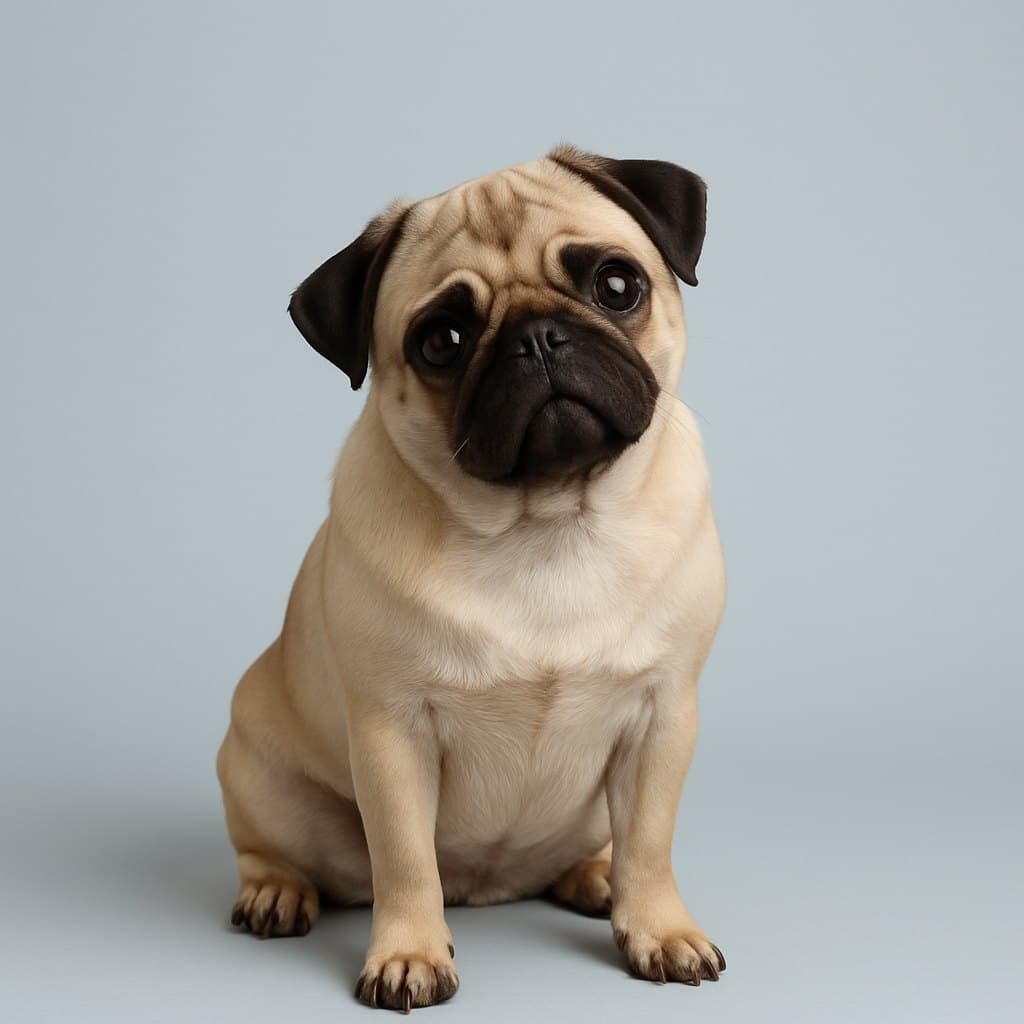
An adult Pug weighs 6.3 to 8.2 kg and stands 25.4 to 33 cm at the withers.
Both major kennel standards list weight ranges covering both sexes without distinction. Height standards are provided by the AKC breed profile and club guidelines rather than the official written standards.
[S7][S8][S9][S10]How long does a Pug live?
A Pug lives 7.7 to 15 years.
Kennel club profiles list general life expectancies up to 13 to 15 years, while veterinary population studies record lower median lifespans between 7.7 and 11.6 years.
[S10][S11][S12][S13][S14][S15][S16]What health problems are common in the Pug?
The most common in the Pug are: Brachycephalic Obstructive Airway Syndrome (BOAS), Pug Dog Encephalitis (PDE) / Necrotizing Meningoencephalitis (NME), Patellar Luxation, Hip Dysplasia, Spinal Malformations (Hemivertebrae & Pug Myelopathy), Corneal Ulceration & Pigmentary Keratopathy.
Brachycephalic Obstructive Airway Syndrome (BOAS) [S18][S23][S25]
Upper airway malformations restrict normal airflow and cause labored breathing.
Ask your vet about:
- Respiratory Function Grading Scheme (RFGS) test
- Physical upper-airway inspection
- Head and chest radiographs
Pug Dog Encephalitis (PDE) / Necrotizing Meningoencephalitis (NME) [S25][S26]
An inflammatory disease of the central nervous system that affects brain tissue.
Ask your vet about:
- OFA DNA marker test for PDE susceptibility
- Brain MRI imaging
- Cerebrospinal fluid (CSF) analysis
Patellar Luxation [S18][S25][S26][S27]
The kneecap slips out of its normal anatomical groove during movement.
Ask your vet about:
- OFA physical patella palpation exam after 12 months
Hip Dysplasia [S18][S25][S28]
Abnormal joint development in the hips leads to wear, looseness, and arthritis.
Ask your vet about:
- OFA pelvic radiographic evaluation after 24 months
Spinal Malformations (Hemivertebrae & Pug Myelopathy) [S16][S18][S25][S28]
Deformed vertebrae or chronic spinal cord compression cause movement problems.
Ask your vet about:
- Spinal radiographs
- Computed tomography (CT) scan
- Spinal MRI
What is a Pug's temperament like?
Pugs are affectionate, even-tempered companions that thrive on regular human presence. They combine playful charm with quiet dignity in a sturdy frame.
[S1][S9][S17][S18][S19]How much exercise does a Pug need?
A Pug needs 20 to 30 minutes of exercise a day.
Controlled gentle walking split into brief outings helps maintain healthy weight without straining airways. Mental games and puzzle feeders offer safe indoor stimulation.
- Energy2 / 5
How does a Pug handle heat and cold?
Compressed airways prevent efficient cooling through panting, making warm temperatures dangerous. Short coats provide limited insulation against freezing weather.
- Handles heat1 / 5
- Handles cold2 / 5
How much does a Pug shed, and how do you groom it?
Regular brushing with a rubber curry brush removes loose fur. Facial skin folds must be cleaned with a damp cloth or pet wipe and dried thoroughly to prevent dermatitis.
Short, fine, smooth, and glossy
- Shedding5 / 5
Is a Pug good with children and other pets?
Their small size and low barking make them great apartment dogs. They live well with cats and other dogs, though play with large dogs requires supervision to protect their eyes.
- With children4 / 5
- With other pets5 / 5
- In an apartment5 / 5
Is a Pug easy to train?
Positive reinforcement using treats and praise yields good results. Punitive corrections can cause avoidance, while early crate acclimation reduces separation distress.
- Ease of training3 / 5
What does a Pug eat at each life stage?
- PuppyChoose a high-grade puppy diet for small breeds to support controlled growth without excessive weight gain. Serve food in wide, shallow dishes to minimize air swallowing.
- AdultOffer a portion-controlled adult maintenance kibble with digestible proteins and moderate fat to prevent obesity. Slow-feeder bowls help manage eating pace.
- SeniorFeed a lower-calorie, high-fiber senior recipe to balance a slower metabolic rate and protect joints. Consult your vet to adjust rations as activity decreases.
Where does the Pug come from?
Ancient Chinese courts bred flat-faced lapdogs for emperors before 400 BCE, and Buddhist monasteries in Tibet also kept their ancestors. Dutch traders transported the breed to Europe in the 16th century, and the dogs later reached England in 1688 with William III and Mary II.
Country of origin: China.
[S1][S2][S3][S4][S5][S6]Fun facts about the Pug
- In 1572, a Pug named Pompey saved William the Silent from assassins by scratching and barking inside his military tent. [S4][S6][S30]
- A group of two or more Pugs is traditionally called a grumble. [S31][S32]
- Imperial Chinese breeders aimed to produce forehead wrinkles resembling the Chinese character for prince. [S3][S4][S32]
- Empress Joséphine Bonaparte hid secret messages beneath her Pug's collar while held in prison. [S4][S6]
- Breed standards value a curled tail, considering a double curl the visual ideal. [S7][S32][S34]
Tips by life stage and weather
- PuppyTeach young children how to handle the puppy gently to protect protruding eyes from accidental injury.
- PuppyStart crate desensitization and brief periods of alone time early to foster independence.
- AdultInspect and clean facial skin folds weekly with a damp cloth, drying them completely afterwards.
- AdultProvide 20 to 30 minutes of low-impact walking divided into short intervals to curb weight gain.
- SeniorSwitch to indoor puzzle toys to keep mental alertness high without tiring the respiratory system.
- SeniorSchedule regular veterinary assessments to evaluate mobility, spine health, and breathing changes.
- Hot seasonKeep your dog indoors in air-conditioned spaces during peak daylight temperatures to avoid heatstroke.
- Hot seasonWatch for noisy breathing, panting, or discolored gums, seeking veterinary care immediately if seen.
- Cold seasonDress your dog in a fitted sweater or coat during cold weather to compensate for their short fur.
- Cold seasonKeep outdoor cold-weather walks brief to maintain body warmth and avoid unnecessary strain.
- Rainy seasonDry your dog thoroughly with a towel after wet walks, paying extra attention to facial folds and ears.
- Rainy seasonReplace rainy outdoor exercise sessions with indoor obedience training or food puzzle games.
In the Kiba Vet app, your pet's breed profile shows a tip of the day based on its age and the weather where you live.
This is general guidance. Always ask your vet.
Checked against sources; veterinary review pending. Updated on September 29, 2026.
Written with the help of AI from the cited sources and checked fact by fact against them by a second model.
Sources
Every health fact and every number on this page comes from these sources. Identifiers from Wikidata (CC0).
- S1 fci.be
- S2 Pug - All About Dogs | Orvis
- S3 Facts About the Pug That You May Not Know
- S4 Fun Facts About Pugs
- S5 PUG
- S6 Meet the Pug – Pug Dog Club of Greater New York
- S7 kusa.co.za
- S8 Pug | Breed Standards | The Kennel Club
- S9 akc.org
- S10 Services — Pug Dog Club of America
- S11 New research calculates a dog’s life expectancy - ARU
- S12 Dog Breed Lifespan Research: A UK Study from 2024
- S13 Flat-faced dogs ‘have 40% higher risk of shorter lives than other breeds’ | The National
- S14 rvc.ac.uk
- S15 New research aids in understanding of the canine life expectancy | dvm360
- S16 Demography and Causes of Mortality of Pugs Under Primary Veterinary Care in Australia - PMC
- S17 akc.org
- S18 Pug | VCA Animal Hospitals
- S19 Chug Dog Breed Guide: Care, Health & Size Breed Information & Insights | Basepaws
- S20 Teacup Pug: Info, Pictures, Temperament & Traits | Hepper Pet Resources
- S21 Pug | VCA Animal Hospitals
- S22 How Long Do Pugs Live? Lifespan & Health Issues – Bully Crew CBD
- S23 Brachycephalic Dog Lifespan: BOAS, Heat & Senior Care – La Petite Labs
- S24 pawlicy.com
- S25 Services — Pug Dog Club of America
- S26 Pug Lifespan & Hereditary Health: Essential Testing Guide | Lancaster Puppies
- S27 Brenich Pugs -- Home
- S28 pugclubofcanada.ca
- S29 How Will You Know When It's Time to Euthanize Your Dog? 5 Caring, Heartfelt Messages - Dr. Buzby's ToeGrips for Dogs
- S30 Urban Hounds: Pug History-William the Silent and Pompey
- S31 12 Fun Facts About Pugs
- S32 Fun Facts About Pugs–Fun Facts Daily – Apple Podcasts
- S34 Fact Sheet Dog Breed Pug - QUEN Qualzucht-Database