
This is general guidance. Always ask your vet.
How big does a Ragdoll get?
An adult Ragdoll weighs 4.5 to 9.1 kg.
Ragdolls mature slowly and require three to four years to achieve full bone structure and adult body weight.
[S3][S4]How long does a Ragdoll live?
A Ragdoll lives 12 to 17 years.
Indoor Ragdolls typically live between 12 and 17 years, with feline population baselines showing medians around 12 to 14 years.
[S5][S6]What health problems are common in the Ragdoll?
The most common in the Ragdoll are: Hypertrophic Cardiomyopathy (HCM), Polycystic Kidney Disease (PKD), Feline Lower Urinary Tract Disease (FLUTD) / Urolithiasis, Obesity and Secondary Osteoarthritis.
Hypertrophic Cardiomyopathy (HCM) [S13][S14][S17]
This condition causes abnormal thickening of the heart muscle walls.
Ask your vet about:
- DNA test for the MYBPC3 R820W mutation
- Annual transthoracic echocardiography by a veterinary cardiologist
- OFA cardiac database screening
Polycystic Kidney Disease (PKD) [S15]
Fluid-filled cysts form in the kidneys and can alter normal renal function over time.
Ask your vet about:
- DNA test for the feline PKD1 mutation
- High-resolution renal ultrasound
Feline Lower Urinary Tract Disease (FLUTD) / Urolithiasis [S16]
This condition involves inflammation or the formation of stones inside the urinary bladder and urethra.
Ask your vet about:
- Complete urinalysis
- Urine culture
- Abdominal radiography
- Bladder ultrasonography
What is a Ragdoll's temperament like?
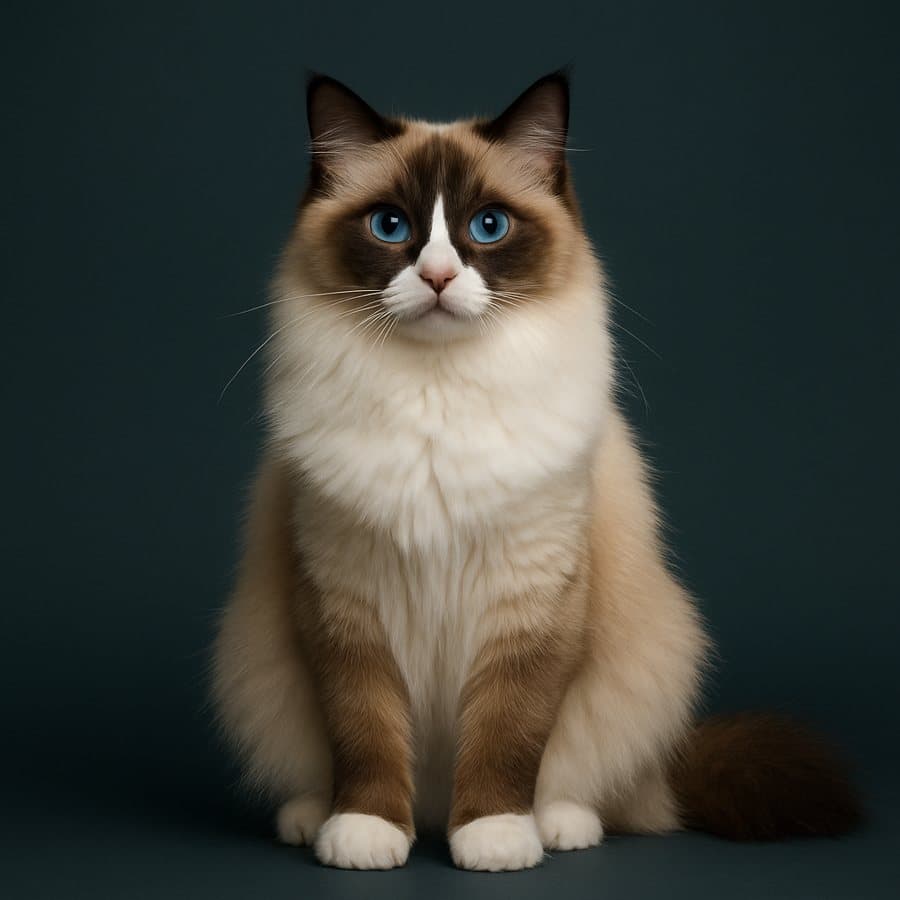
The Ragdoll is docile, gentle, and trusting. It relaxes its muscles when lifted and stays close to its human family.
[S1][S7][S8][S9]How much exercise does a Ragdoll need?
A Ragdoll needs 15 to 30 minutes of exercise a day.
Ragdolls have low-to-moderate energy and spend much of the day resting. They prefer floor-level play, short interactive sessions, and low perches.
- Energy2 / 5
How does a Ragdoll handle heat and cold?
Because the single-layer coat lacks a dense, insulating undercoat, Ragdolls have limited cold tolerance and live exclusively indoors.
- Handles heat3 / 5
- Handles cold2 / 5
How much does a Ragdoll shed, and how do you groom it?
Comb the coat one to two times weekly with a steel greyhound comb, focusing on friction areas under the legs, armpits, and groin.
Semi-long, plush, and silky with minimal undercoat
- Shedding3 / 5
Is a Ragdoll good with children and other pets?
Ragdolls adapt smoothly to apartments and multi-pet homes. Children must handle them gently and avoid dragging their relaxed bodies.
- With children5 / 5
- With other pets5 / 5
- In an apartment5 / 5
Is a Ragdoll easy to train?
Many Ragdolls learn to play fetch, retrieve small toys, and respond to their names on recall.
- Ease of training4 / 5
What does a Ragdoll eat at each life stage?
- KittenOffer calorie-dense, high-protein growth diets to fuel prolonged skeletal development, adjusting intake across early years to prevent excess fat accumulation as bones finish setting.
- AdultProvide portion-controlled, moisture-rich wet or mixed meals with controlled calories to counter low activity levels and maintain a healthy weight.
- SeniorSelect diets with easily digestible proteins, controlled phosphorus to support kidney function, and omega-3 fatty acids for joint health.
Where does the Ragdoll come from?
Ann Baker developed the Ragdoll during the 1960s in Riverside, California. She founded the breed using a white domestic longhair dam named Josephine. The International Cat Association recognized the breed in 1979, and the Cat Fanciers' Association granted championship status in 2000.
Country of origin: United States.
[S1][S2]Fun facts about the Ragdoll
- Ragdoll kittens are born completely white due to a temperature-sensitive gene, developing color points only after birth. [S7][S20]
- The coat requires two to three years to develop its final adult pigmentation and full markings. [S7]
- Show standards require all pointed Ragdolls to possess distinctly blue, oval eyes. [S7][S12]
- Ragdolls earned the nickname puppy-cats because they follow their owners from room to room. [S1][S8]
Tips by life stage and weather
- KittenProvide low scratching posts and low climbing options to safeguard growing joints during the extended growth period.
- KittenTeach children and family members how to support the chest and hindquarters fully whenever lifting your kitten.
- AdultSchedule 15 to 30 minutes of interactive wand play each day to maintain lean muscle mass.
- AdultComb friction zones behind the legs and under the armpits twice a week using a steel comb.
- SeniorKeep food bowls, water dishes, and low-sided litter boxes easily accessible on floor level.
- SeniorAsk your vet to monitor renal blood markers and body weight during routine senior wellness checkups.
- Hot seasonMaintain cool indoor airflow with fans or air conditioning during hot Mexican dry seasons.
- Hot seasonProvide multiple freshwater stations throughout the home to encourage moisture intake during high heat.
- Cold seasonKeep your cat indoors away from cold drafts, as the coat lacks an insulating undercoat.
- Cold seasonOffer plush, raised bedding in warm indoor areas to help your cat conserve body heat during chilly nights.
- Rainy seasonKeep your cat inside your home during storms to prevent exposure to dampness and sudden temperature drops.
- Rainy seasonUse indoor treat puzzles and interactive floor toys to keep activity steady when weather confines everyone indoors.
In the Kiba Vet app, your pet's breed profile shows a tip of the day based on its age and the weather where you live.
This is general guidance. Always ask your vet.
Checked against sources; veterinary review pending. Updated on September 29, 2026.
Written with the help of AI from the cited sources and checked fact by fact against them by a second model.
Sources
Every health fact and every number on this page comes from these sources. Identifiers from Wikidata (CC0).
- S1 Ragdoll - Wikipedia
- S2 Ragdoll | VCA Animal Hospitals
- S3 Ragdoll Cat Size: Weight, Growth Chart & How Big
- S4 Ragdoll Cat Size Guide: Weight, Height & Growth Chart (2026)
- S5 Demography, common disorders, cause-specific mortality and life expectancy of Ragdoll cats under primary veterinary care during 2019 in the UK - PMC
- S6 Ragdoll Cat Lifespan: How Long Do Ragdolls Live?
- S7 Ragdoll Cat Breed : The Complete Guide - Pearl's Ragdolls
- S8 Ragdoll Cat Size: How Big Can They Get? Adult Size & Weight
- S9 Ragdoll breeders in Australia - breed guide | Perfect Pets
- S10 Ragdoll Cat: Giant, Floppy, and Prone to Heart Disease
- S11 Do Ragdoll Cats Shed? Coat Care and Grooming Guide
- S12 The Breed Standards
- S13 Ragdoll Cat Hypertrophic Cardiomyopathy (HCM) | Veterinary Hospital
- S14 ucdavis.edu
- S15 Health Concerns in the Ragdoll Breed — Ragdoll Kittens For Sale | Ragdoll Breeder
- S16 Heart Disease in Cats | VCA Animal Hospitals
- S17 Diseases in Dogs | OFA
- S18 Ragdoll Cat Lifespan and Common Health Concerns - Pet Releaf
- S19 Ragdoll Cat Grooming Tips for a Fluffy Coat
- S20 Ragdoll » Cat Breed Profile: Personality, Care, Pictures