
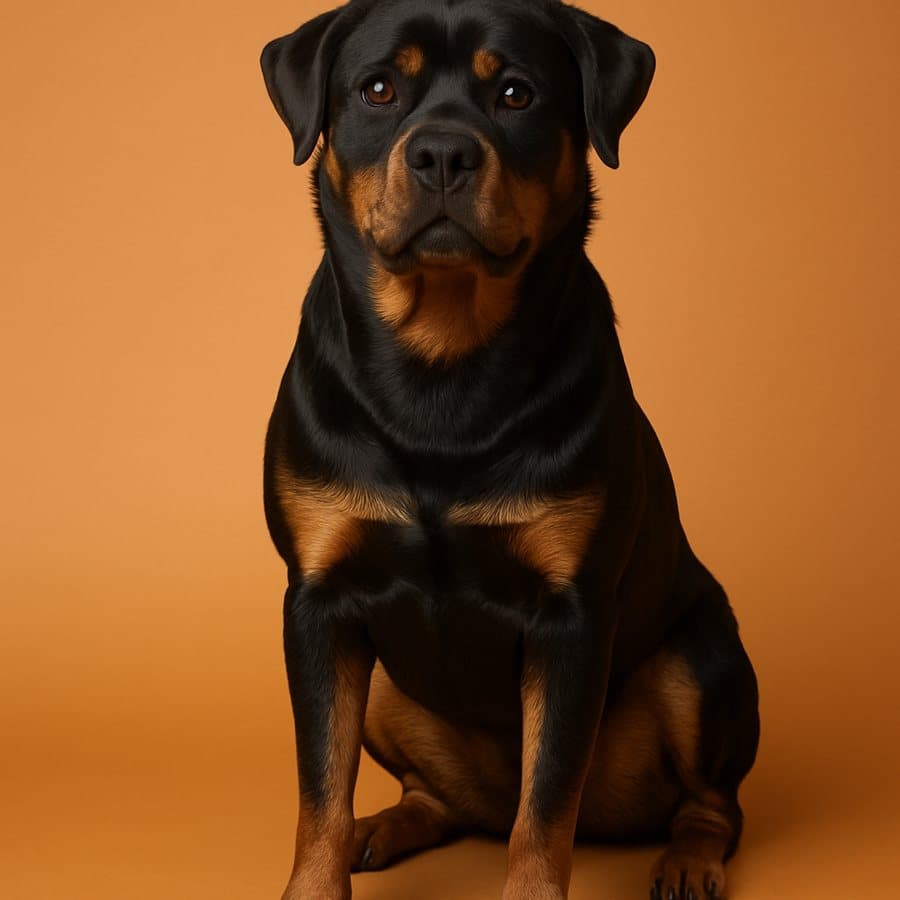
This is general guidance. Always ask your vet.
How big does a Rottweiler get?
An adult Rottweiler weighs 36 to 61 kg and stands 55.9 to 68.6 cm at the withers.
Under the FCI standard, males measure 61 to 68 cm with a weight around 50 kg, while females measure 56 to 63 cm with a weight around 42 kg. The AKC standard records shoulder heights of 60.96 to 68.58 cm for males and 55.88 to 63.5 cm for females, listing male weights of 43 to 61 kg and female weights of 36 to 45 kg.
[S7][S8][S9][S10][S11][S12]How long does a Rottweiler live?
A Rottweiler lives 9 to 10.6 years.
The AKC notes an expected lifespan of 9 to 10 years. Large-scale UK studies document median lifespans ranging from 9.0 to 10.6 years.
[S7][S13][S14]What health problems are common in the Rottweiler?
The most common in the Rottweiler are: Hip Dysplasia, Elbow Dysplasia, Subaortic Stenosis (SAS), Osteosarcoma (Bone Cancer), Gastric Dilatation-Volvulus (GDV / Bloat), Juvenile Laryngeal Paralysis & Polyneuropathy (JLPP), Cataracts, Entropion, and Ectropion.
Hip Dysplasia [S26]
This condition involves abnormal formation of the hip joints, which causes joint instability and pain.
Ask your vet about:
- OFA radiographic evaluation after 24 months of age
- PennHIP laxity testing starting from 16 weeks of age
Elbow Dysplasia [S26]
This developmental disorder affects the elbow joint and leads to lameness and joint deterioration.
Ask your vet about:
- OFA radiographic elbow evaluation after 24 months of age
- Veterinary CT scans to assess fragmented coronoid or ununited anconeal processes
Subaortic Stenosis (SAS) [S27][S28][S29]
This congenital heart disease features a fibrous ring below the aortic valve that obstructs normal blood outflow.
Ask your vet about:
- Veterinary cardiac auscultation to detect systolic left basilar murmurs
- Transthoracic echocardiogram with continuous-wave Doppler evaluation
- OFA Advanced Cardiac clearance at 24 months or older
Osteosarcoma (Bone Cancer) [S30][S31][S32]
This aggressive malignant bone tumor causes structural destruction and pain in canine limbs.
Ask your vet about:
- Limb radiographs to identify bone patterns
- Thoracic radiographs or CT scans for staging
- Bone biopsy or fine-needle aspirate
Gastric Dilatation-Volvulus (GDV / Bloat) [S33][S34]
This life-threatening condition occurs when the stomach fills with gas and twists on its axis.
Ask your vet about:
- Emergency abdominal radiography
- Pre-operative blood lactate evaluation
- Prophylactic gastropexy discussion
Juvenile Laryngeal Paralysis & Polyneuropathy (JLPP) [S35][S36]
This hereditary neurological disease paralyzes the laryngeal muscles and leads to weakness in the limbs.
Ask your vet about:
- DNA testing for the RAB3GAP1 gene mutation
Cataracts, Entropion, and Ectropion [S37]
These disorders encompass lens opacities as well as eyelid abnormalities that roll inward or outward.
Ask your vet about:
- Annual Canine Eye Registry examination by a veterinary ophthalmologist
What is a Rottweiler's temperament like?
The Rottweiler is a calm, confident, and devoted companion that displays strong protective drives and loyalty toward its family. It approaches strangers with self-assured aloofness and works with steady obedience.
[S1][S2][S7][S17][S18]How much exercise does a Rottweiler need?
A Rottweiler needs 60 to 120 minutes of exercise a day.
The breed needs between 60 and 120 minutes of daily exercise, including brisk walks, hiking, obedience routines, carting, or tracking, alongside puzzle tasks to engage its mind.
- Energy4 / 5
How does a Rottweiler handle heat and cold?
A dense undercoat gives the Rottweiler good insulation in cold conditions.
- Handles cold4 / 5
How much does a Rottweiler shed, and how do you groom it?
Weekly brushing with a rubber curry brush or medium-bristle brush removes loose hair, accompanied by weekly ear examinations, daily teeth brushing, and monthly nail trims.
Double coat with a coarse, flat outer layer and a dense undercoat on the neck and thighs
- Shedding3 / 5
Is a Rottweiler good with children and other pets?
Rottweilers interact gently with family children but require constant adult supervision due to their large size. They may show same-sex dog intolerance and high prey drive toward unfamiliar small pets. Apartment life requires rigorous daily physical exercise and mental tasks to prevent vocalization, separation anxiety, and territorial guarding.
- With children3 / 5
- With other pets2 / 5
- In an apartment2 / 5
Is a Rottweiler easy to train?
Rottweilers are highly intelligent and excel in canine sports, competitive obedience, tracking, and carting when trained with consistent positive reinforcement and clear rules established during puppyhood.
- Ease of training4 / 5
What does a Rottweiler eat at each life stage?
- AdultProvide complete and balanced large-breed maintenance food divided into at least two meals daily to support lean muscle and reduce bloat risks. Restrict strenuous physical exercise for one hour before and up to two hours after every meal.
- SeniorOffer diets featuring adjusted calories, lower fat content, and higher dietary fiber to accommodate a slower metabolic rate and lower activity.
Where does the Rottweiler come from?
Ancient Roman drover and mastiff-type dogs crossed with native working dogs in the southern German town of Rottweil. Local butchers bred these dogs to herd cattle, pull heavy meat carts, and guard earnings. The breed earned official recognition as a police service dog in 1910.
Country of origin: Germany.
[S1][S2][S3][S4]Fun facts about the Rottweiler
- Butchers originally called this dog the Metzgerhund because it pulled heavy meat wagons and drove livestock across town markets. [S1][S3]
- Ancient and medieval cattle drovers secured their money bags directly onto their Rottweilers' necks to protect their earnings from thieves. [S4]
- The town of Rottweil acquired its name from red tiles uncovered at ancient Roman villa ruins. [S1][S3]
- The German police and armed forces adopted the Rottweiler as one of their earliest official service dogs in the early 20th century. [S1][S2]
Tips by life stage and weather
- PuppySocialize your puppy between 8 and 16 weeks of age by introducing novel sounds, people, and environments.
- PuppyEstablish consistent house rules, firm leadership, and clear boundaries during early puppyhood to manage your dog's future physical strength.
- AdultSchedule 60 to 120 minutes of structured daily activity such as hiking, tracking, carting, or advanced obedience.
- AdultDivide your dog's daily ration into at least two separate meals and avoid vigorous exercise right before or after eating.
- SeniorConsult your vet about adjusting food calories and increasing dietary fiber to match your aging dog's slower metabolism.
- SeniorVisit your vet regularly for orthopedic checks and screenings to monitor joint comfort and bone health.
- Hot seasonWalk your dog during the coolest hours of the morning or late evening to prevent overheating.
- Hot seasonEnsure your dog always has access to cool shaded areas and fresh drinking water throughout the warmest parts of the day.
- Cold seasonRely on your dog's dense natural undercoat for insulation during cold weather walks.
- Cold seasonProvide dry, draft-free indoor sleeping quarters to protect joints as temperatures fall.
- Rainy seasonDry your dog's double coat thoroughly after rainy walks to prevent moisture retention in the dense undercoat.
- Rainy seasonInspect your dog's ears weekly during humid, wet seasons to keep them clean and dry.
In the Kiba Vet app, your pet's breed profile shows a tip of the day based on its age and the weather where you live.
This is general guidance. Always ask your vet.
Checked against sources; veterinary review pending. Updated on September 29, 2026.
Written with the help of AI from the cited sources and checked fact by fact against them by a second model.
Sources
Every health fact and every number on this page comes from these sources. Identifiers from Wikidata (CC0).
- S1 fci.be
- S2 Rottweiler Dog Breed: Size, Personality and More | Dog Food Advisor
- S3 Rottweiler - Wikipedia
- S4 Facts About the Rottweiler That You May Not Know
- S7 Rottweiler Dog Breed Information
- S8 International Federation of Rottweiler Friends
- S9 Standard
- S10 akc.org
- S11 pawlicy.com
- S12 Rottweiler Breed Standards Explained: AKC vs FCI Differences
- S13 Rottweiler Lifespan: How Long Do Rottweilers Live?
- S14 Rottweilers under primary veterinary care in the UK: demography, mortality and disorders - PMC
- S17 Rottweiler - Alchetron, The Free Social Encyclopedia
- S18 Rottweiler | VCA Animal Hospitals
- S19 Rottweiler Dog Breed: Health, Care, and Training | PetMD
- S20 Learn About the Powerful, Confident, and Courageous Rottweiler – American Kennel Club
- S21 How Long Do Rottweilers Live? Lifespan & Longevity | VitaDog
- S23 German Rottweiler Breed Stadnard for Sale WA, USA - King Rottweilers | King Rottweilers
- S24 Breed Info – Black Creek Veterinary Clinic
- S25 Rottweiler Breed Guide & Rottweiler Insurance | Healthy Paws
- S26 What Is OFA Certification for Rottweilers? Health Testing Every Buyer Should Know – Rottweiler Chronicles
- S27 vin.com
- S28 Aortic & Subaortic Stenosis: Bunbury Vet Clinic and Eaton Vet Clinic
- S29 Aortic Stenosis in Dogs | VCA Animal Hospitals
- S30 Dr. Sue’s Recommended Tests for Osteosarcoma Diagnosis and Work up (pre-surgical biopsy optional) - Dog Cancer Blog
- S31 Osteosarcoma | What’s on the Horizon? | Animal Cancer Foundation
- S32 vin.com
- S33 Gastric Dilatation and Volvulus: Stabilization and Surgery | Today's Veterinary Practice
- S34 Gastric Dilation and Volvulus in Small Animals - Digestive System - Merck Veterinary Manual
- S35 Breeding Rottweiler: Complete Guide for Responsible Breeders | BreedTracker
- S36 Genetic Health Testing for Rottweilers - Embark for Breeders – Embark Vet
- S37 Rottweiler FAQ | Puppies, Health & Breeder Questions | King Rottweilers
- S38 Gastric dilatation volvulus (GDV) or “bloat” | Cornell University College of Veterinary Medicine
- S39 Bloat: Gastric Dilatation and Volvulus in Dogs | VCA Animal Hospitals
- S40 Senior wellness testing: Early detection means earlier treatment