
This is general guidance. Always ask your vet.
How big does a Russian Blue get?
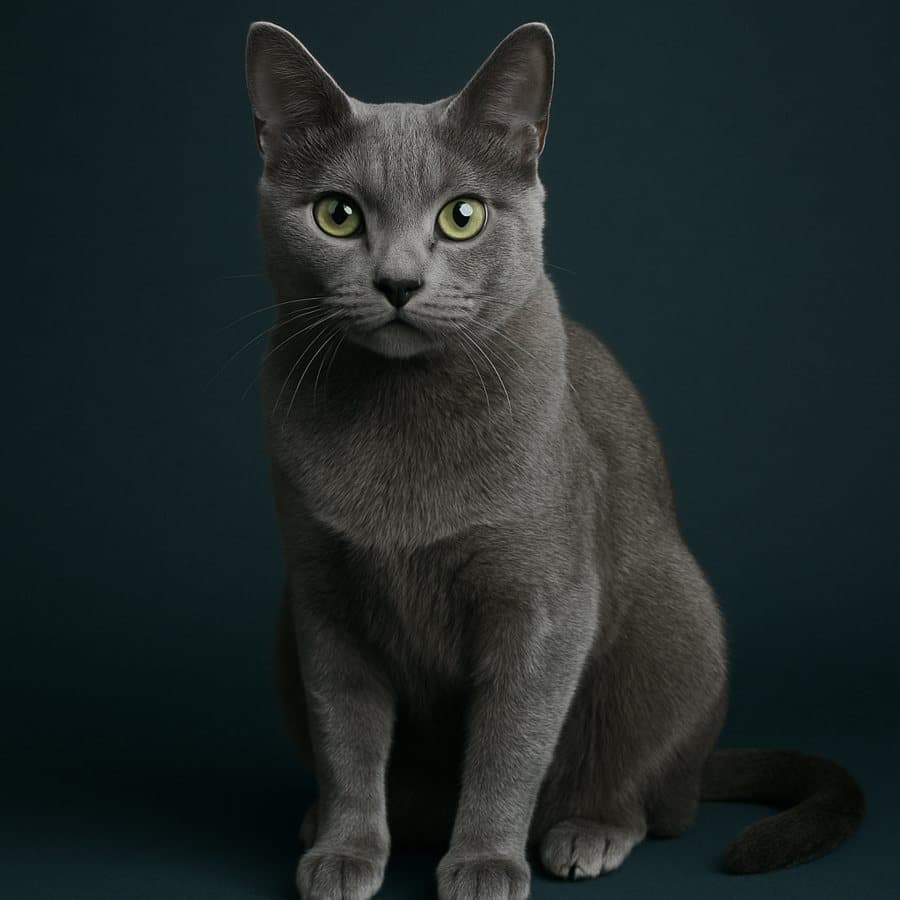
An adult Russian Blue weighs 2.3 to 6.8 kg and stands 20 to 28 cm at the withers.
Registry standards classify this breed as medium-sized with elegant, fine-boned, and lithe muscular bodies. Adult weights vary widely, with intact males occasionally reaching up to 6.8 kg.
[S7][S8][S9][S10][S11][S12][S13]How long does a Russian Blue live?
A Russian Blue lives 9.7 to 20 years.
UK epidemiological studies report a life expectancy of 9.65 years for pooled Russian cats, while cat registry profiles and veterinary centers cite 12 to 20 years for indoor cats.
[S10][S13][S14][S15]What health problems are common in the Russian Blue?
The most common in the Russian Blue are: Obesity, Feline Lower Urinary Tract Disease (FLUTD) / Urolithiasis, Diabetes Mellitus, Hereditary Cataracts.
Obesity [S23][S24][S25][S26]
Excessive body fat accumulation caused by strong food motivation and overeating.
Ask your vet about:
- Body condition score evaluation
- Routine weight checks
Feline Lower Urinary Tract Disease (FLUTD) / Urolithiasis [S27][S28]
Inflammation or stone formation within the feline urinary bladder and urethra.
Ask your vet about:
- Urinalysis including urine specific gravity and sediment exam
- Bladder ultrasound
- Abdominal radiography
Diabetes Mellitus [S24][S29]
A metabolic disorder impairing blood sugar regulation, frequently secondary to weight gain.
Ask your vet about:
- Fasting blood glucose test
- Serum fructosamine assay
- Urine glucose and ketone dipstick
Hereditary Cataracts [S30]
Clouding of the ocular lens found in specific Scandinavian ancestral lines.
Ask your vet about:
- Slit-lamp biomicroscopy eye examination by a veterinary ophthalmologist
What is a Russian Blue's temperament like?
The Russian Blue is quiet, intelligent, and deeply affectionate with household members. It displays a cautious, reserved disposition around strangers and prefers a predictable, calm household routine.
[S4][S10][S12][S13][S15][S16]How much exercise does a Russian Blue need?
They have moderate energy, alternating agile running and climbing bursts with peaceful rest. Long legs make them skilled jumpers requiring scratching posts and high perches.
- Energy3 / 5
How does a Russian Blue handle heat and cold?
The plush double coat evolved in sub-arctic climates and provides strong insulation against the cold. Modern indoor cats still actively seek warmth from sunbeams and blankets.
- Handles heat3 / 5
- Handles cold4 / 5
How much does a Russian Blue shed, and how do you groom it?
Brush weekly with a soft bristle brush or fine-toothed comb to remove dead hairs. When brushed in reverse, the dense fur stays upright.
Short plush double coat with equal length undercoat and guard hairs
- Shedding2 / 5
Is a Russian Blue good with children and other pets?
Quiet habits and soft vocalizations make this breed well suited for apartment life. They live well with respectful children and companion animals, though loud noises cause them to seek high hiding spots.
- With children3 / 5
- With other pets4 / 5
- In an apartment5 / 5
Is a Russian Blue easy to train?
Curious and motivated by food, they learn quickly with positive reinforcement and clicker training. They easily learn games of fetch, but harsh reprimands cause them to withdraw.
- Ease of training4 / 5
What does a Russian Blue eat at each life stage?
- KittenProvide measured, scheduled meals rather than ad libitum dry feeding to instill healthy eating habits early in life.
- AdultFeed a complete carnivorous diet using strict portion control. Integrate high-moisture wet food to support urinary hydration.
- SeniorOffer formulas designed to preserve lean muscle with controlled levels of phosphorus and sodium to support kidney health.
Where does the Russian Blue come from?
Originating near the northern port city of Arkhangelsk, this natural landrace was transported by Russian sailors to Great Britain during the 1860s. First shown in London under the name Archangel Cat, the breed gained independent recognition in 1912 and received breed preservation through Siamese and British Shorthair outcrosses following World War II.
Country of origin: Russia.
[S1][S2][S3][S4][S5][S6]Fun facts about the Russian Blue
- The natural upward curve of their whisker pads gives Russian Blues a perpetual, enigmatic Mona Lisa smile. [S2][S10][S20]
- Kittens start life with yellow or amber eyes, which gradually change to vivid emerald green over the course of two years. [S10][S19]
- In 1890, a historic Archangel cat named Kola was purchased from a ship crew in London in exchange for a leg of mutton. [S13]
- Translucent tips that lack pigment reflect light to produce the coat's characteristic frosty silver shimmer. [S4][S7][S19]
- Breed standards describe the paw pads as lavender pink or mauve, contrasting with the dark slate-grey nose leather. [S7]
- The British GCCF and Australian ACF registries register white and black coat variants alongside the traditional blue standard. [S1][S12][S13][S33]
Tips by life stage and weather
- KittenIntroduce claw trimming and harness exposure during early weeks using food treats as gentle rewards.
- KittenEstablish vertical cat trees and scratching posts so your kitten can climb and jump safely.
- AdultDistribute daily meals inside puzzle toys to provide mental stimulation and reduce eating speed.
- AdultSchedule daily interactive play sessions with wand toys to satisfy your cat's natural hunting drive.
- SeniorSchedule semi-annual veterinary visits for body weight and condition monitoring.
- SeniorPosition comfortable indoor blankets in sunny indoor areas to support warm resting spaces.
- Hot seasonSupply fresh water in multiple indoor dishes alongside wet food to maintain proper hydration.
- Hot seasonMaintain accessible shaded rest areas away from direct sunlight during peak temperature hours.
- Cold seasonPlace cat beds in draft-free spots near indoor warmth zones where your cat can sleep insulated.
- Cold seasonBrush the dense plush undercoat weekly so it preserves its insulating air layer.
- Rainy seasonKeep home schedules and feeding times steady to minimize anxiety from sudden outdoor thunder.
- Rainy seasonProvide elevated perches indoors so your cat can retreat to a quiet, elevated sanctuary when stormy noise begins.
In the Kiba Vet app, your pet's breed profile shows a tip of the day based on its age and the weather where you live.
This is general guidance. Always ask your vet.
Checked against sources; veterinary review pending. Updated on September 29, 2026.
Written with the help of AI from the cited sources and checked fact by fact against them by a second model.
Sources
Every health fact and every number on this page comes from these sources. Identifiers from Wikidata (CC0).
- S1 Russian Blue - Wikipedia
- S2 Russian Blue Cat Facts: History, Personality, Health & More - RAWZ
- S3 CATTERY ALYONA RUSSISCH BLAUW
- S4 Russian Blue | The Viking Cat Club
- S5 Russian Blue | VCA Animal Hospitals
- S6 Russian Blue Cat Breed: Looks and Personality
- S7 cfa.org
- S8 Russian Blue Cat: Full Breed Profile & Facts
- S9 Russian Blue Cat: Traits & Care Tips | WHISKAS® UK
- S10 Russian Blue Cat - Temperament, Personality and Characteristics Traits | Hill's Pet US
- S11 All about Russian Blue breed
- S12 Russian Blue: Personality, Lifespan, Price, Colors, Health
- S13 Russian - The Governing Council of the Cat Fancy
- S14 Life tables of annual life expectancy and risk factors for mortality in cats in the UK - PMC
- S15 Russian Blue Cat Breed Health and Care | PetMD
- S16 Breed Info | Veterinarians Greenville | Vet Care Animal Hospital
- S18 Russian Blue Cat Origin, History & Facts | Le Félin
- S19 Russian Blue Cat: Temperament, Care & Price Guide
- S20 Russian Blue Cat Breed Guide - PetPlace
- S21 The Russian Blue: origin, temperament, health and price
- S22 Burmese Cat: The Measured Champion of Longevity
- S23 Russian Blue Lifespan: How Long Do They Live?
- S24 Russian Blue Cat Health Problems: 7 Vet-Reviewed Issues — Catster
- S25 How Long Do Russian Blue Cats Live? Vet-Reviewed Lifespan & Care Tips — Catster
- S26 liverpool.ac.uk
- S27 Breed-related disease: Russian Blue Cat - Bioguardlabs
- S28 Understanding the Health and Care of Your Russian Blue Cat | Peqaboo
- S29 localpetfinder.ca
- S30 researchgate.net
- S32 How Long Do Russian Blue Cats Live? Lifespan – La Petite Labs
- S33 12 Things You Did Not Know About the Russian Blue Cat - Cats.com