
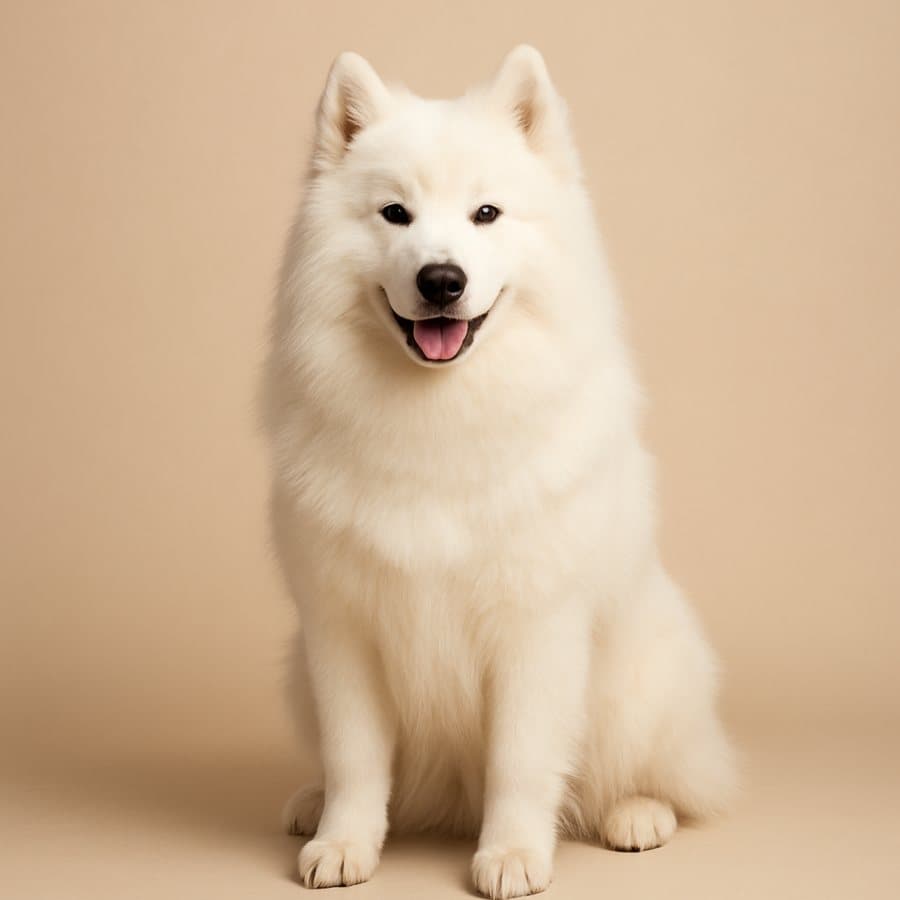
This is general guidance. Always ask your vet.
How big does a Samoyed get?
An adult Samoyed weighs 15.9 to 30 kg and stands 46 to 60 cm at the withers.
FCI standards specify an ideal height of 57 cm for males and 53 cm for females, with a 3 cm margin. Weight should be proportional to build.
[S2][S6][S8][S9]How long does a Samoyed live?
A Samoyed lives 12 to 14 years.
Large surveys identify a median lifespan of 13.1 years.
[S10][S11][S12]What health problems are common in the Samoyed?
The most common in the Samoyed are: Samoyed Hereditary Glomerulopathy, Hip Dysplasia, Progressive Retinal Atrophy, Cardiac Conditions.
Samoyed Hereditary Glomerulopathy [S22][S23][S24][S25]
This inherited kidney disorder leads to protein loss in the urine and can cause early renal failure.
Ask your vet about:
- COL4A5 DNA mutation test
- Urinalysis with protein-to-creatinine ratio
- Renal serum panel
Hip Dysplasia [S26]
This condition involves abnormal development of the hip joint, causing joint laxity and mobility problems.
Ask your vet about:
- PennHIP passive laxity testing
- OFA extended hip radiographs
What is a Samoyed's temperament like?
The Samoyed is an open, lively, and pack-oriented dog that lacks guarding instincts. It shows great warmth toward family and strangers and expresses itself through frequent vocalizations.
[S1][S7][S13][S14]How much exercise does a Samoyed need?
A Samoyed needs 60 to 120 minutes of exercise a day.
This working lineage possesses high stamina and needs structured physical activities alongside mental challenges such as puzzle toys or scent games.
- Energy4 / 5
How does a Samoyed handle heat and cold?
A dense double coat allows the dog to thrive in freezing temperatures but leaves it vulnerable to heat exhaustion in warm environments.
- Handles heat1 / 5
- Handles cold5 / 5
How much does a Samoyed shed, and how do you groom it?
Thorough line-brushing two to three times weekly, increasing to daily brushing during seasonal coat blows.
Dense double coat with a harsh outer layer and woolly undercoat
- Shedding5 / 5
Is a Samoyed good with children and other pets?
The breed enjoys children and other dogs. It can live in apartments if you satisfy its exercise needs and manage its vocal barking habits.
- With children4 / 5
- With other pets4 / 5
- In an apartment2 / 5
Is a Samoyed easy to train?
Samoyeds learn quickly because of their high intelligence, though they get bored with repetition and need positive reinforcement.
- Ease of training3 / 5
What does a Samoyed eat at each life stage?
- PuppyOffer medium-to-large-breed puppy food with controlled calcium and phosphorus to support steady skeletal development, dividing daily rations across three to four meals until six months of age.
- AdultProvide balanced adult maintenance food rich in animal protein to support muscle mass and the double coat, dividing portions into two daily meals based on activity level.
- SeniorChoose a formula suited for lower metabolic activity to prevent weight gain, prioritizing digestible proteins, fiber, and joint-protective omega-3 fatty acids.
Where does the Samoyed come from?
Nomadic Samoyedic tribes in Northern Russia and Siberia developed this breed to herd reindeer, pull sleds, hunt, and provide warmth in shelters. British zoologist Ernest Kilburn Scott imported foundation dogs to England in 1889, where breeders established the modern standard.
Country of origin: Russia.
[S1][S2]Fun facts about the Samoyed
- The upturned corners of the mouth prevent drool from dripping and freezing into icicles in Arctic conditions. [S1][S14]
- The coat lacks typical skin oils and produces little to no characteristic dog odor. [S2]
- You can spin the shed undercoat into a warm, hypoallergenic yarn known as chiengora for knitting. [S2]
- A Samoyed named Etah served as the lead sled dog for the first expedition to reach the South Pole in 1911. [S4]
- Nomadic Nenets families slept alongside these dogs in their tents to use their body heat as living heaters. [S1][S3]
Tips by life stage and weather
- PuppyEnroll your puppy in structured socialization between 8 and 16 weeks to build confident habits.
- PuppyTeach calm crate rest early to manage vocalization and destructive puppy chewing.
- AdultProvide at least an hour of brisk exercise and agility or sledding activities daily.
- AdultLine-brush the coat with an undercoat rake several times weekly to control loose hair.
- SeniorMonitor daily body condition score and schedule regular veterinary checkups to track joint mobility.
- SeniorIncorporate low-impact nosework and scent games to keep your older dog mentally active.
- Hot seasonWalk your dog early in the morning and keep it in air-conditioned indoor rooms during midday peak heat.
- Hot seasonProvide unlimited fresh water and avoid strenuous daytime workouts to prevent heat exhaustion.
- Cold seasonEngage your dog in long outdoor walks or jogging sessions, which match its natural Arctic endurance.
- Cold seasonInspect the paws for any grit or burrs after outdoor cold-weather activities.
- Rainy seasonDry the dense undercoat thoroughly after walks to prevent prolonged dampness near the skin.
- Rainy seasonUse indoor puzzle toys and feeding games to keep your dog exercised when downpours halt outdoor activities.
In the Kiba Vet app, your pet's breed profile shows a tip of the day based on its age and the weather where you live.
This is general guidance. Always ask your vet.
Checked against sources; veterinary review pending. Updated on September 29, 2026.
Written with the help of AI from the cited sources and checked fact by fact against them by a second model.
Sources
Every health fact and every number on this page comes from these sources. Identifiers from Wikidata (CC0).
- S1 fci.be
- S2 Samoyed dog - Wikipedia
- S3 The Samoyed Down Through History – Minuteman Samoyed Club, Inc.
- S4 What Were Samoyeds Bred for? Breed History Explained | Hepper Pet Resources
- S6 Samoyed dog Standard
- S7 Samoyed Standard
- S8 Samoyed | National Kennel Club
- S9 Is Your Samoyed Overweight: Samoyed Standard - Imperial Samoyeds
- S10 How Long Do Samoyeds Live? | dogage.co
- S11 ljmu.ac.uk
- S12 How Long Do Samoyeds Live? Average Lifespan, Data & Care Guide | Hepper Pet Resources
- S13 Samoyed Breed Guide: Facts & Traits | Royal Canin AU
- S14 Samoyeds: Traits, Life Span, Health Issues, Caring, and More
- S15 About Samoyeds | Denver Samoyed Association | Samoyed Club
- S16 zubairkhalid.com
- S17 Samoyed | Dog Breed | Royal Canin UK
- S19 Samoyed Guide – Lifespan, Common Health Problems & Nutrition
- S20 Samoyed Weight Chart by Age, Growth Chart & Size Guide
- S22 Hereditary nephritis: Samoyed hereditary glomerulopathy testing | Pets4Homes
- S23 LABOKLIN (UK)| Genetic Diseases | Dogs| Hereditary Nephritis / Samoyed Hereditary Glomerulopathy
- S24 Dog hereditary diseases
- S25 Checking your browser - reCAPTCHA
- S26 Canine Health (CHIC) — Barbet Club of America - Official Site
- S27 Genetic Disorders
- S28 CHIC Program | OFA
- S29 Health Clinics - OFA
- S30 Farmina Pet Foods - Genius tips - Puppy, Adult, & Senior: Adjusting Nutrition Through Life Stages
- S31 Puppy, Adult & Senior Dog Nutrition | Hill’s Pet US