
This is general guidance. Always ask your vet.
How big does a Siamese get?
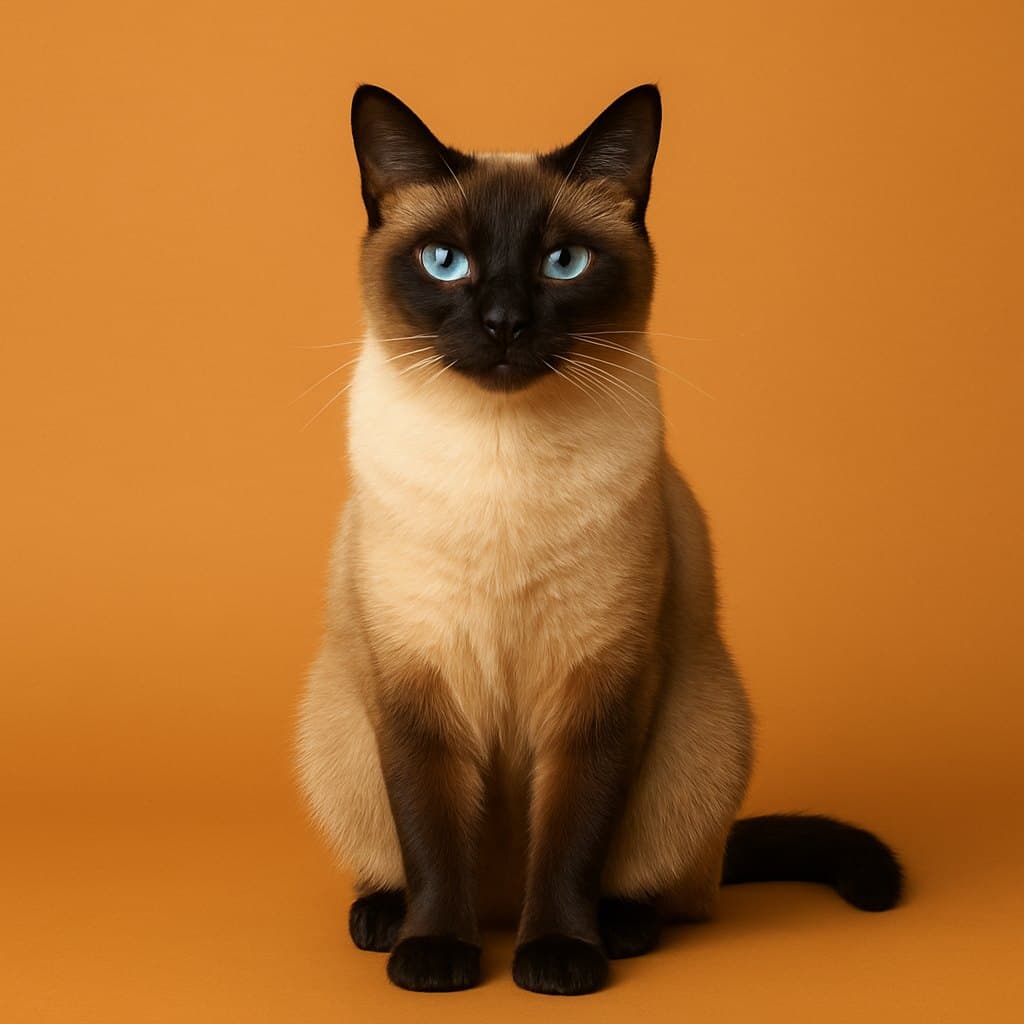
An adult Siamese weighs 1.4 to 5.5 kg and stands 20 to 31 cm at the withers.
Registry standards define conformation proportions rather than strict height or weight limits. Lean body structures are normal for the breed.
[S9][S10][S11][S12][S13][S14][S15]How long does a Siamese live?
A Siamese lives 11.7 to 15 years.
Primary care veterinary data documents an average baseline near 12 years, while clinical consensus ranges to 15 years and older.
[S16][S17][S18]What health problems are common in the Siamese?
The most common in the Siamese are: Progressive Retinal Atrophy (rdAc mutation), Systemic Amyloidosis, Feline Asthma, Hypertrophic and Dilated Cardiomyopathy, Dental Periodontitis and Resorptive Lesions, Pica and Wool-Sucking.
Progressive Retinal Atrophy (rdAc mutation) [S30][S31][S32]
An inherited degenerative eye condition causing night blindness that advances to total vision loss.
Ask your vet about:
- CEP290 genetic test
- Indirect ophthalmoscopy
Systemic Amyloidosis [S16][S20][S33][S34]
An abnormal protein deposition disorder that accumulates inside abdominal organs like the liver.
Ask your vet about:
- Serum biochemistry panel
- Abdominal ultrasound
- Liver biopsy
Feline Asthma [S31][S35][S36]
A chronic inflammatory disorder affecting the lower airways and breathing passages.
Ask your vet about:
- Thoracic radiography
- Bronchoscopy with bronchoalveolar lavage cytology
- Parasite screening
Hypertrophic and Dilated Cardiomyopathy [S33][S34][S35]
Structural heart diseases that compromise proper cardiac pumping efficiency.
Ask your vet about:
- Echocardiogram
- NT-proBNP blood test
- Chest X-rays
What is a Siamese's temperament like?
The Siamese is an extroverted, deeply social cat that communicates with a distinct, raspy voice. The breed follows owners around the home and struggles when left isolated.
[S2][S3][S5][S7][S12][S19][S20]How much exercise does a Siamese need?
The breed possesses sustained agility, strong jumping drives, and a need for interactive play and vertical territory.
- Energy5 / 5
How does a Siamese handle heat and cold?
Tropical ancestry provides tolerance for warm environments, but the lack of an undercoat makes the cat sensitive to cold weather.
- Handles heat4 / 5
- Handles cold1 / 5
How much does a Siamese shed, and how do you groom it?
Minimal brushing satisfies coat maintenance, as shedding occurs lightly year-round.
Short, fine, flat-lying coat with no undercoat
- Shedding1 / 5
Is a Siamese good with children and other pets?
This cat lives well in apartments with high vertical territory, though loud vocalizations can carry through walls. Companion animals help prevent loneliness.
- With children4 / 5
- With other pets5 / 5
- In an apartment4 / 5
Is a Siamese easy to train?
High intelligence allows this breed to learn fetch, cues, and harness walking quickly with clicker training and positive reinforcement.
- Ease of training5 / 5
What does a Siamese eat at each life stage?
- KittenOffer growth formulas meeting complete regulatory standards with high animal protein, DHA, and balanced calcium and phosphorus for bone expansion.
- AdultProvide maintenance nutrition focused on lean animal protein and controlled calories to preserve a lean body condition score without excess belly fat.
- SeniorFeed easily digestible proteins with controlled phosphorus and added moisture to support aging kidneys and preserve muscle mass.
Where does the Siamese come from?
Known originally as Wichienmaat, this natural breed was documented in the Thai Tamra Maew manuscripts between the 14th and 18th centuries. The cats served as royal palace and temple guardians in Siam before arriving in Western exhibitions in London in 1871. The Cat Fanciers' Association granted official recognition in 1906.
Country of origin: Thailand.
[S1][S2][S3][S4][S6][S7]Fun facts about the Siamese
- All Siamese kittens enter the world solid white, developing point colors on their extremities only after birth. [S2][S27]
- The coat works as a living thermal map, growing lighter during hot seasons and darker during cold weather. [S25][S27][S41]
- Shaved areas of skin from clinical visits often regrow darker fur initially because cooler exposed skin activates pigment enzymes. [S27]
- United States First Lady Lucy Hayes received a Siamese cat named Siam at the White House in 1878. [S2][S7]
- The Siamese contributed genetic foundations to multiple modern breeds, including the Oriental Shorthair, Balinese, and Tonkinese. [S1][S7][S42]
Tips by life stage and weather
- KittenIntroduce harness walking and clicker training early to channel intelligence.
- KittenMonitor chewing tendencies on fabrics to identify early signs of pica.
- AdultInstall tall cat trees and perches to satisfy high climbing drives.
- AdultUse interactive wand toys and food puzzle mats daily to prevent boredom.
- SeniorPlace water fountains in multiple rooms to encourage regular hydration.
- SeniorSchedule routine veterinary blood panels to monitor liver and kidney parameters.
- Hot seasonSet wide water dishes out to prevent whisker fatigue and promote fluid intake.
- Hot seasonMaintain indoor ventilation during extreme heat waves across northern and coastal regions.
- Cold seasonProvide warm blankets and heated cat beds because the thin coat lacks an undercoat.
- Cold seasonExpect body coat shades to darken during cooler winter periods.
- Rainy seasonOffer indoor puzzle toys and climbing tracks when storms restrict activity.
- Rainy seasonKeep home bedding completely dry to prevent chilling in humid indoor air.
In the Kiba Vet app, your pet's breed profile shows a tip of the day based on its age and the weather where you live.
This is general guidance. Always ask your vet.
Checked against sources; veterinary review pending. Updated on September 29, 2026.
Written with the help of AI from the cited sources and checked fact by fact against them by a second model.
Sources
Every health fact and every number on this page comes from these sources. Identifiers from Wikidata (CC0).
- S1 Siamese cat - Wikipedia
- S2 National Siamese Cat Day Facts | College of Veterinary Medicine
- S3 Siamese - The Governing Council of the Cat Fancy
- S4 Siamese cat history shows they originated in Siam - Paws CatOSphere for Cat Lovers
- S5 Siamese Cat Breed Health and Care | PetMD
- S6 ::::: National Siamese Cat Club :::::
- S7 Siamese | VCA Animal Hospitals
- S9 cfa.org
- S10 Cat Breed Size Calculator — How Big Will My Cat Get?
- S11 Thai vs Siamese: The Old Style and the New, Precisely
- S12 Siamese Cat Breed: Characteristics & Temperament | Royal Canin US
- S13 Siamese Cat Dimensions & Drawings | Dimensions.com
- S14 All about Siamese cat breed
- S15 Siamese Cat Weight Guide — Ideal Range, BCS & Calories | Paws & Pounds
- S16 How Long Do Siamese Cats Live? Lifespan & Senior Care – La Petite Labs
- S17 rvc.ac.uk
- S18 Siamese Cat Lifespan Uncovered How Long Do They Live
- S19 Breed Info | Veterinarians Humble | Atascazoo Animal Hospital
- S20 Diseases for Siamese Cat | Long Beach Animal Hospital
- S21 Siamese Cat Breed Profile | Litter-Robot
- S22 Nutrition and Weight: Kittens - AAHA
- S23 Siamese Cat Breed -Temperament, Personality and Characteristics Traits | Hill's Pet US
- S24 Do Siamese cats get cold easily? - Adopt a Pet
- S25 Are Siamese Cats Sensitive to Cold? Understanding Their Temperature Needs | Gumtree
- S26 At What Temperature Do Cats Get Cold? Below 45F Is Risky - Lady N US
- S27 The Siamese Cat's “Color-Changing Magic”: How Does Temperature Alter F – Clawsable
- S29 What cat breeds live the longest? | Tucson Vets
- S30 ucdavis.edu
- S31 Siamese Cat Health Problems: 7 Vet-Reviewed Issues — Catster
- S32 5 Siamese Cat Health Issues [Symptoms, Causes, Treatment & Prevention] – Integricare
- S33 Oriental Shorthair White Paper: Breed Characteristics, Health Risks and Care Guidelines - Bioguardlabs
- S34 Oriental Shorthair Lifespan: How Long They Live
- S35 zubairkhalid.com
- S36 Breed Info – East Cooper Animal Hospital
- S37 How Long Do Siamese Cats Live? Average Lifespan & Care Tips – K9 Carts
- S38 baileyscbd.com
- S39 Siamese Cats Guide - Expert Advice for Siamese Cat Owners
- S40 Nutrition and Weight: Mature Adult and Senior Cats - AAHA
- S41 Cats as Living Heat Maps
- S42 Siamese Article 2000 - The Cat Fanciers' Association