
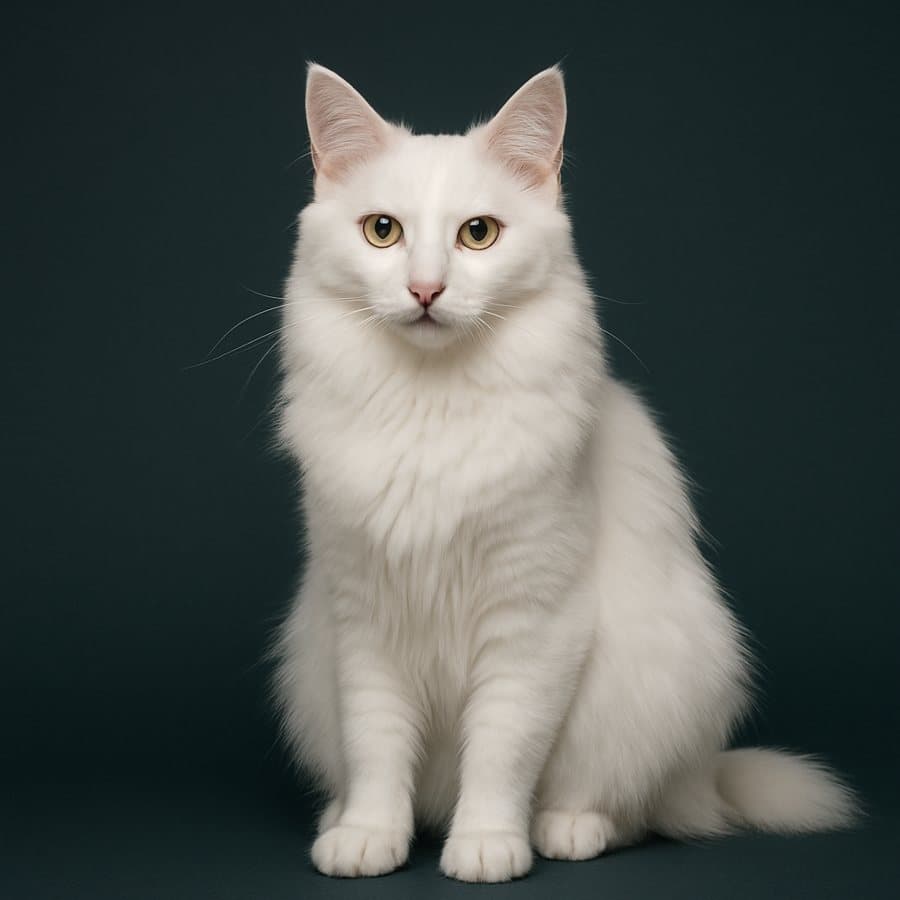
This is general guidance. Always ask your vet.
How big does a Turkish Angora get?
An adult Turkish Angora weighs 2.3 to 5 kg and stands 23 to 35 cm at the withers.
Breed standards evaluate conformation based on fine boning, balance, and a lithe torso rather than fixed height limits.
[S1][S6][S7][S9][S11][S12]How long does a Turkish Angora live?
A Turkish Angora lives 12 to 18 years.
Healthy indoor individuals frequently live between 15 and 20 years.
[S14][S15][S16]What health problems are common in the Turkish Angora?
The most common in the Turkish Angora are: Congenital Sensorineural Deafness, Hypertrophic Cardiomyopathy (HCM), Hereditary Ataxia, Neonatal Isoerythrolysis.
Congenital Sensorineural Deafness [S21][S23][S24][S25]
A genetic hearing loss linked to the dominant white coat gene and blue eye color.
Ask your vet about:
- Brainstem Auditory Evoked Response (BAER) hearing test
Hypertrophic Cardiomyopathy (HCM) [S21][S25]
A heart condition that causes thickening of the muscular walls of the heart.
Ask your vet about:
- Transthoracic echocardiography (heart ultrasound)
Hereditary Ataxia [S25][S26]
A progressive neurological disorder that causes uncoordinated body movements.
Ask your vet about:
- Comprehensive neurological examination
- Pedigree analysis for inherited recessive traits
Neonatal Isoerythrolysis [S27]
A condition in newborn kittens where maternal antibodies destroy their red blood cells after nursing.
Ask your vet about:
- Feline blood type testing
- Genetic test for CMAH gene variants
What is a Turkish Angora's temperament like?
Extroverted and vocal, this cat engages closely with household routines and often assumes a dominant presence among other family pets.
[S1][S2][S4][S12]How much exercise does a Turkish Angora need?
This cat maintains high energy levels throughout life and instinctively seeks vertical high spots like door tops and shelves.
- Energy4 / 5
How does a Turkish Angora handle heat and cold?
The breed sheds its coat significantly in summer to handle heat, but its lack of an undercoat makes it sensitive to damp cold and freezing weather. Cats with white or pale coats can develop sunburn on unpigmented ears and noses.
- Handles heat3 / 5
- Handles cold2 / 5
How much does a Turkish Angora shed, and how do you groom it?
Comb or brush once to twice a week with a fine-toothed steel comb or slicker brush to remove loose hair.
Semi-longhaired, fine, and silky without a woolly undercoat
- Shedding3 / 5
Is a Turkish Angora good with children and other pets?
Coexists well with respectful children, dogs, and other cats, though small pets must remain separated due to its hunting drive. Adapts well to apartment spaces when provided with vertical cat furniture.
- With children4 / 5
- With other pets4 / 5
- In an apartment4 / 5
Is a Turkish Angora easy to train?
Quickly learns tricks, agility routines, and clicker cues, and can often figure out how to open latches and turn doorknobs.
- Ease of training4 / 5
What does a Turkish Angora eat at each life stage?
- KittenFeed a complete kitten formula high in animal protein and essential fatty acids like DHA, with a balanced calcium-to-phosphorus ratio for developing bones.
- AdultProvide an adult diet with animal protein and taurine, incorporating moisture-rich wet food and portion control to support urinary tract health and a lean frame.
- SeniorOffer a senior recipe with easily digestible proteins, controlled levels of phosphorus and sodium for kidneys and heart, and omega-3 fatty acids for joints.
Where does the Turkish Angora come from?
Originating in central Anatolia as a naturally occurring landrace, this ancient breed arrived in Britain and France in the late 16th and early 17th centuries. Extensive crossbreeding to improve the Persian cat nearly led to its disappearance outside Turkey, prompting the Ankara Zoo to establish a preservation program in the early 20th century. Modern breeding lines descend from Ankara Zoo imports brought to the United States in 1962.
Country of origin: Turkey.
[S1][S2][S3][S4][S5][S6][S7][S8][S9]Fun facts about the Turkish Angora
- The Turkish Angora holds official recognition as a protected national treasure in Turkey, where the government strictly monitored its export. [S6][S19]
- Marie Antoinette and King Louis XVI admired the breed, and legend states her cats were sent to Maine during the French Revolution, contributing to the Maine Coon lineage. [S6][S28]
- In 2007, South Korean researchers cloned Turkish Angora cats with red fluorescent proteins that glow red under ultraviolet lighting. [S29]
- Although famous for solid white fur, the breed officially occurs in more than forty different recognized colors and patterns. [S8][S9][S30]
- Heterochromia is common in this breed, producing cats with one blue eye and one amber or green eye. [S20][S31]
Tips by life stage and weather
- KittenSet up low, safe climbing platforms and interactive feather toys so your kitten can direct its natural agility into safe play.
- KittenIntroduce weekly steel-comb brushing early so your young cat gets used to handling before full seasonal shedding starts.
- AdultInstall tall cat trees or high wall shelving to satisfy your cat's drive to sit in elevated vantage spots.
- AdultUse food puzzles and positive reinforcement training sessions to keep this intelligent cat mentally challenged each day.
- SeniorProvide step ramps or intermediate resting points so your older cat can reach favorite high shelves without joint strain.
- SeniorKeep your senior cat on a regular veterinary screening routine to check heart function and body condition as it ages.
- Hot seasonProtect white and pale-pointed cats from direct sun exposure through glass windows to shield unpigmented ears and noses.
- Hot seasonBrush more frequently during the spring-to-summer transition to remove loose molting hair and help your cat stay comfortable.
- Cold seasonKeep your cat inside a temperature-controlled room during chilly periods, as it lacks a dense undercoat to insulate against cold.
- Cold seasonProvide warm, elevated nesting spaces away from floor drafts so your cat can rest in comfort.
- Rainy seasonKeep your cat strictly indoors on damp, stormy days to prevent chilling from ambient humidity and drafts.
- Rainy seasonOffer extra interactive wand play inside when gloomy or wet weather limits natural light and window observation.
In the Kiba Vet app, your pet's breed profile shows a tip of the day based on its age and the weather where you live.
This is general guidance. Always ask your vet.
Checked against sources; veterinary review pending. Updated on September 29, 2026.
Written with the help of AI from the cited sources and checked fact by fact against them by a second model.
Sources
Every health fact and every number on this page comes from these sources. Identifiers from Wikidata (CC0).
- S1 Turkish Angora - Fédération Internationale Féline
- S2 Turkish Angora Cats | Cat Breeds
- S3 Turkish Angora - Wikipedia
- S4 Breed Info – Animal Care Center
- S5 What makes Turkish Angora cat so special? - Türkiye Today
- S6 cfa.org
- S7 Turkish Angora | VCA Animal Hospitals
- S8 Turkish Angora Cat: Price, Personality, History & Care Guide
- S9 Turkish Angora: Colors, White-Cat Facts, Price, Real Data
- S11 Turkish Angora Breed Standard | Cattery Havvanur
- S12 Facts, Features, and Personality Traits of Turkish Angora Cats
- S14 How Long Does a Turkish Angora Live? Average & Max Lifespan — Catster
- S15 Turkish Angora Lifespan: How Long Do They Live | Hepper Pet Resources
- S16 10 of the Longest-Living Cat Breeds | PetMD
- S18 Turkish Angora: everything you need to know - Petplan Seguro de Salud para Perros y Gatos nº1 en Europa
- S19 History - CFA Turkish Angora Breed Council
- S20 Explore Turkish Angora Cat Breeding Standards Now!
- S21 Turkish Angora: Hereditary Health Issues and Care Guide | Pets4Homes
- S22 Turkish Angora Cats: Temperament, Grooming, and Health Care Explained – CATLINK
- S23 What To Know About a Turkish Angora Cat
- S24 Understanding the Health and Care of Your Turkish Angora | Peqaboo
- S25 zubairkhalid.com
- S26 Turkish Angora | Royal Canin US
- S27 Hematology and Immune-Related Disorders - PMC
- S28 Maine Coon - Wikipedia
- S29 FELINE MEDICAL CURIOSITIES: MISCELLANEOUS
- S30 cfa.org
- S31 Turkish Angora cat breed - Information & characteristics | KatKin