
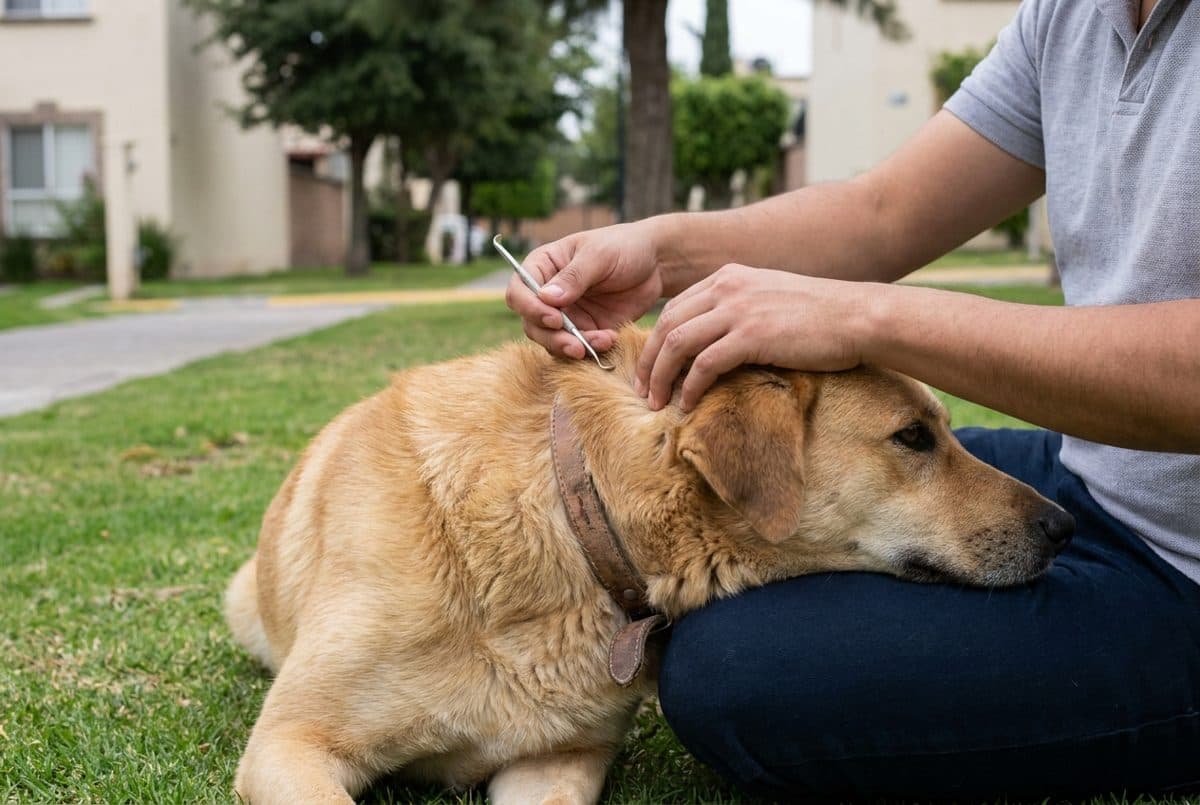
Ticks spread serious bacterial infections to dogs and humans across Mexico. Inspecting your dog daily and removing ticks quickly stops infections before they spread.
This is general guidance. Always ask your vet.
Where do you check your dog for ticks?
Feel through your dog's entire coat daily, focusing on the ears, eyelids, collar area, armpits, groin, paws, and tail.
Run your fingers through your dog's coat after every outdoor walk. Unfed larvae feel flat and measure under 1 millimeter, while blood-fed adult females swell to 10 to 12 millimeters.
Inspect hidden spots with care. Spread the hair inside and around the ears, under the collar, between the toes, and under the legs to find ticks.
[S1][S3][S5][S6][S7]How do you remove an attached tick from a dog?
Grasp the tick close to the skin with fine-tipped tweezers and pull straight upward with steady pressure.
Keep your hands protected with gloves or clean tissue during removal. Disinfect the bite wound and wash your hands with soap, rubbing alcohol, or an iodine scrub after the tick comes off.
- Put on protective gloves or hold a clean tissue.
- Position clean, fine-tipped tweezers close to your dog's skin.
- Grip the tick at the skin level and avoid squeezing its swollen body.
- Pull straight upward using continuous, even pressure.
- Attempt to lift any remaining mouthparts with tweezers, or leave them alone to heal naturally.
- Clean the bite area with rubbing alcohol or soap and water.
- Kill the live tick in rubbing alcohol, seal it in tape, or flush it down the toilet.
What should you avoid doing during tick removal?
Avoid crushing the tick, twisting it, applying oils, or using heated objects.
Crushing a tick with bare fingers exposes your skin to dangerous pathogens. Twisting or jerking breaks the mouthparts off inside your dog's skin.
Petroleum jelly, grease, oils, nail polish, and lit matches agitate the tick. These substances trigger the tick to regurgitate infected saliva into your dog's bloodstream. Hot objects also burn your dog's skin.
[S1][S6][S7]What diseases do ticks transmit to dogs in Mexico?
Ticks in Mexico transmit Rocky Mountain spotted fever, canine monocytic ehrlichiosis, and anaplasmosis.
The brown dog tick is the main vector in Mexico and feeds on dogs across all life stages. In northern states like Baja California, Sonora, Chihuahua, Coahuila, and Nuevo León, it carries the bacteria for Rocky Mountain spotted fever, which can also kill humans.
Tick bites can also transmit Ehrlichia canis, which causes fever, swollen lymph nodes, weight loss, and abnormal bleeding. Subclinical infections lower blood platelets quietly, and chronic cases cause bone marrow failure.
Ticks transmit Anaplasma phagocytophilum after feeding for 24 hours. Symptoms like fever, joint pain, lameness, and lethargy show up 1 to 2 weeks later.
[S2][S4][S5][S7][S8][S9]How do you clear ticks from your home and yard?
Clear ticks by washing dog bedding in hot water, vacuuming baseboards and furniture seams, sealing wall crevices, and mowing the lawn short.
Brown dog ticks thrive indoors and outdoors. A single female tick lays an average of 4,000 eggs before dying, hiding in wall cracks, baseboards, rugs, and furniture.
Unfed ticks survive for 3 to 5 months. Empty vacuum canisters outdoors immediately after cleaning to keep live ticks out of your house.
- Wash dog bedding and blankets in hot water and dry them on high heat.
- Vacuum carpets, baseboards, furniture seams, and floor cracks thoroughly.
- Empty the vacuum contents into an outdoor trash bin immediately.
- Seal open cracks in walls, baseboards, and kennels.
- Mow lawn grass and weeds short to reduce sheltered outdoor areas.
How do you protect your dog from future tick bites?
Ask your veterinarian to recommend a year-round preventative suited to your dog's age, weight, and health.
Veterinarians prescribe tick control in oral chewable tablets, topical spot-on liquids, or collars.
Keep dog tick products away from cats. Canine tick treatments contain substances toxic to felines.
[S3][S5][S6][S7][S8]When should you go to the vet right away?
- Fever
- Sudden lethargy
- Loss of appetite
- Unexplained lameness
- Abnormal bruising or bleeding
This is general guidance. Always ask your vet.
Checked against sources; veterinary review pending. Information checked on September 28, 2026. Updated on September 28, 2026.
Written with AI help from the cited sources. A second model checked every fact against them.
Sources
- S1 What to Do After a Tick Bite | Ticks | CDC
- S2 Where Ticks Live | Ticks | CDC
- S3 Preventing Tick Bites | Ticks | CDC
- S4 Health Alert Network (HAN) - 00502 | Severe and Fatal Confirmed Rocky Mountain Spotted Fever among People with Recent Travel to Tecate, Mexico
- S5 EENY-221/IN378: Brown Dog Tick, Rhipicephalus sanguineus Latreille (Arachnida: Acari: Ixodidae)
- S6 Ticks of Dogs - Dog Owners - Merck Veterinary Manual
- S7 Ticks in Dogs | VCA Animal Hospitals
- S8 Ehrlichiosis in Dogs | VCA Animal Hospitals
- S9 Anaplasmosis in Dogs | VCA Animal Hospitals