Veterinary surveys show that around 60% of cats and dogs carry excess weight, though owners often see this extra fat as a normal shape. Learning how to evaluate your pet's body condition and measure daily food helps your pet live a longer, healthier life.
This is general guidance. Always ask your vet.
How do I check my pet's body condition score at home?
You check your pet's body condition by feeling the ribs, checking the waistline from above, and viewing the abdominal tuck from the side.
The standardized WSAVA body condition scale ranges from 1 to 9. A score of 4 to 5 indicates a healthy body condition. Pets scoring between 1 and 3 are underweight, while pets scoring between 6 and 9 carry excess weight or obesity.
Your veterinarian also evaluates a muscle condition score during physical exams. This assessment tracks lean muscle preservation alongside body fat stores.
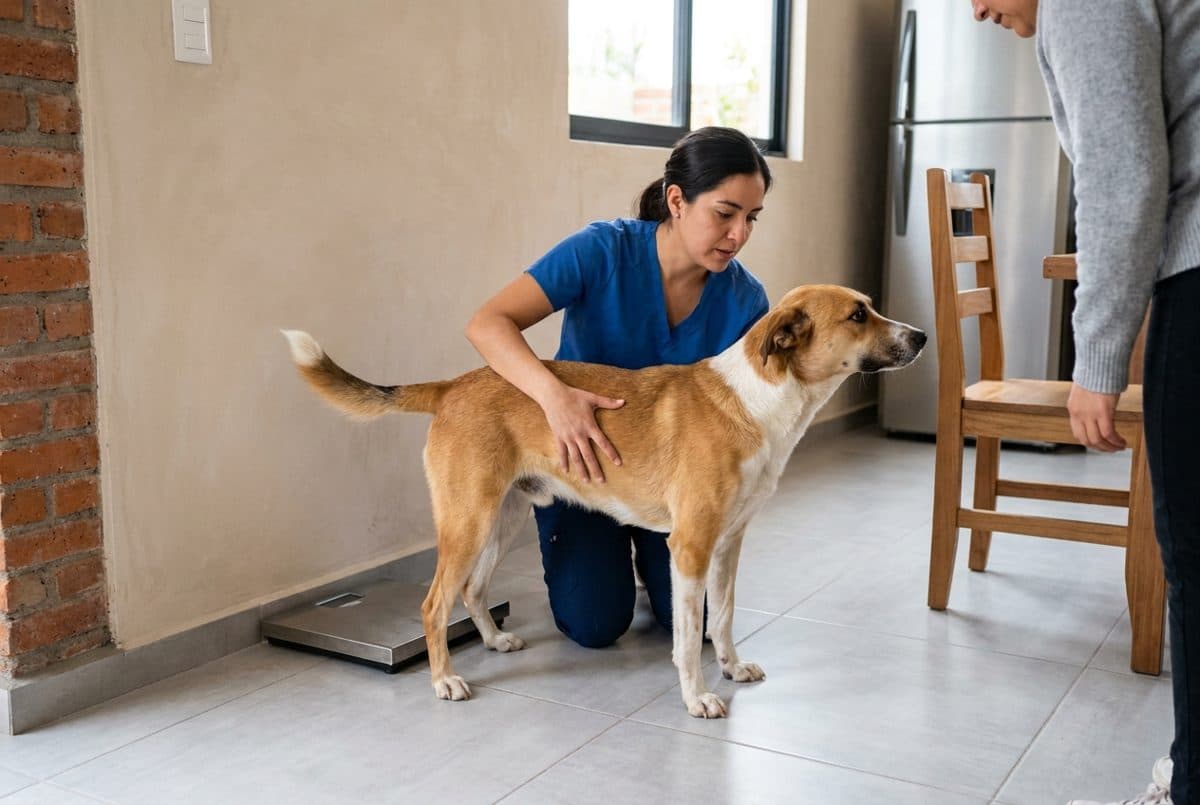
- Place your flat hands over your pet's ribcage; healthy ribs feel like the back of your hand, bare knuckles indicate an underweight body, and a fleshy palm indicates excess fat.
- Stand above your pet and look straight down to verify an hourglass waist indentation behind the ribs.
- View your pet from the side at eye level to confirm that the abdomen tucks upward toward the hips.
- Feel the base of your pet's tail to ensure a smooth line without excess fat pads.
How do I weigh my dog or cat accurately at home?
You weigh cats and small dogs on a dedicated digital scale, and weigh medium to large dogs on a bathroom scale by subtracting your own body weight.
Cats and small dogs gain or lose weight in tiny amounts. A digital pet scale or infant scale measures precise ounces or grams so you catch changes early.
Schedule monthly visits to your veterinary clinic for calibrated weigh-ins. These clinical checks confirm the accuracy of your home measurements.
- Step onto your bathroom scale alone and write down your weight.
- Pick up your dog, step back onto the scale, and record the combined number.
- Subtract your initial weight from the combined total to find your dog's current weight.
- For cats and small dogs, set a digital infant or pet scale on a flat floor and place your pet gently in the center.
Why is excess weight harmful to my pet's health?
Excess fat functions as an active endocrine organ that triggers chronic inflammation and raises the risk of life-threatening illnesses.
Overweight dogs live 6 months to 2.5 years less than lean dogs. In cats between 8 and 12 years of age, obesity increases the risk of death 2.8 times.
Extra body weight increases the risk of osteoarthritis, joint breakdown, type 2 diabetes, high blood pressure, heart disease, and urinary stones.
Carrying excess fat also raises breathing complications and clinical risks during general anesthesia.
[S2][S3][S4][S7][S10][S11]How do I measure my pet's food portions accurately?
You measure pet food by weighing dry kibble on a digital kitchen gram scale.
Household measuring cups cause portion errors between 15% and 80%, leading to accidental overfeeding. Fractional cup portions for cats and small dogs are difficult to divide evenly across daily feedings.
Divide your pet's veterinary calorie target by the food's calories per gram to find the exact daily grams. Splitting that total into multiple smaller meals throughout the day improves fullness and energy control.
- Ask your veterinarian for your pet's specific daily calorie target and the calorie density of your pet's food in kilocalories per gram.
- Divide the target calories by the calories per gram to calculate the daily food amount in grams.
- Place your pet's bowl on a digital gram scale, zero the tare weight, and weigh each meal portion.
How many treats can I give my pet per day?
Treats should supply up to 10% of your pet's total daily calorie budget.
Complete pet food must provide at least 90% of your pet's daily calories to prevent micronutrient deficiencies. A dog on a 600-calorie daily plan can receive up to 60 calories in treats and at least 540 calories from complete food.
Commercial cat treats generally contain 1 to 3 calories per piece. Add every biscuit, chew, and training bite into your pet's total daily calorie count.
[S2][S4][S5][S6][S7]How do feeding needs change by life stage and after neutering?
You adjust feeding amounts as your pet grows, lowering food portions after spay or neuter surgery while keeping young animals on puppy or kitten food.
Puppies and kittens require complete and balanced growth diets until they reach at least 12 months of age or full skeletal maturity. Your veterinarian designs vaccination, deworming, and nutritional schedules tailored to this developmental stage.
Spaying or neutering reduces a pet's daily maintenance energy needs by 20% to 30%. Reducing daily food portions by 20% to 30% right at surgery prevents rapid postoperative weight gain in adult pets.
Senior pets, especially cats from 8 to 12 years old, require close weight monitoring because obesity sharply increases mortality risks in older age.
[S3][S6][S7][S9]How do I start a safe weight loss plan for my dog or cat?
You start a weight loss plan by getting a veterinary health exam and a tailored therapeutic diet.
A veterinarian runs blood tests and a physical exam to check for underlying medical conditions like hypothyroidism or Cushing's disease before any diet changes begin.
Cutting back standard adult food causes nutrient deficiencies. Therapeutic weight diets supply fewer calories while providing higher protein to protect muscle, higher fiber for satiety, and concentrated essential vitamins and minerals.
Target weekly weight loss sits between 1% and 2% of starting body weight, or 0.5% for severely obese pets. Cats that lose weight too fast or stop eating face feline hepatic lipidosis, a life-threatening liver disease.
- Take your pet to the vet for baseline blood work and a health screening.
- Transition to the veterinary weight-loss food over 8 to 12 days, spending 2 to 3 days on each step: 25% new food, 50% new food, 75% new food, and 100% new food.
- Return to the vet clinic within 1 week of starting, 1 to 2 weeks after completing the food transition, and every 2 weeks afterward for calibrated weigh-ins.
When should you go to the vet right away?
- A cat stops eating or refuses food for 24 hours (risk of life-threatening feline hepatic lipidosis).
- A pet struggles to breathe, pants heavily while resting, or shows severe respiratory distress.
- A pet cannot stand up, limps severely, or displays acute joint pain.
- A pet shows sudden, unexplained weight gain or signs of hormonal disorders.
This is general guidance. Always ask your vet.
Checked against sources; veterinary review pending. Information checked on September 27, 2026. Updated on September 28, 2026.
Written with AI help from the cited sources. A second model checked every fact against them.
Sources
- S1 Nutrition Guidelines - WSAVA
- S2 Obesity in Dogs | VCA Animal Hospitals
- S3 Obesity in Cats | VCA Animal Hospitals
- S4 Creating a Weight Reduction Plan for Dogs | VCA Animal Hospitals
- S5 Creating a Weight Reduction Plan for Cats | VCA Animal Hospitals
- S6 Feeding Practices in Small Animals - Management and Nutrition - Merck Veterinary Manual
- S7 Nutrition in Disease Management in Small Animals - Management and Nutrition - Merck Veterinary Manual
- S8 Should You Be Weighing Your Pet’s Food?
- S9 Think You Have a Fat Cat? The Ten Things You Need to Know
- S10 Research Review: A Simple Step for Extending Your Dog’s Life
- S11 Obesity in dogs - PDSA