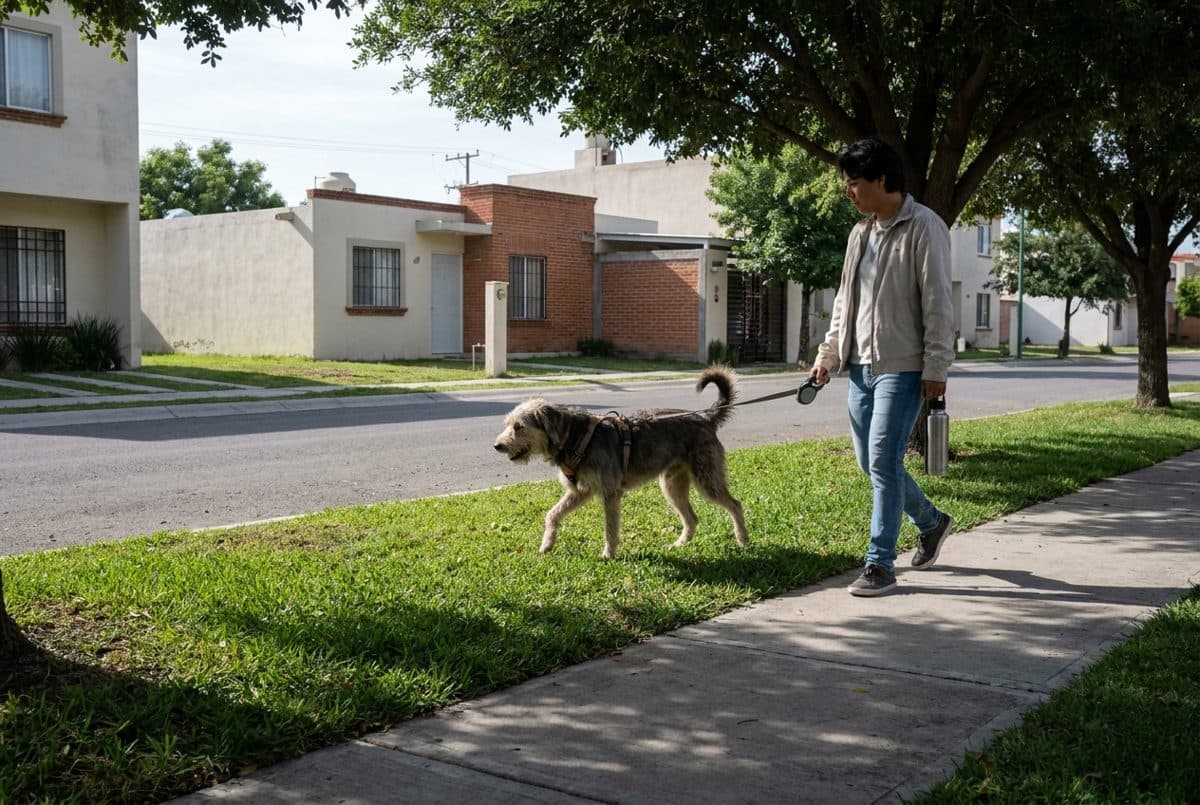
Dogs and cats release heat through limited areas like their paw pads and respiratory tract. High ambient temperatures can cause rapid heat stress during everyday activities.
This is general guidance. Always ask your vet.
When is it safe to walk a dog in hot weather?
Walk your dog early in the morning or late in the evening when outside temperatures are lowest.
Peak solar heat builds between 10:00 and 17:00. Pavements and city air frequently stay hot until 18:00.
Physical exertion causes nearly 75% of canine heatstroke cases. Simple walking triggers 67.5% of those incidents.
Exercise in unventilated areas can induce heatstroke at mild temperatures as low as 16.9 °C (62.4 °F).
[S1][S2][S3][S4][S6][S7][S10]How do I check if the pavement is too hot for my dog?
Press the back of your hand against the pavement for five seconds to check the surface temperature.
Concrete sidewalks absorb solar energy rapidly. At an air temperature of 27.0 °C (80.6 °F), concrete reaches 50.0 °C (122.0 °F), which burns paw pads.
Dogs and cats sweat through their paw pads and nose. Leaving paws bare allows these sweat glands to release heat.
- Place the back of your hand against the sunny pavement for five seconds, or hold your palm flat for ten seconds.
- Move your walk to shaded grass if the pavement feels too hot for your skin.
- Keep dog boots off your pet during hot days so paw sweat glands stay functional.
How fast does a parked car heat up?
A parked vehicle cabin heats to lethal temperatures within fifteen to twenty minutes even with the windows cracked open.
When the outside temperature is 24.0 °C (75.2 °F), vehicle cabin heat doubles to 48.0 °C (118.4 °F) in 20 minutes. At 27.0 °C (80.6 °F), interior heat reaches 60.0 °C (140.0 °F) in 15 minutes.
Cracked windows and shaded parking spots still allow heat to climb to fatal levels. Leave pets inside your home during warm errands.
[S1][S3][S4][S6][S7][S10]Which pets face the highest risk of heatstroke?
Flat-faced breeds, overweight animals, senior pets, and double-coated dogs face the highest risk of heat illness.
Upper airway malformations in Pugs, Boxers, and Bulldogs restrict airflow and panting. Bulldogs suffer heat illness at 14 times the rate of Labrador Retrievers.
Excess fat tissue traps body heat like an insulating blanket. Older pets possess lower baseline water reserves and adapt slowly to rising heat.
Double-coated breeds have fur that holds warm air against the skin. Keep coats brushed to preserve the natural layers that shield skin from the sun.
- Walk flat-faced dogs with a chest harness to keep pressure off the windpipe.
- Remove muzzles during hot weather because jaw restriction stops panting.
- Keep double coats unclipped to protect the skin from direct solar heat.
How do cats regulate their body temperature in summer?
Cats regulate their temperature by lying on cool surfaces, drinking water, and grooming saliva across their coat.
Feline sweat glands exist almost entirely on the paw pads and nose. Saliva grooming and contact with cool floors provide vital cooling.
Panting in cats indicates a severe physiological crisis. A cat panting with an open mouth requires immediate emergency veterinary help.
Cats seeking shade frequently hide inside sheds, greenhouses, and parked cars. Check these enclosed spaces before shutting the doors.
[S1][S2][S3][S5][S7][S8]How do I keep my dog safe around water in the summer?
Supervise all water play, provide clean drinking water, and rinse your dog with fresh tap water after swimming.
A hard plastic paddling pool placed in the shade lets dogs cool their paws safely without claw punctures.
Keep watch around pools and beaches to stop pets from drinking chlorinated water or saltwater.
Chlorine and sea salt cause skin irritation. Rinse your dog completely with clean fresh water after every swim.
- Set up a rigid plastic paddling pool in a shady spot outdoors.
- Offer fresh tap water continuously so your pet avoids drinking pool water or sea water.
- Rinse your dog with fresh water after swimming to protect the skin.
Do pets need sunscreen in hot weather?
Pets with white fur, thin coats, or pink skin need veterinary sunscreen on exposed areas to prevent burns and cancer.
Direct sun burns vulnerable areas with sparse hair, including ear tips, nose leather, belly, and groin.
Chronic ultraviolet radiation causes actinic keratosis on white ears and noses in cats. This damage can become squamous cell carcinoma and require surgical ear tip removal.
Human sunscreens contain zinc oxide and salicylates that poison pets during grooming. Use sun protection formulated specifically for veterinary use.
- Check the ears, nose, and belly of light-colored pets for redness.
- Apply veterinary sunscreen to areas with thin hair before sun exposure.
- Keep white-furred pets indoors during peak daylight hours.
What should I do if my dog overheats?
Apply cool water over your dog's body under a running fan, and transport your dog to the clinic immediately.
Normal canine body temperature ranges from 37.5 °C to 39.0 °C (99.5 °F to 102.2 °F). Hyperthermia begins above 39.4 °C (103.0 °F), and body temperatures from 41.2 °C to 42.7 °C (107.0 °F to 109.0 °F) cause organ failure.
Dogs that recover from heatstroke often have permanent damage to the temperature center in the brain. This damage leaves them vulnerable to future heat episodes.
- Move your dog to shade or an air-conditioned room immediately.
- Pour cool tap water over the head, neck, belly, groin, and paws.
- Aim an electric fan or air conditioner directly at the wet fur.
- Lay your dog on a damp towel or cooling mat, keeping the top of the body uncovered.
- Stop water application when rectal temperature falls to 39.4 °C (103.0 °F) to prevent hypothermia.
- Avoid ice packs on skin and rubbing alcohol, because both trigger blood vessel narrowing and shivering.
When should you go to the vet right away?
- Open-mouth panting in a cat.
- Rectal body temperature exceeding 39.4 °C (103.0 °F).
- Body temperature reaching 41.0 °C to 43.0 °C (105.8 °F to 109.4 °F).
- Absence or reduction of urination during hot weather.
- Blistered, red, detached, or darkened skin on paw pads.
- Refusal to walk or limping following hot pavement contact.
This is general guidance. Always ask your vet.
Checked against sources; veterinary review pending. Information checked on September 28, 2026. Updated on September 28, 2026.
Written with AI help from the cited sources. A second model checked every fact against them.
Sources
- S1 Consejos para cuidar a tu mascota en época de calor - UNAM Global
- S2 Protege a tus mascotas del calor - Gaceta UNAM
- S3 INFOGRAFÍA: Evita que tu perro sufra un golpe de calor - Ciencia UNAM
- S4 Hot Weather Safety Tips | ASPCA
- S5 Heat Stroke in Dogs | VCA Animal Hospitals
- S6 Dog Hot Weather Safety Tips & Help | Dogs Trust
- S7 Keeping Your Dog Safe in Summer - RSPCA - rspca.org.uk
- S8 Hazardous weather and your cat - International Cat Care
- S9 Should I use sunscreen on my cat? - International Cat Care
- S10 Warm weather pet safety | American Veterinary Medical Association