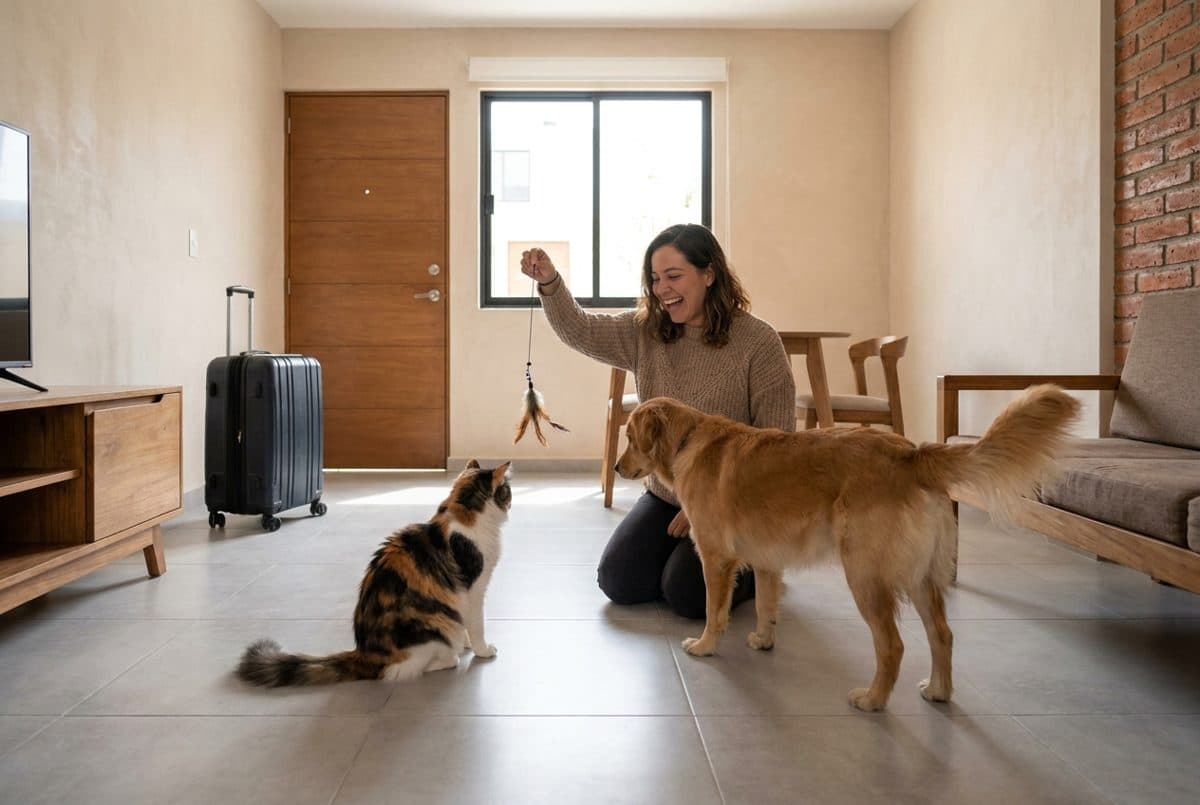
Traveling without your pet requires selecting a safe care environment and preparing clear veterinary instructions. Your options include home sitters, family caregivers, and professional boarding facilities.
This is general guidance. Always ask your vet.
Should I choose boarding, a pet sitter, or family care for my pet?
Select the care option that matches your pet's medical requirements and stress tolerance.
Pet owners traveling without their pets have three main options: an in-home pet sitter, care at a friend or family member's home, or a commercial boarding facility.
Care by a trusted friend or family member minimizes stress because your pet already knows the caregiver. Veterinary hospital boarding provides direct medical supervision for senior pets and animals with chronic conditions.
Cats bond to their territory and routine. Senior cats and anxious cats remain calmest in their own home with a visiting pet sitter.
[S1][S2][S3][S4][S5]What should I inspect before booking a pet boarding facility?
Visit the boarding facility in person to check hygiene, security, staff supervision, and housing layouts.
Boarding facilities operate independently or connect directly to veterinary hospitals. Each pet requires private quarters with room to move and physical separation between resting and feeding areas.
Daily disinfection of runs, cages, and utensils prevents pathogen buildup. Staff must remove animal waste rapidly to maintain sanitation.
- Tour the facility in person to check cleanliness, ventilation, physical security, and staff supervision.
- Confirm that feline housing areas isolate cats from the sight, sound, and scent of dogs.
- Verify that cat enclosures provide vertical perches, hiding spots, and litter boxes separated from food and sleeping areas.
- Schedule a short trial stay of a few days or a weekend before your trip to accustom your pet to the staff.
What vaccines and health records do boarding facilities require?
Boarding facilities require written documentation of current veterinary vaccines and a recent negative parasite test.
Boarding facilities enforce strict health requirements because high animal density increases transmission risks for respiratory infections and intestinal parasites.
A licensed veterinarian must administer all required vaccines 7 to 14 days before check-in to allow protective immunity to develop.
Boarded dogs routinely require vaccines against rabies, distemper, parvovirus, and Bordetella, with many facilities also requiring canine influenza and leptospirosis vaccines. Cats require vaccines against rabies and feline viral rhinotracheitis, calicivirus, and panleukopenia.
Facilities require proof of active flea and tick prevention and a negative fecal parasite screen completed within the preceding 6 to 12 months.
[S2][S3][S6][S7][S8]How do I prepare food and medication for a pet sitter or boarding kennel?
Provide your pet's regular food and keep all prescribed medications in their original prescription containers.
Supply your pet's regular food and written feeding schedules. Sudden dietary changes cause vomiting and diarrhea.
Deliver prescription medications in original pharmacy bottles with written administration schedules. Confirm in advance that the caregiver or kennel staff has professional training for specialized treatments like injections.
Store flavored veterinary medications at home inside pet-resistant containers out of reach to prevent accidental toxic ingestions. When boarding pets from the same household together, verify that staff monitors each animal's individual food intake and stool output.
[S2][S4][S6][S9]What emergency instructions should I leave for my pet's caregiver?
Leave a written veterinary authorization form, your complete travel itinerary, and direct contact numbers for emergency clinics.
Caregivers must have immediate access to your primary veterinarian and clear legal authorization to approve treatment if you cannot be reached.
- Write an emergency authorization document naming a designated decision-maker with pre-set veterinary spending limits.
- Provide phone numbers and addresses for your primary veterinarian and the closest 24-hour emergency hospital.
- Verify that your pet has an up-to-date microchip and an ID tag with current contact numbers.
- Deliver your travel itinerary along with multiple contact channels.
- Schedule an in-home cat sitter to visit at least once or twice daily to replenish food and water, clean litter boxes, and check well-being.
When should you go to the vet right away?
- Accidental toxic ingestion of stored veterinary medications
- Vomiting and diarrhea after boarding or dietary changes
This is general guidance. Always ask your vet.
Checked against sources; veterinary review pending. Information checked on September 30, 2026. Updated on September 30, 2026.
Written with AI help from the cited sources. A second model checked every fact against them.
Sources
- S1 Boarding Your Cat | VCA Animal Hospitals
- S2 Pet Sitter Options | VCA Animal Hospitals
- S3 Exploring Pet Sitting Options - RSPCA - rspca.org.uk
- S4 Take Him or Leave Him: Where Your Pet Should Stay When You Are Away | VCA Animal Hospitals
- S5 Special considerations for senior cats - International Cat Care
- S6 Boarding Policies & Vaccine Requirements | VCA Willow Creek Pet Center
- S7 Boarding Policies & Vaccine Requirements | VCA Family Pet Resort
- S8 Overview of Preventative Health Care and Husbandry in Small Animals - Management and Nutrition - Merck Veterinary Manual
- S9 Pet Sitter Safety: What to Know Before You Go | ASPCA