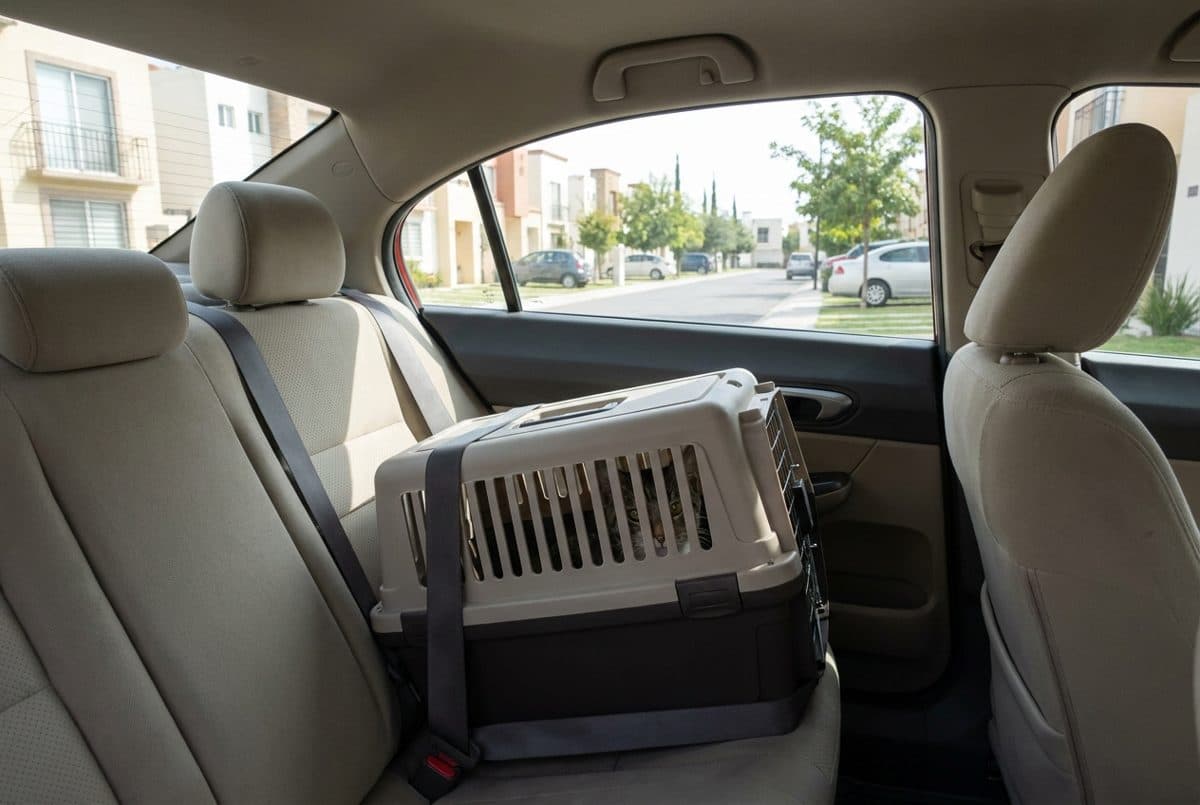
Car travel introduces unfamiliar noise, motion, and visual stimulation that trigger stress in felines. Proper carrier preparation and vehicle safety measures ensure a calm journey for your cat.
This is general guidance. Always ask your vet.
How do you choose the right carrier for car travel?
Pick a sturdy, solid plastic or metal wire carrier that lets your cat stand, turn around, and lie down comfortably.
A carrier with both top and front doors lets you lift your cat out gently. Removable carrier tops permit veterinary staff to examine your cat while the cat stays seated in the bottom tray.
Cats feel secure in compact enclosures that stop sliding during turns. Secure each cat in an individual carrier to prevent sudden aggression between bonded animals during high-stress travel.
[S1][S2][S3][S4][S5][S6][S7][S8]How do you train your cat to use a carrier at home?
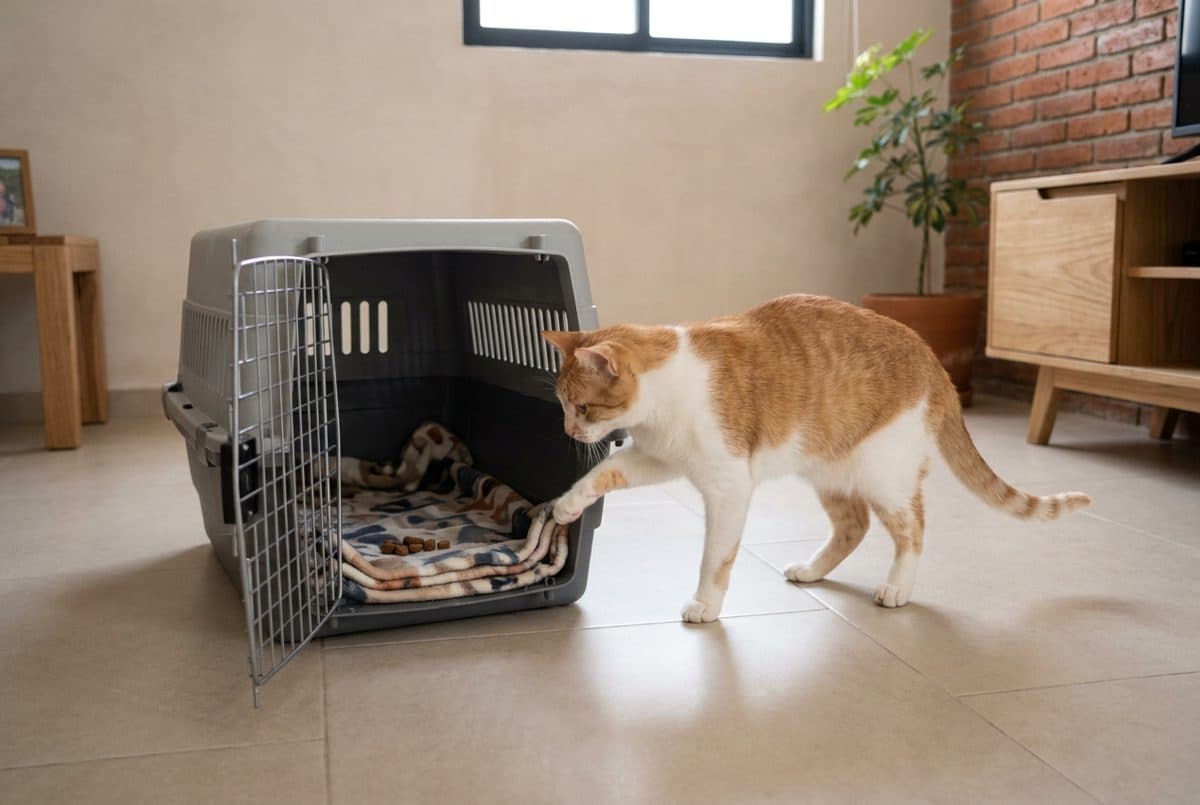
Acclimate your cat through positive associations in small steps inside your home before taking car rides.
Kittens adapt to novel experiences most easily up to 7 weeks of age. Older cats also learn new habits through gradual conditioning.
If your cat shows persistent fear toward an existing carrier, switch to an unfamiliar carrier model to reset training. Use the old carrier for any urgent trips during training to keep the new carrier free of negative associations.
- Clean carriers previously exposed to stressful visits with an enzymatic cleaner to eliminate lingering alarm pheromones.
- Leave the carrier open at all times in a quiet room where your cat rests.
- Place familiar blankets, toys, and daily meals inside the open carrier.
- Detach the top half initially, then attach the roof with the door open as your cat relaxes.
- Close the carrier door for several seconds, extending the time to several minutes across daily sessions.
- Lift the closed carrier and walk around the room in short bursts.
- Drive short neighborhood loops that return home, maintaining ten calm rides for every single stressful trip.
Where is the safest place to put a cat carrier in a car?
Place the carrier on the vehicle floor behind the front seats to keep your cat secure during motion.
The Feline Veterinary Medical Association designates the vehicle floor behind the front seats as the safest location.
Safety authorities publish differing instructions regarding seat belts. The Feline Veterinary Medical Association instructs owners to avoid seat belts on carriers lacking crash-test certification, because standard seat belts crush uncertified enclosures. Cats Protection, Blue Cross, and PetMD recommend fastening carriers securely onto car seats using vehicle seat belts.
Place folded towels or foam pads under the carrier base to keep the carrier level on sloped car seats.
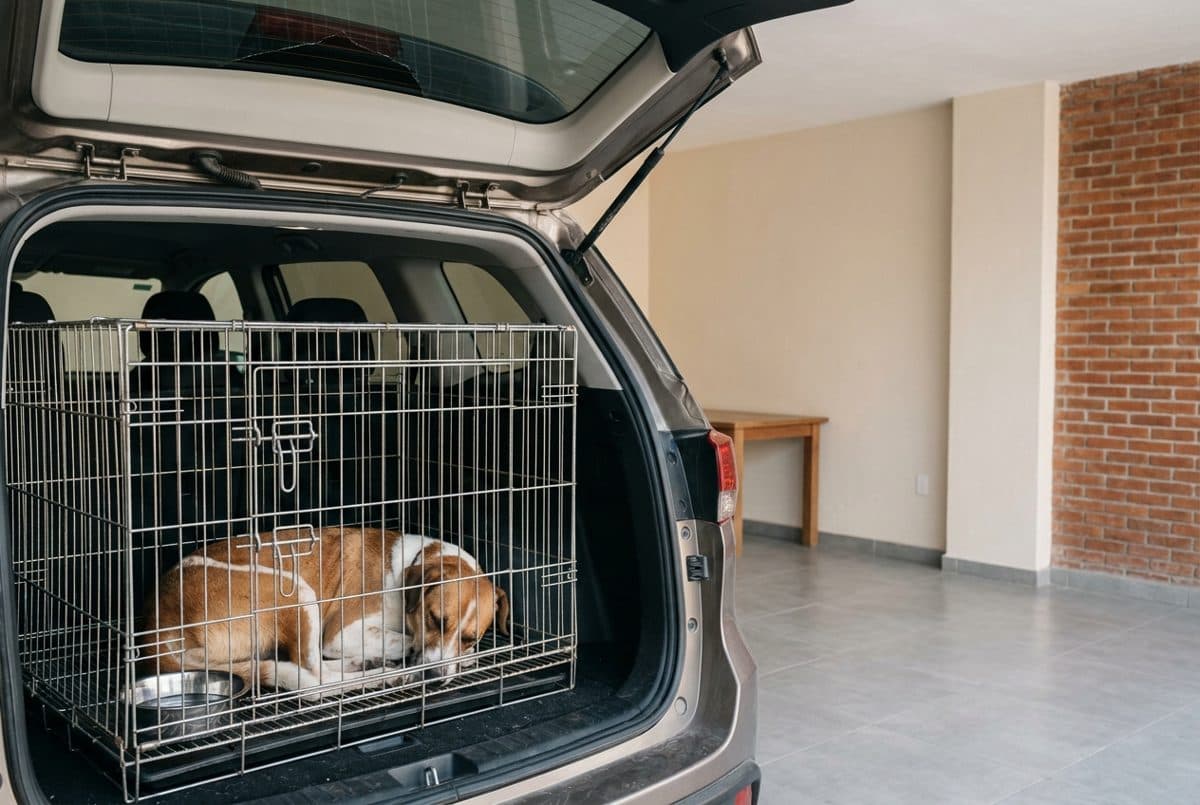
Keep your cat out of enclosed car boots and unventilated hatchback spaces, which lack adequate airflow and cause rapid overheating. Secure your cat inside the carrier at all times during travel.
[S1][S2][S4][S6][S8]How should you feed and hydrate your cat on a car trip?
Offer water continuously until departure and schedule meals according to established veterinary guidelines.
Welfare organizations publish specific pre-travel feeding schedules. iCatCare directs owners to withhold food for 4 to 5 hours before travel. The ASPCA recommends feeding a light meal 3 to 4 hours prior to departure. Cats Protection advises limiting food for several hours before driving.
Provide fresh water right up to departure and at regular stops. Attach spill-proof bowls to the carrier mesh to refill water from the outside without opening the carrier door. Pack bottled water from home to prevent digestive upset from unfamiliar minerals or bacteria in municipal tap supplies.
Line the carrier floor with absorbent puppy pads and pack spare blankets for accidents. Cats rarely use litter pans during transit due to noise and vehicle movement. Bring your cat's regular litter box and substrate from home to provide familiar scents and textures.
[S2][S4][S7][S8]How do you keep a cat calm during a car ride?
Cover the carrier with a light towel and use feline facial pheromones to reduce sensory stress.
A light towel or blanket draped over the carrier blocks visual motion and satisfies the feline drive to hide. Maintain open ventilation around the carrier mesh so air circulates freely.
Spray synthetic feline facial pheromone onto bedding at least 15 to 20 minutes before departure. This delay lets the alcohol base evaporate completely to protect your cat's respiratory system. Never apply pheromone sprays directly onto your cat's body.
Consult your veterinarian before travel to select appropriate prescription anti-anxiety options, anti-nausea medication, or calming supplements. Speak in low, calm tones if your cat meows, keeping the carrier closed until you reach a fully enclosed room.
[S1][S2][S3][S4][S5][S8]How often should you stop when driving with a cat?
Take rest breaks every 2 to 4 hours and keep total daily drive time under 4 hours.
Cats Protection advises limiting car journeys to a maximum of 4 hours per day and scheduling rest breaks every 2 to 4 hours.
Placing the travel carrier inside a larger dog crate at rest areas allows your cat access to litter and food without escape risks.
Confirm all vehicle doors and windows are closed tight before opening the carrier inside your car.
Never leave your cat unattended inside a parked vehicle. Cabin temperatures reach lethal heatstroke levels within minutes, even in shaded spots with cracked windows.
[S2][S4][S6][S7]When should you go to the vet right away?
- Open-mouth panting or rapid, shallow breathing
- Repeated vomiting or involuntary diarrhea during travel
- Signs of heatstroke after exposure to vehicle heat
This is general guidance. Always ask your vet.
Checked against sources; veterinary review pending. Information checked on September 30, 2026. Updated on September 30, 2026.
Written with AI help from the cited sources. A second model checked every fact against them.
Sources
- S1 2025 Transportation of Cats in Motor Vehicles Position Statement - catvets.com
- S2 Travelling with your cat - International Cat Care
- S3 Cat Behavior and Training - Crate Training and Travel | VCA Animal Hospitals
- S4 Travelling With Your Cat | Cats Protection
- S5 Putting Your Cat In a Cat Carrier | Blue Cross
- S6 Moving house and travelling with cats | Blue Cross
- S7 Road Trip Tips for You and Your Pet | ASPCA
- S8 8 Tips for Traveling With a Cat | PetMD
- S9 Motion Sickness in Animals - Nervous System - Merck Veterinary Manual