
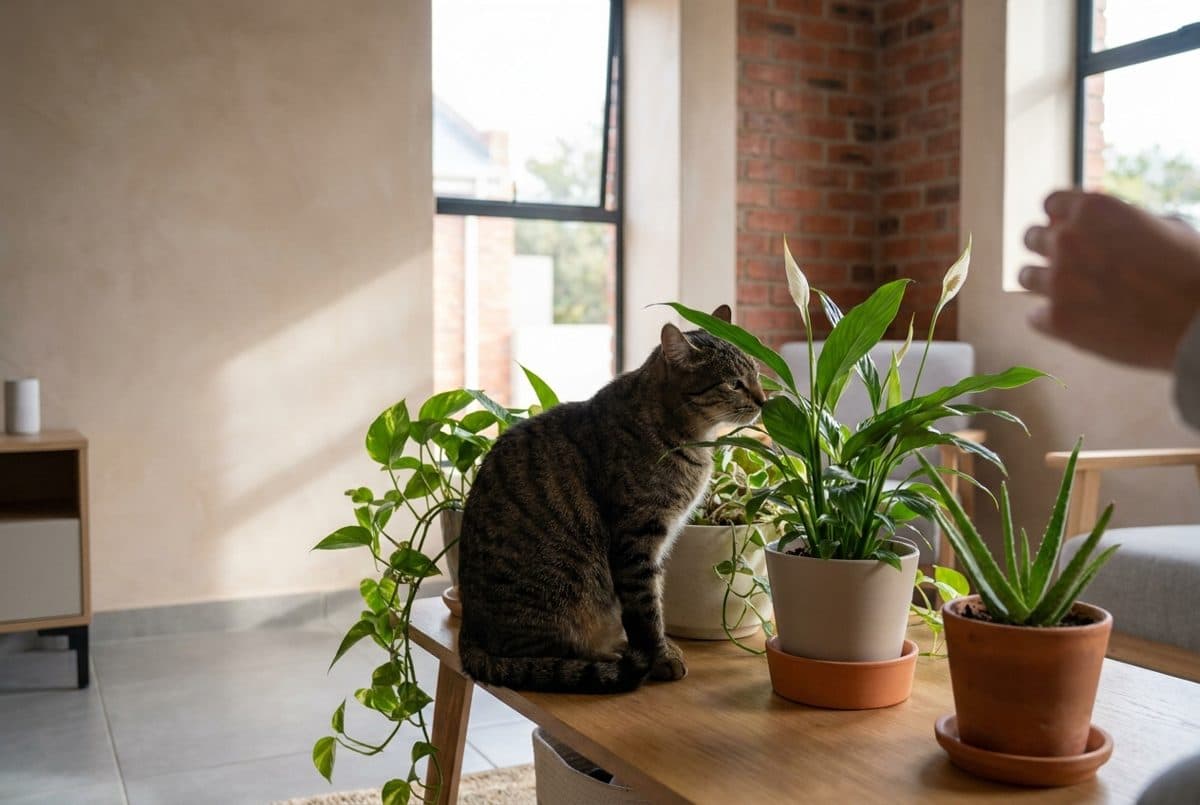
Plant ingestion requires prompt veterinary attention before severe complications develop. Emergency first aid stabilizes your pet and keeps them safe on the way to the clinic.
This is general guidance. Always ask your vet.
What should you do if your dog or cat eats a toxic plant?
Call your veterinarian or an animal poison control center immediately and transport your pet safely to the clinic.
First aid stabilizes your pet and protects their safety during travel to the veterinary hospital.
Inducing vomiting at home carries severe risks. You must induce vomiting only when a licensed veterinarian explicitly directs you to do so.
Withhold all human medications and home remedies because these substances worsen internal organ damage.
- Call your veterinarian or an animal poison control center immediately.
- Collect a physical sample or a clear photo of the ingested plant to help the clinic identify the species.
- Move dogs with minimal handling on a blanket or firm surface, and place cats inside a secure carrier.
Why are lilies dangerous to cats?
True lilies and daylilies cause fatal acute kidney failure in cats.
Cats suffer fatal poisoning from chewing a petal, grooming pollen grains from their coat, or drinking water from a flower vase.
Initial clinical signs appear within 12 hours, kidney damage begins within 12 to 24 hours, and acute renal failure develops within 6 to 48 hours.
Delays in veterinary treatment past 18 hours cause irreversible kidney damage and death within 24 to 72 hours.
Dogs experience mild stomach upset after eating true lilies. Peruvian lilies belong to the Alstroemeria genus and cause mild digestive upset in both species.
[S1][S5]How dangerous is sago palm to dogs and cats?
Sago palm is extremely toxic to dogs and cats and causes severe liver failure.
All parts of the sago palm contain cycasin, and the seeds carry the highest concentration of the toxin.
The poisoning presents with acute digestive and neurological signs before progressing to severe liver failure.
The Merck Veterinary Manual reports canine recovery rates of 34 percent in suspected ingestions and 50 to 64 percent in confirmed cases.
[S6][S7]What happens if a pet eats oleander or azalea?
Oleander and azaleas contain toxins that disrupt heart function and trigger cardiovascular collapse.
Oleander contains oleandrin throughout all plant tissues, causing gastrointestinal distress, irregular heart rates, cardiac arrhythmias, and cardiovascular collapse.
Azaleas contain grayanotoxins that disrupt cellular sodium channels, producing severe gastrointestinal distress and cardiovascular dysfunction.
[S9][S14]Why do dieffenbachia, pothos, and philodendron harm pets?
These plants release microscopic calcium oxalate crystals that pierce oral tissues and cause acute mouth pain.
Chewing dieffenbachia releases sharp crystals that trigger severe mouth pain, profuse salivation, vomiting, and occasional airway swelling.
Pothos causes upper digestive irritation, profuse drooling, gagging, lip swelling, and vomiting.
Philodendrons release oxalate needles that cause rapid oral irritation, pain, excessive salivation, and vomiting.
[S10][S11][S12]How toxic are aloe vera, tulips, and poinsettias?
These common household plants contain chemical irritants and alkaloids that cause digestive distress, heart alterations, or tremors.
The outer white sap of aloe leaves contains anthraquinone glycosides that cause vomiting, diarrhea, lethargy, muscle tremors, and reddish urine.
Tulips contain toxic alkaloids concentrated inside the bulbs, triggering persistent vomiting, diarrhea, drooling, and potential cardiovascular alterations.
Poinsettia sap contains irritants that produce mild drooling, lip licking, vomiting, diarrhea, and skin or eye irritation.
[S5][S8][S13][S15]When should you go to the vet right away?
- Suspected or confirmed ingestion of any lily plant part, pollen, or vase water by a cat
- Ingestion of any part or seed of a sago palm
- Ingestion of oleander or azalea plants
- Airway swelling or breathing difficulties
- Irregular heart rate, cardiac arrhythmias, or sudden collapse
- Muscle tremors or neurological symptoms
- Persistent vomiting, diarrhea, or reddish urine
- Intense mouth pain, lip swelling, or profuse drooling
- Severe weakness or extreme lethargy
This is general guidance. Always ask your vet.
Checked against sources; veterinary review pending. Information checked on September 28, 2026. Updated on September 28, 2026.
Written with AI help from the cited sources. A second model checked every fact against them.
Sources
- S1 Lovely Lilies and Curious Cats: A Dangerous Combination | FDA
- S3 Emergency Care for Your Pet | ASPCA
- S4 Emergencies in Dogs | VCA Animal Hospitals
- S5 Plants That are Toxic to Cats | VCA Animal Hospitals
- S6 Hepatotoxins in Small Animals - Digestive System - Merck Veterinary Manual
- S7 Sago Palm Is Toxic To Dogs | Pet Poison Helpline®
- S8 Poinsettia Are Toxic To Pets | Pet Poison Helpline®
- S9 Oleander Toxic To Pets | Pet Poison Helpline®
- S10 Dieffenbachia Are Toxic To Pets | Pet Poison Helpline®
- S11 Devils Ivy Are Toxic To Pets | Pet Poison Helpline®
- S12 Philodendron Are Toxic To Pets | Pet Poison Helpline®
- S13 Tulips & Hyacinths Are Toxic To Pets | Pet Poison Helpline®
- S14 Azalea Is Toxic To Dogs | Pet Poison Helpline®
- S15 Aloe Vera Is Toxic To Dogs | Pet Poison Helpline®